

SEO fits into an ecommerce marketing strategy as the channel that captures demand that already exists, at a cost that stops growing with every click once pages rank. Paid media buys that demand click by click, email and retention monetize customers you already have, and conversion work decides how much of every visit turns into revenue.
SEO is slower than paid and weaker on its own, so the real question is not “SEO or paid?” but how much of the budget SEO should get, and when. This guide gives a role for each channel, a 24-month payback model with a break-even formula, and a way to decide your SEO share without guessing.
Stores that want to know whether SEO is their next move or a distraction can run the Revenue Growth Diagnosis.
What SEO does in an ecommerce marketing mix
Search engine optimization (SEO) is the work of making pages findable and useful in organic search results. In a marketing mix it has one specific job: it puts a store in front of shoppers who are already searching for what it sells, without paying for each visit. The broader plan around it is covered in the ecommerce marketing strategy guide; this article zooms in on where SEO sits inside that plan.
Context helps size the opportunity. The U.S. Census Bureau estimated that ecommerce reached $340.2 billion in the second quarter of 2026, or 17.1% of total retail sales (seasonally adjusted). That is all U.S. retail, not search traffic, so it shows how large online selling is, not how much of it comes from SEO. For your store, the share of revenue that starts in search is a number to read from your own analytics.
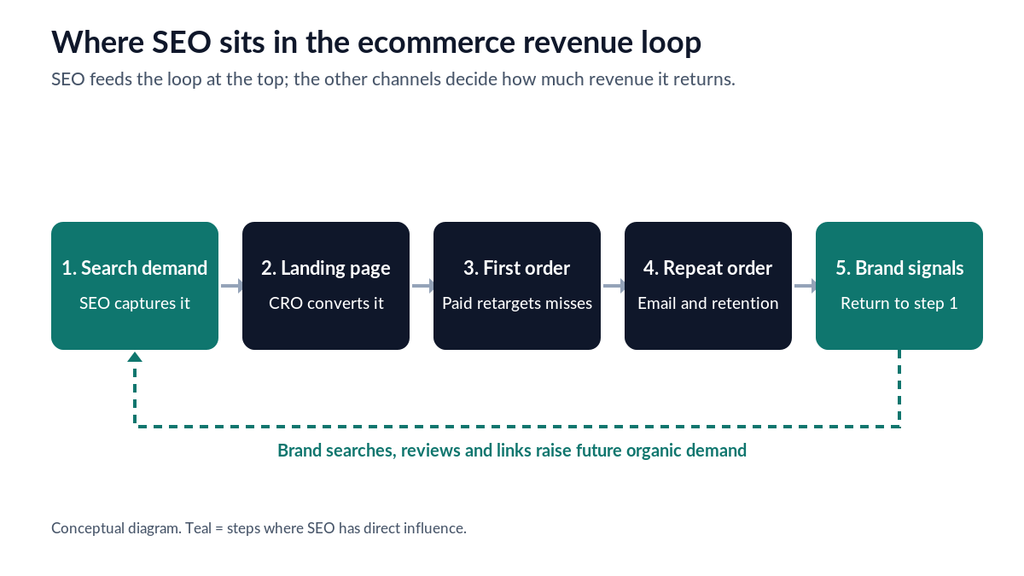
The loop above is the simplest way to place SEO. It feeds the top, and every other channel decides how much revenue it returns. Brand mentions, reviews and links created further down the loop also raise future organic demand, which is why SEO and the other channels compound together rather than compete.
SEO versus paid, email and CRO: what each channel is for
Each channel does a different job, so the useful comparison is by role, cost behavior and time to impact. The table is qualitative on purpose: no universal benchmark exists for these, and published ones vary by industry and store size.
| Channel | Job in the mix | Cost behavior | Time to impact | What to measure |
|---|---|---|---|---|
| SEO | Capture existing search demand for categories, products and questions | Mostly upfront work: content, technical, links, then maintenance | Weeks to months | Non-brand clicks, organic revenue, contribution per order |
| Paid search and social | Buy demand now, test offers, retarget visitors who did not buy | Rises with every click | Immediate | Cost per order, ROAS, contribution after ad spend |
| Email and retention | Turn first-time buyers into repeat buyers | Low cost per send, grows with the list | Days to weeks | Repeat rate, revenue per recipient |
| CRO | Raise the share of visits that buy | Project cost, then reusable gains | Weeks | Conversion rate, revenue per session |
On timing, Google Search Centrale says every change takes time to be reflected in search, from a few hours to several months, and suggests waiting a few weeks before judging whether a change helped. That is why SEO is a poor fit for a store that needs cash within the quarter, and a good fit for one that wants to lower its dependence on paid over a longer horizon.
Two links between channels deserve attention. SEO lowers blended customer acquisition cost only when its orders are incremental, which the ecommerce customer acquisition guide shows how to test. And organic visitors who buy once still need a reason to return, which is the territory of the ecommerce customer retention guide.
Where SEO fits in the shopper journey
Search covers more of the journey than “buy now” queries, but not all of it equally. A practical map for an online store:
| Stage | Typical query type | Page that should rank | SEO role |
|---|---|---|---|
| Problem aware | Questions and how-to topics | Guide or blog article | Build early familiarity, capture email |
| Solution aware | Category and comparison terms | Category page, buying guide | Main revenue lever for most stores |
| Ready to buy | Product, model or brand plus product | Product page | Win the click and the sale |
| Existing customer | Brand name, reorder, support | Home, account or help pages | Protect branded traffic, avoid leaks |
Google’s own ecommerce documentation reflects the same structure. It covers how product data reaches Google surfaces, structured data for products, URL design, navigation and internal links that show which pages matter most, and how pagination affects crawling. For the page level, the guide to SEO for ecommerce product pages gives a practical framework, and the ecommerce SEO optimization guide goes deeper on building organic revenue.
How to size SEO against paid: a payback model with a break-even formula
Most ranking articles stop at “SEO is cheaper than ads” and give no data. The model below makes the trade-off visible. It uses a fictional store, not a client, and every figure is an assumption to replace with your own.
Assumptions: average order value of $90 and a contribution before marketing of 45%, which is $40.50 per order (product cost, shipping, fees and returns already removed). Paid search costs $0.80 per click with a 2% conversion rate. The SEO program costs $3,000 a month for content, technical work and tools, and organic visits convert at the same 2%.
Paid cost per order = cost per click ÷ conversion rate = $0.80 ÷ 0.02 = $40.
At $40 per order against $40.50 of contribution, paid search roughly breaks even on the first order. It earns money only through repeat purchases, and it stops the moment spend stops.
SEO break-even orders per month = monthly SEO cost ÷ contribution per order = $3,000 ÷ $40.50 = about 74 orders.
Required organic sessions = break-even orders ÷ conversion rate = 74 ÷ 0.02 = about 3,700 sessions a month.
So this program must bring about 3,700 incremental organic sessions a month just to cover its monthly cost. The next table assumes organic orders ramp slowly, which is typical of the delay Google describes.
| Period | Organic orders per month, assumed | Cumulative net position at end of period |
|---|---|---|
| Months 1 to 3 | 0 | -$9,000 |
| Months 4 to 6 | 15 | -$16,178 |
| Months 7 to 9 | 40 | -$20,318 |
| Months 10 to 12 | 80 | -$19,598 |
| Months 13 to 24 | 120 | +$2,722 at month 24 |
Three conclusions follow from the numbers, and each depends on the assumptions above.
First, the cash trough matters more than the monthly cost. The program peaks at a $20,318 cumulative loss in month 9, and only breaks even in month 23. A store that cannot fund that trough should shrink the scope (fewer, higher-value category pages) rather than abandon SEO halfway.
Second, SEO pays back through the plateau. At 120 orders a month the program delivers orders at $25 each ($3,000 ÷ 120), against $40 through paid search. The same 120 orders from paid would cost $4,800 a month in clicks, and they would disappear if spend were cut.
Third, the result depends on one input you control least: the organic orders curve. If your store ranks for terms with real demand and a catalog that converts, the curve rises faster. If not, the cost line wins. Treat the break-even figure as a check on a plan, not a forecast.
How much of the budget should SEO get?
There is no honest industry percentage to copy: budgets depend on margins, catalog size, and how dependent the store is on paid. A decision grid works better than a ratio.
| Situation | SEO priority | First move |
|---|---|---|
| New store, little traffic, thin cash | Medium, narrow scope | Technical basics and a handful of category pages for terms with proven demand |
| Store dependent on paid, contribution near zero after ads | High | Build non-brand category and comparison content to lower blended acquisition cost |
| Large catalog, many filters and variants | High, technical first | Fix URL structure, duplicate pages and crawl waste before adding content |
| Seasonal store | Planned early | Start months ahead so pages rank before demand peaks |
| Strong repeat rate, weak new-customer flow | Medium | Protect branded search, add buying guides that bring new first orders |
Google’s ecommerce documentation covers the technical items in the large-catalog row, including URL structure and pagination, and stresses internal links as a signal of which pages matter. The final row ties to seasonality as well: for the biggest sales moment of the year, SEO preparation has to begin far earlier than paid campaigns.
SEO in 2026: what changes with AI search features
Search now includes AI-generated answers, so the practical question is whether stores need a separate approach. Google’s documentation says no special optimization is required for AI Overviews or AI Mode, no new markup or AI-specific file is needed, and a page must be indexed and eligible to appear with a snippet to be considered. Traffic from these features is counted in the Search Console Performance report under the Web search type.
The consequence for a marketing plan is simple: the foundations (indexable pages, clear product data, useful content) serve both classic results and AI features. For how answer engines differ, see the generative engine optimization guide.
How to measure SEO as a marketing channel
Measure SEO in revenue terms, with definitions fixed from the start.
- Non-brand clicks. Search Console’s Performance report shows impressions, clicks, click-through rate and average position. Separate searches that include your brand name from those that do not; growth in non-brand clicks is the signal that SEO is finding new customers.
- Organic revenue and orders. Pull from your analytics, using one attribution rule for every channel.
- Contribution per organic order. Revenue minus product, shipping, fees and returns, so SEO is compared with paid on the same basis.
- Cost per organic order. Monthly SEO cost divided by organic orders, the number to compare with the $40 paid benchmark in the model above.
- Incrementality check. Compare periods or product groups to see whether organic orders replace paid or branded ones before crediting SEO with them.
Review monthly, but judge changes over several weeks, as Google advises. A single bad week is rarely a signal.
Common mistakes when adding SEO to the mix
Judging SEO on the first month is the most common error, because the ramp in the model above shows nothing happening for a quarter. Cutting paid spend before organic orders arrive creates a revenue gap. Optimizing for traffic instead of orders fills reports with clicks that never buy. Treating SEO as a one-time project ignores that pages age and competitors move. And running SEO separately from conversion work wastes the visits it earns, since a page that ranks but does not convert returns nothing from the loop.
Making SEO a deliberate part of the plan
SEO earns its place in an ecommerce marketing strategy by doing one job well: capturing search demand that already exists, at a cost that improves as pages mature. It does not replace paid, email or conversion work, and it should not be funded by emptying them. Start with the break-even formula for your own numbers, fund the cash trough you can afford, pick the scope that fits your situation from the decision grid, and measure non-brand clicks and cost per organic order monthly. The model in this article is fictional and its break-even month will differ for every store, but the method transfers.
Anaia Marketing applies this logic through its Predictable Revenue Growth (PRG) System, which starts by finding where revenue leaks across the customer journey, including how much of it search should capture. Start your Revenue Growth Diagnosis to see how much of your plan SEO should carry first.
Frequently asked questions about SEO and ecommerce marketing
Q1 : How does SEO fit into ecommerce marketing?
SEO captures shoppers who are already searching for what a store sells, without a cost per click. Paid media buys demand immediately, email and retention bring customers back, and conversion work lifts the share of visits that buy. SEO feeds the top of this loop, and the other channels decide how much revenue it returns.
Q2 : Is SEO or paid advertising better for an ecommerce store?
Neither wins in every case. Paid gives immediate traffic at a cost that rises with every click; SEO takes months to build and then costs less per order if it reaches enough volume. In the fictional model above, paid cost $40 per order while SEO reached $25 per order at its plateau, but it took 23 months to cover its cumulative cost. Use both, sized to your cash position.
Q3 : How long does ecommerce SEO take to work?
Google says changes can take from a few hours to several months to show in search, and recommends waiting a few weeks before judging a change. For a new program, plan for a first quarter with little revenue and judge it on indexed pages and impressions before orders.
Q4 : How much should an ecommerce store spend on SEO?
There is no standard percentage. Calculate the monthly break-even orders (monthly SEO cost divided by contribution per order), check whether the sessions required are realistic for your catalog, and fund only the cash trough you can carry. A narrow scope that you can sustain beats a broad one you abandon.
Q5 : Does SEO still matter with AI search features?
Yes. Google states that no special optimization is needed for AI Overviews or AI Mode and that standard SEO foundations apply, with indexed pages eligible to show a snippet. Traffic from these features appears in Search Console’s Web performance data, so it can be measured alongside classic results.

Passionate about the future of search, co-founder of Anaia Marketing and an SEO strategist focused on helping brands grow through search, strategic content, and AI-driven visibility. Her work sits at the intersection of technical SEO, content systems, and emerging AI search optimization, with a focus on building sustainable organic growth.