
An ecommerce marketing strategy is a written plan that decides which customers a store targets, which channels it uses to reach them, and how each channel turns into profitable first and repeat orders. A strong strategy ties every channel to contribution margin and repeat revenue, not to traffic or clicks.
What is ecommerce marketing, and how does it differ from a strategy?
Ecommerce marketing is the set of activities that bring shoppers to an online store, convert them into buyers and bring them back to buy again. It covers SEO, paid media, email, SMS, social and onsite conversion. A strategy is the layer above: the decisions about which of these activities get budget, in what order and why.
The distinction matters because most stores run tactics without a strategy. They add a channel when a competitor does, cut it when it underperforms for a month, and measure success by revenue. A strategy replaces that cycle with explicit rules: who the target buyer is, what a new customer is worth, and how much a store can pay to acquire one.
Digital ecommerce marketing adds one more constraint. Every channel produces data, so the strategy has to name a single source of truth for margin and customer value. Without it, each platform reports its own success and the totals never reconcile with the bank account.
Why do most ecommerce marketing strategies fail to grow profit?
Most ecommerce marketing strategies fail because they optimize for acquisition volume while ignoring what each order leaves after product cost, shipping, returns and ad spend. A store can double traffic and shrink profit. The failure is rarely the channel. It is a plan that never defined what a good customer is worth.
Three patterns repeat. First, paid media becomes the default engine because it is the fastest to switch on, and its cost per acquisition drifts up as the store scales. Second, retention is treated as a later project, so every customer has to be bought again at full price. Third, conversion problems stay hidden behind traffic growth, and each new visitor leaks through the same checkout friction. Anaia’s analysis of ecommerce revenue leaks shows how these gaps compound when no one owns them.
The fix is a strategy built in a different order, with margin and repeat revenue defined before channel selection. The next section covers the building blocks.
What are the core components of an ecommerce marketing plan?
An ecommerce marketing plan has five components: a target customer, a margin floor, a channel mix, a measurement rule and a testing cadence. Each component is a decision, not a document. Together they fit on one page, which is the test of whether the plan is clear enough to run.
| Component | The decision it forces | Example of a clear answer |
|---|---|---|
| Target customer | Who the store sells to first | Repeat buyers of one category, not “everyone online” |
| Margin floor | The lowest contribution margin an order may leave | Every channel must stay above a set margin after ad cost |
| Channel mix | Which channels earn budget, and what job each does | Paid finds buyers, email and SMS bring them back |
| Measurement rule | The one source of truth for results | Blended contribution margin, checked weekly |
| Testing cadence | How often the plan is challenged | One structured test per channel per month |
The margin floor is the component most plans skip, and it is the one that prevents a profitable-looking strategy from losing money. Setting it first turns channel decisions into arithmetic. A channel that cannot clear the floor either gets fixed or loses budget.
The target customer deserves more precision than most stores give it. A store that sells to everyone buys expensive traffic from everyone. A store that defines its best repeat buyer, then looks for more of them, lowers acquisition cost and raises lifetime value together.
Which ecommerce marketing channels should a store prioritize?
A store should prioritize the channels that match its stage and its margin. Early stores usually start with search, paid social and email capture. Stores past a certain scale add SMS, affiliates, influencers and AI search visibility. The best ecommerce marketing strategies give each channel one clear job instead of asking every channel to do everything.
| Channel | Main job | Best stage to invest | Main risk |
|---|---|---|---|
| SEO and content | Capture demand that already exists | From the start, compounds over time | Slow payback, needs patience |
| Paid search and shopping | Capture buyers with purchase intent | When margin per order is proven | Rising cost per click |
| Paid social | Create demand and reach new buyers | After conversion rate is stable | Creative fatigue, attribution gaps |
| Convert subscribers and drive repeat orders | From the first subscriber | List decay without upkeep | |
| SMS | Time-sensitive offers and recovery | Once an email base exists | Over-messaging |
| Influencers and affiliates | Borrow trust from established audiences | After the offer is proven | Hard to attribute |
| AI search visibility | Appear in AI-generated answers | As a parallel investment | Standards are still forming |
Channel choice should follow a simple rule: put budget where the marginal order is most profitable, not where reported return on ad spend looks highest. Platform return on ad spend usually credits the last click and overstates the channel that closes the sale. Blended margin is a more honest guide.
Owned channels deserve more weight than most plans give them. Email and text accounted for 42% of total revenue across Klaviyo merchants during Black Friday Cyber Monday 2025, and revenue from repeat customers grew 13.5% year over year, faster than revenue from new buyers (Klaviyo, December 2025). The data comes from one platform’s customers and peak shopping days, so it is a directional signal and not a universal benchmark. It still points the same way as the economics of repeat orders: a returning customer has no acquisition cost.
How do the stages of a strategy fit together?
Every ecommerce marketing strategy runs through three stages: attract, convert and retain. Attraction brings shoppers to the store, conversion turns them into buyers, and retention brings buyers back. The stages form a loop, because retained customers refer new ones and lower the cost of attracting the next cohort.
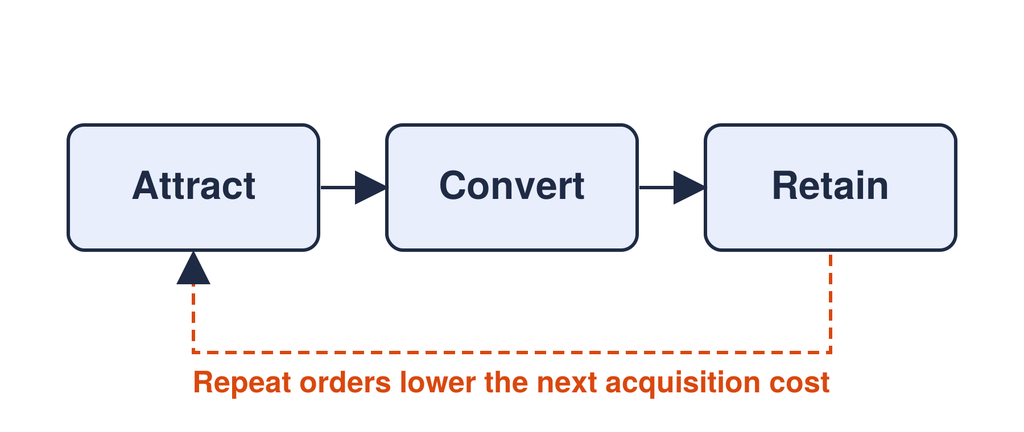
The loop explains why order of investment matters. Money spent on attraction before conversion is fixed buys visitors who leave. Money spent on conversion before retention exists wins a first order and nothing after it. The strongest returns usually come from working the loop backward: protect the customers already won, fix the friction that loses them, then feed the top of the funnel.
What does an ecommerce marketing strategy example look like?
A practical example uses a hypothetical DTC skincare store with a strong product, rising ad costs and flat profit. The numbers below are illustrative, not a benchmark or a client result. They show how a strategy changes decisions, not how much any store should expect to gain.
The store spends most of its budget on paid social and treats email as a weekly newsletter. Its plan has no margin floor, so it scales every campaign that shows a positive return on ad spend. Profit stays flat because discounts and shipping absorb the gains.
A strategy applied to the same store makes four changes. It sets a margin floor per channel and pauses the campaigns that miss it. It builds a post-purchase email flow so the second order is prompted, not hoped for. It fixes the two checkout steps with the highest drop-off before adding budget. Only then does it raise paid spend, on the campaigns that clear the floor.
None of these changes require a new tool. They require decisions made in the right order, which is the entire difference between a plan and a set of tactics.
How much should an ecommerce store spend on marketing?
An ecommerce store should set marketing spend from its contribution margin and its customer lifetime value, not from a fixed percentage of revenue. As a reference point, marketing budgets average 7.8% of company revenue across large organizations in 2026 (Gartner, May 2026).
That Gartner figure comes from a survey of 401 CMOs, most at companies above $1 billion in revenue, so it describes large enterprises, not a typical DTC store. It is useful mainly as a signal that budgets are tight: 56% of those leaders said their budget was too low to deliver their 2026 strategy. For a growing store, the better method is to work backward from unit economics.
The method has three steps. First, calculate contribution margin per order after product cost, shipping, fees and returns. Second, estimate what a customer is worth over twelve months, using the store’s own repeat purchase data. Third, set the maximum acquisition cost the store can pay and still reach its margin floor. The budget is then the amount the store can spend at or below that cost, not a number chosen in advance.
What changes with AI in ecommerce marketing?
AI changes ecommerce marketing in two places: how shoppers discover products and how marketing teams produce and personalize work. Shoppers increasingly ask AI assistants for recommendations, and teams use AI to generate creative, segment audiences and personalize messages. Both raise the value of clear product data and consistent brand signals.
Klaviyo reported that revenue from AI-powered messages grew 71% year over year during Black Friday Cyber Monday 2025, while use of AI recommendations rose 45% (Klaviyo, December 2025). That points to personalization at scale as the most proven use of AI ecommerce marketing today.
The discovery side is less settled. Google states that the same fundamentals apply to AI features in Search as to classic results: helpful, original content and a technically sound site (Google Search Central). A store does not need a separate playbook to start. It needs accurate product pages, structured data and content that answers real questions in plain language, the same foundations covered in Anaia’s work on ecommerce SEO optimization.
The risk with AI is adding it to a plan that has no margin floor. Faster content production only helps a store whose conversion and retention work already pays back.
How should a store build its strategy step by step?
A store should build its strategy in five steps: measure margin, define the target customer, assign one job to each channel, set the testing cadence and review results weekly. This order puts the cheapest decisions first and delays the most expensive ones, which is paid scale, until the economics are proven.
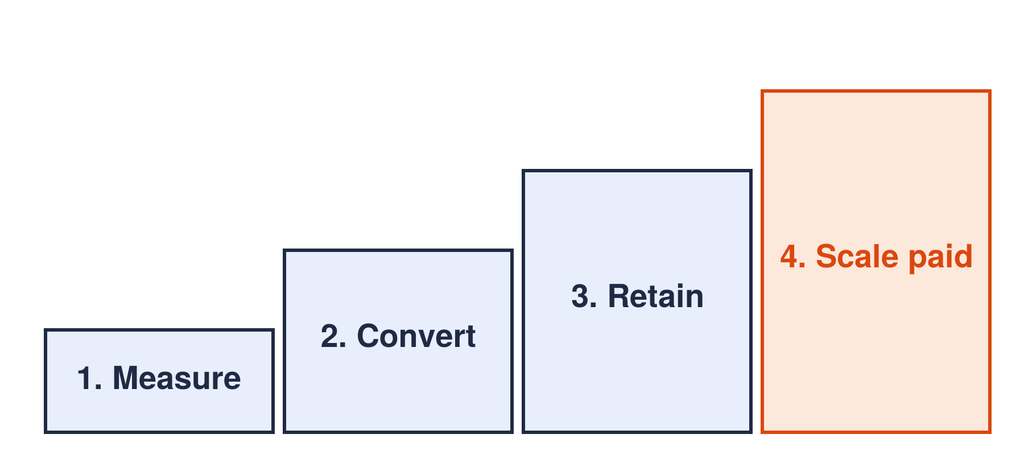
The steps by store size look different in practice, because the same decision costs more or less depending on the stage.
| Store revenue | First priority | Second priority | What to delay |
|---|---|---|---|
| Under 500k € a year | Margin tracking and email capture | Conversion fixes on top pages | Multi-channel paid scale |
| 500k € to 2M € | Retention flows and repeat purchase | Channel margin floors | New channels without a test plan |
| Above 2M € | Attribution discipline and incrementality tests | Channel diversification | Adding spend without proof of lift |
The PRG System (Predictable Revenue Growth), Anaia’s methodology, follows this logic: a Revenue Growth Diagnosis comes first, because every later decision depends on knowing where revenue is leaking today. Stores that want a structured start can read how the ecommerce growth strategy framework connects diagnosis to channel decisions.
Where this leaves ecommerce marketing strategy
The core idea of an ecommerce marketing strategy is simple: marketing exists to produce profitable orders, first and repeated. Traffic, clicks and reach are inputs. Contribution margin and repeat revenue are outputs, and a strategy is only as good as its ability to connect the two. Everything else in this guide, from the channel table to the budget method, serves that connection.
Most stores do not lack channels or ideas. They lack an order of operations. Margin is measured late, conversion problems hide behind traffic growth, and retention is treated as a project for next quarter. Reversing that order costs little and changes what every later dollar of spend can return. The evidence from owned channels and repeat buyers points the same way: the customers a store already has are its cheapest source of growth.
A plan this clear also makes decisions faster. When a new channel, tool or AI feature appears, the store asks one question: does it raise contribution margin or repeat revenue? If the answer is unclear, it goes into the testing cadence, not into the budget. That discipline is what separates a strategy that compounds from a collection of tactics that resets every quarter.
The practical next step is to find where the current plan loses the most revenue. A short diagnostic of margin, conversion and retention shows which of the five decisions is weakest, and that decision is where the first week of effort should go.
Ecommerce marketing strategy FAQ
Q1 : What is an ecommerce marketing strategy?
An ecommerce marketing strategy is a plan that defines the target customer, the channels used to reach them and the rules for spending on each. It connects acquisition, conversion and retention to profit. Without it, a store runs disconnected tactics and measures success by traffic or revenue instead of margin.
Q2 : What are the best ecommerce marketing strategies for DTC brands?
The best strategies combine search and content for demand capture, email and SMS for repeat orders, and paid media as an amplifier once margins are proven. No single channel wins for every store. The right mix depends on stage, margin per order and how often customers buy again.
Q3 : What is the difference between ecommerce marketing and digital marketing?
Digital marketing covers any online promotion. Ecommerce marketing is the subset focused on selling products through an online store, so it adds conversion, checkout and retention to the usual awareness work. Its success is measured by orders and margin, not only by reach or leads.
Q4 : How do I know which ecommerce marketing channels to use?
Choose channels by the job each one does and by margin. Start with the channel that captures existing demand, such as search or email. Add a new channel only when the current ones clear the margin floor and the store has capacity to test the new channel properly.
Q5 : How long does an ecommerce marketing strategy take to work?
Paid channels and email can show results within weeks. SEO and content typically need several months to compound. A fair review period is one full purchase cycle for the product category. Reviewing weekly on contribution margin catches problems early without judging slow channels too soon.
Q6 : Should a small store use AI in its marketing?
Yes, for narrow tasks such as drafting copy, segmenting audiences and personalizing emails, where results are easy to check. AI helps most when conversion and retention already work. Applied to a plan with unclear margins, it only produces more content that does not change profit.

Founder & CEO of Anaia Marketing, Dominique doesn’t manage traffic. He builds systems that grow revenue, predictably, measurably, without guesswork. With 15+ years at the intersection of search strategy and editorial precision, he focuses on what matters : turning organic growth into a compounding asset that moves revenue.