
An ideal customer profile (ICP) in B2B is a data-backed description of the companies most likely to buy, retain, and expand: defined by firmographic traits (industry, size, revenue), technographic signals (tech stack), and behavioral patterns (hiring, funding, buying intent), not by guesswork or a founder’s gut feeling.
What is an ICP in B2B, exactly?
An ICP is a detailed, data-backed profile of the company type most likely to get real value from a product and pay for it long-term. Salesforce defines it as “a detailed description of the perfect company for your business, the one that will get the most value from your product,” built from firmographic, technographic, and behavioral characteristics (Salesforce, 2026).
The confusion most B2B teams run into is treating an ICP and a buyer persona as the same thing. They are not. An ICP describes the organization: its size, industry, revenue band, tech stack, and growth stage. A buyer persona describes the individual inside that organization: their title, priorities, objections, and how they make decisions. A company can match a perfect ICP and still have no persona willing to champion the purchase internally. Both are needed, but they answer different questions: the ICP tells sales which accounts to pursue, the persona tells them who to talk to once they are inside.
At Anaia, ICP work is not academic. It is the first input into every Revenue Growth Diagnosis, because a growth engine built on the wrong accounts cannot be fixed by better ads or better content. It has to be fixed by better targeting first. This is exactly what Anaia’s own growth methodology does before touching a single campaign: it segments accounts by fit, not by volume, whether the business sells to e-commerce brands, SaaS scale-ups, or SMBs in transformation.
Why does a precise ICP matter for B2B revenue growth right now?
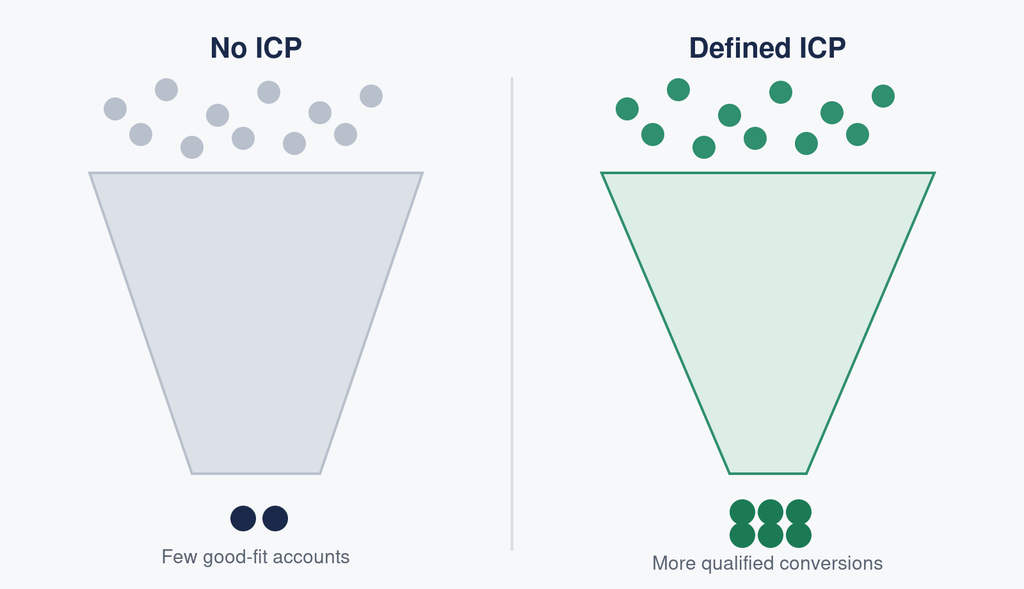
A precise ICP matters because B2B buying decisions now involve more people, more scrutiny, and more self-directed research than they did even two years ago, so unfocused targeting multiplies wasted effort across every stakeholder in the deal, not just the first contact.
The scale of that shift is not anecdotal. Forrester’s The State of Business Buying, 2026 report, based on its 2025 Buyers’ Journey Survey, found that the typical B2B purchase now involves 13 internal stakeholders and nine external influencers, with the number rising further for complex or strategic deals (Forrester, January 2026). Every one of those stakeholders evaluates the same vendor against a different set of priorities: finance checks the budget case, security checks the risk, the end user checks whether it solves their actual problem. A vague ICP means a business is trying to build one message for all thirteen of them at once, which usually means a message that convinces none of them.
Buyer behavior is compounding the problem. Gartner’s March 2026 sales survey found that 67% of B2B buyers now prefer a rep-free purchasing experience, and 45% had already used AI tools during a recent purchase (Gartner, March 2026). Buyers are doing more evaluation alone, earlier, and with less direct seller input than before. Without a sharp ICP guiding content, ad targeting, and lead scoring, a business has no way to make sure the right accounts even reach that self-directed research phase in a state to say yes. This is also why ICP precision shows up directly in the numbers behind how revenue growth compounds: a smaller pool of well-fit accounts converting at a higher rate consistently outperforms a larger pool of average-fit accounts converting at a lower one.
What data actually belongs in a B2B ICP?
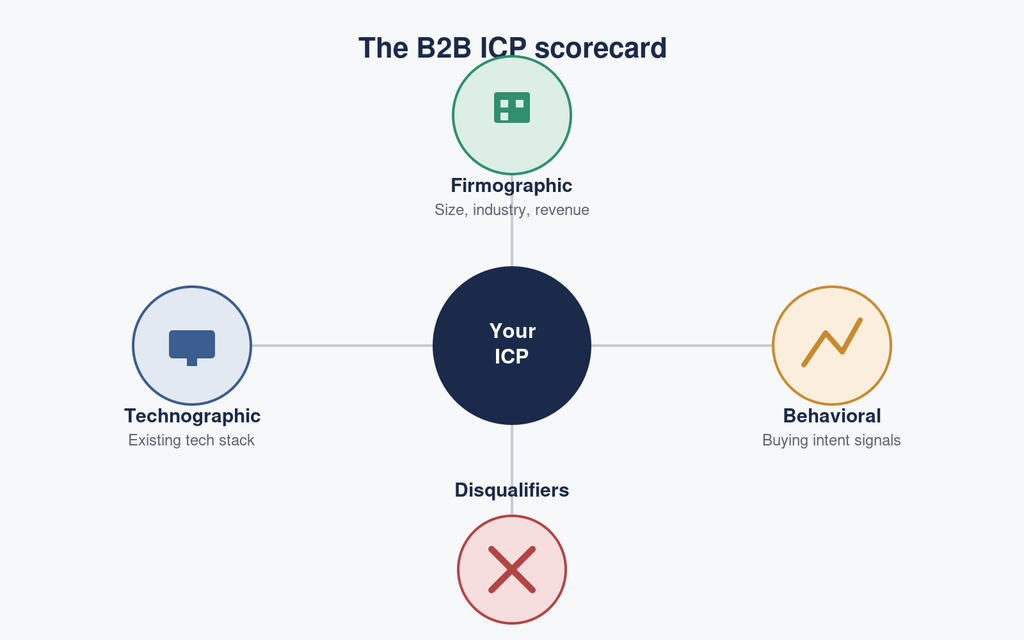
A complete B2B ICP combines three layers of data: firmographic (who the company is), technographic (what it already uses), and behavioral (what it is actively doing right now), plus a fourth layer of disqualifiers that rule accounts out even when the other three look like a match.
Firmographics alone are the most common trap. Industry, headcount, and revenue describe a company; they do not predict whether it will buy. A 200-person logistics company and a 200-person fintech company can share every firmographic trait and still behave completely differently as buyers. Technographic and behavioral signals are what turn a static description into something a sales and marketing team can actually act on.
| ICP dimension | What it captures | Example signal |
|---|---|---|
| Firmographic | Company-level facts | Industry, headcount, revenue band, geography |
| Technographic | Existing tech stack | CRM in use, competitor tool already adopted |
| Behavioral | Active buying intent | Recent funding round, hiring for RevOps or sales roles, pricing page visits |
| Disqualifiers | Reasons to exclude, even on a firmographic match | Segments with historically high churn, hiring freezes, no internal budget owner |
How do you define your ICP in five steps?
The fastest, most defensible way to build a B2B ICP is to reverse-engineer it from real deal data rather than start from assumptions about who the product is “supposed” to serve.
- Pull every closed-won deal from the last 12 months. For each one, record industry, headcount, revenue band, tech stack, the signal that triggered the deal, and time to close.
- Isolate the shared traits among the best accounts, not just the most numerous ones. Sort by deal size, retention, and expansion rather than volume alone; the accounts with the highest lifetime value usually reveal the sharpest pattern.
- Cross-check against closed-lost deals with the same firmographic profile. If lost deals look identical to won deals on paper, firmographics alone are not the deciding factor, and a technographic or behavioral layer needs to be added to the profile.
- Bring in sales and customer success before finalizing it. The teams closest to the account relationship usually catch disqualifying patterns that a spreadsheet alone will miss, such as a segment that buys easily but churns within two quarters.
- Score every account in the addressable market against the finished profile, then revisit the scoring against the revenue growth metrics that actually predict outcomes on a quarterly basis. A first-pass ICP is a hypothesis, not a finished asset.
What mistakes quietly break most B2B ICPs?
The most common ICP mistake is building a profile broad enough to include almost everyone, which defeats the purpose of having one at all. If an ICP does not exclude a meaningful share of the addressable market, it is functioning as a market description, not a targeting tool.
The second mistake is stopping at firmographics. Industry and headcount are the easiest data points to pull, so many teams treat them as sufficient and skip the technographic and behavioral layers that actually separate a good-fit account from a poor one. The third is treating the ICP as a one-time deliverable that lives in a slide deck rather than a working model reviewed against fresh closed-won and closed-lost data. Markets shift, product-market fit narrows or widens, and a profile built eighteen months ago is working from assumptions that may no longer hold. The fourth is building the ICP in isolation, without input from the sales and customer success teams who see disqualifying signals a CRM export cannot show on its own.
What this means for your B2B pipeline
An ICP is not a branding exercise or a slide for a sales kickoff. It is the single input that determines whether every dollar spent on content, ads, and outbound lands on an account with a real chance of buying, staying, and expanding. Skip it, and even excellent creative or a well-run sales team is aimed at a target that was never precisely defined in the first place.
The data backs this up plainly: buying groups have grown to thirteen internal stakeholders on average, buyers increasingly research and shortlist alone before a seller ever gets a call, and firmographics by themselves cannot tell a business which of two similar-looking companies will actually convert. Getting more specific, not less, is what closes that gap.
Anaia treats ICP definition as foundational rather than a one-off exercise, because it calibrates every other lever in the PRG System (Predictable Revenue Growth): the AI Workflow Factory cannot score and route leads correctly without it, the Content Growth Engine cannot write to the right pain points without it, and the CRO Revenue System cannot prioritize the right traffic without it. None of the three pillars compensate for a wrong starting target. The team behind that methodology works this way with every account, whether the engagement starts with a stalled B2B pipeline or a growth plan that never had a defined target in the first place.
For a business selling into B2B, whether that is SaaS scale-ups, PMEs in transformation, or B2B e-commerce accounts, the ICP built today is the filter every future growth decision runs through. Getting it right once saves months of optimizing campaigns aimed at the wrong companies.
Stop guessing which B2B accounts are worth pursuing. Run the Anaia revenue growth diagnostic in 15 minutes and identify where your current targeting is leaking pipeline.
Frequently asked questions about B2B ICPs
Q1 : What’s the difference between an ICP and a buyer persona?
An ICP describes the ideal company: industry, size, tech stack, and growth signals. A buyer persona describes the individual inside that company who evaluates or champions the purchase: their title, priorities, and objections. Both are needed; an ICP filters which accounts to pursue, a persona shapes how to engage the right person inside them.
Q2 : How many ICPs should a B2B company build?
Most companies should start with one primary ICP and only add a second when the first is fully operationalized in scoring and campaigns. Multiple ICPs make sense when a business genuinely serves distinct segments with different products or sales motions; beyond two or three, ICPs tend to dilute focus rather than sharpen it.
Q3 : How often should a B2B ICP be updated?
Review it quarterly against fresh closed-won and closed-lost data. Product changes, new market entrants, and shifts in buyer behavior, like the move toward rep-free, AI-assisted research, can make an ICP stale well before the twelve-month mark most teams default to.
Q4 : What’s the minimum data needed to build a first ICP?
Ten to twenty closed-won deals is enough to spot an initial pattern in industry, size, and the buying signal that triggered the deal. It will not be a finished profile, but it is enough to start scoring accounts and refining it against real outcomes rather than waiting for a “complete” dataset that never arrives.
Q5 : Does ICP definition work the same way for B2B e-commerce sellers?
The same three layers apply: firmographic, technographic, behavioral. What changes is the signal set. A B2B e-commerce seller should weight order frequency, catalog complexity, and procurement cycle length alongside the standard firmographic and technographic data, since those behavioral patterns predict fit as much as company size does.

Founder & CEO of Anaia Marketing, Dominique doesn’t manage traffic. He builds systems that grow revenue, predictably, measurably, without guesswork. With 15+ years at the intersection of search strategy and editorial precision, he focuses on what matters : turning organic growth into a compounding asset that moves revenue.