Ecommerce marketing automation is software that sends the right message to a shopper at the right moment, triggered by behavior such as signing up, browsing, abandoning a cart or buying. It replaces manual sends with rules, so revenue-producing messages run continuously without extra headcount.
TL;DR
- Automated emails were 2% of sends but 30% of email revenue in 2025, earning $2.87 per send against $0.18 for scheduled campaigns (Omnisend, January 2026).
- Start with four workflows: welcome, abandoned cart, post-purchase and win-back. They cover the moments where revenue is won or lost.
- Choose tools by stage, not by feature count. Native Shopify tools are enough for a new store; a dedicated platform pays off once segmentation matters.
- Automation multiplies whatever the funnel already does. Fix the leak first, then automate the fix.
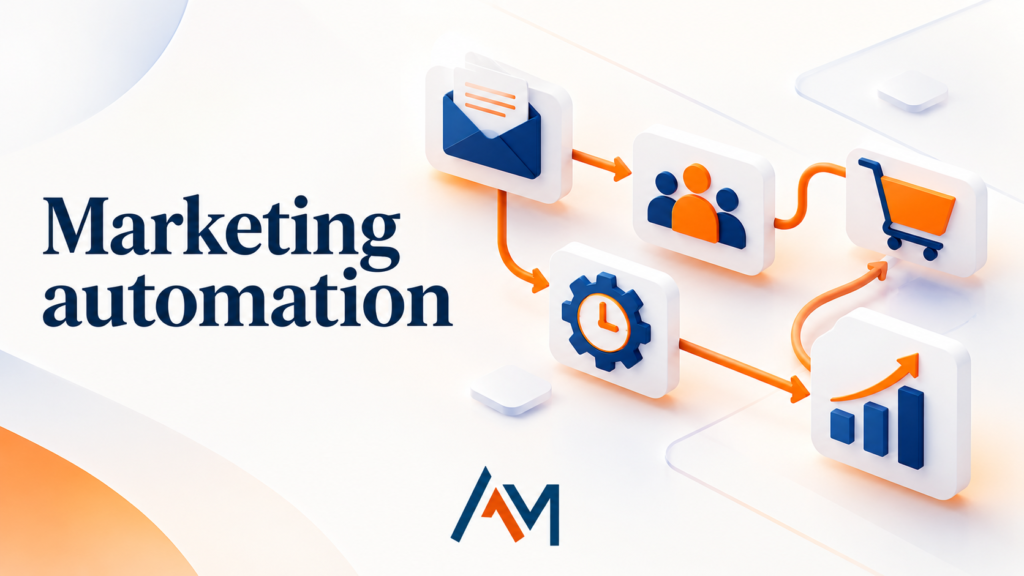
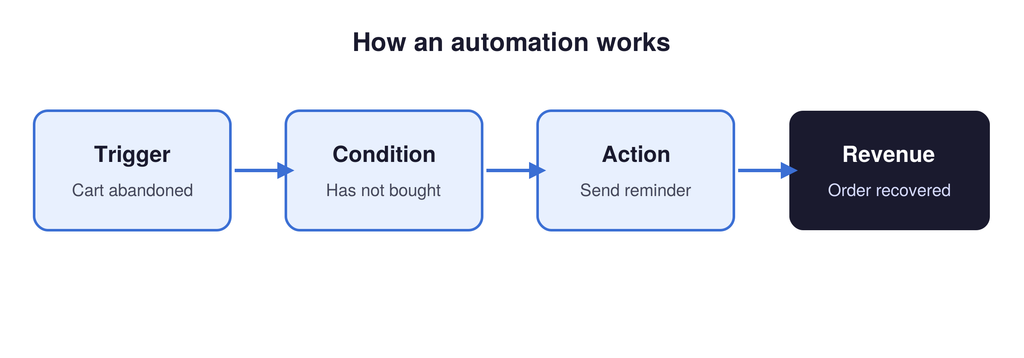
Ecommerce marketing automation flow from trigger to condition to action to revenue.
What is ecommerce marketing automation?
Ecommerce marketing automation is a system of triggers, conditions and actions that sends messages without manual work. A trigger is a shopper behavior, a condition filters who qualifies, and an action sends an email, text or push notification. The result is a message timed to intent rather than to a calendar.
The distinction from ordinary email marketing is timing. A campaign goes to a list on a date the team chooses. An automation goes to one shopper at the moment that shopper does something. A cart left open at 9 p.m. gets a reminder because of the cart, not because it was Tuesday.
This is why automation belongs inside any ecommerce marketing strategy rather than beside it. The strategy decides which customer moments matter, and the automation makes sure none of them is missed.
Why does ecommerce marketing automation earn more per message?
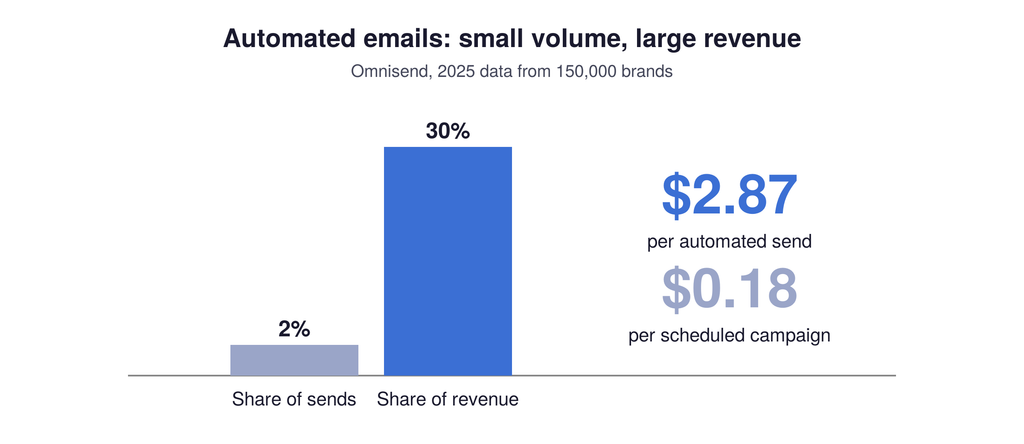
Automated messages earn more because they reach shoppers at a moment of intent. Omnisend’s analysis of 150,000 ecommerce brands found that automated emails were 2% of sends yet produced 30% of email revenue in 2025, and converted clicks at 31.2% against 9.0% for scheduled campaigns.
Automated emails were 2 percent of sends but 30 percent of email revenue, Omnisend 2025 data
| Metric (2025) | Automated | Scheduled campaigns |
|---|---|---|
| Share of email sends | 2% | 98% |
| Share of email revenue | 30% | 70% |
| Revenue per send | $2.87 | $0.18 |
| Email click-to-conversion | 31.2% | 9.0% |
Source: Omnisend, January 2026. Share of sends and revenue for scheduled campaigns is derived as the remainder.
The gap is not a reason to stop sending campaigns. It is a reason to make sure the automated layer exists first, because it is the cheapest revenue a list produces.
Which ecommerce marketing automation workflows should a store build first?
Build four workflows first: a welcome series, abandoned cart recovery, post-purchase follow-up and win-back. Together they cover first impression, lost intent, the second order and lapsed buyers. Each one starts with a clear trigger and a single success metric.
| Workflow | Trigger | Job | Benchmark to compare against |
|---|---|---|---|
| Welcome series | New subscriber | Turn a signup into a first order | Nearly 10% placed-order rate (Klaviyo, via Shopify) |
| Abandoned cart | Cart left without checkout | Recover intent already shown | 3.33% average conversion, 7.69% for top brands (Klaviyo, via Shopify) |
| Post-purchase | Order delivered | Drive reviews, cross-sell, reorder | Repeat purchase rate |
| Win-back | No purchase in a set window | Reactivate lapsed buyers | Reactivation rate |
The Klaviyo benchmarks above are reported in the Shopify guide to ecommerce marketing automation (updated July 2026). Treat them as reference points, not targets, since category and price point change every rate.
Abandoned cart deserves priority because the leak is large. Baymard Institute puts average cart abandonment at 70.22% across 50 studies, and 40% of shoppers who left cited extra costs (Baymard Institute, September 2025). A reminder cannot remove a shipping surprise, but it can bring back the shoppers who were interrupted. Fixing the surprise itself is covered in the ecommerce conversion rate optimization guide.
What does a good ecommerce automation example look like?
A good example is specific, short and tied to one behavior. Consider an illustrative abandoned cart flow for a skincare store: a first message after one hour that restates the cart, a second after 24 hours that answers the top objection such as delivery time, and a third after three days that adds social proof.
Each message has one job, and the sequence stops the moment the shopper buys. Stopping rules are the detail most stores skip. A reminder sent after a purchase damages trust and wastes a send.
Which tools and software run ecommerce marketing automation?
Ecommerce marketing automation runs on three layers of tooling: a data source such as the store itself, a messaging engine for email, SMS and push, and an orchestration layer that connects them. Small stores can cover all three natively, while larger ones add a dedicated platform.
What is an ecommerce marketing platform?
An ecommerce marketing platform is software that connects store data to marketing channels so campaigns and automations run from one place. It reads orders, products and behavior, then uses them to segment audiences and trigger messages. Without that data link, automation is just scheduled email.
How does an ecommerce marketing automation platform differ from a basic email tool?
A basic email tool sends messages to a list. An ecommerce marketing automation platform adds behavioral triggers, segmentation by purchase history and multi-channel sending across email, SMS and push. The practical test is whether a message can change based on what a shopper bought, viewed or ignored.
Which ecommerce marketing tools belong in a starter stack?
A starter stack needs only a sign-up form, a customer segment and the four core flows. Shopify offers native versions of each: Shopify Forms for capture, Customer Segments for grouping, Shopify Messaging for prebuilt email and SMS automations, and Shopify Flow for custom trigger-condition-action logic (Shopify, July 2026).
When is ecommerce marketing automation software worth paying for?
Paid ecommerce marketing automation software earns its cost when segmentation, testing or multi-channel logic starts to limit results. The signal is usually a list large enough that one generic flow underperforms, or a catalog where product-level personalization changes the offer. Before that point, native tools are the safer spend.
Which ecommerce marketing automation tools fit each stage?
Match the tool to the store’s stage and to the one capability it needs next. More features only help when someone owns them.
| Store stage | What is usually enough | Add when |
|---|---|---|
| New store | Native store tools for forms, segments and core flows | The first 90 days of data show clear segments |
| Scaling store | A dedicated email and SMS platform with deeper segmentation | Flows need purchase-history logic and testing |
| Established store | Platform plus workflow tooling to connect support, loyalty and subscription apps | Teams need one view of the customer across systems |
Shopify names Klaviyo, Omnisend and ActiveCampaign as common third-party options, with Klaviyo and Omnisend focused on ecommerce segmentation and multi-channel sending.
How should a store choose ecommerce marketing software without overbuying?
Choose ecommerce marketing software by listing the three workflows that would earn the most in the next quarter, then confirming a tool can run them cleanly. Ignore the rest of the feature list. A tool that runs four flows well beats one that offers forty and runs two.
What are the best ecommerce marketing tools for a store under 2M€?
The best ecommerce marketing tools for a store under 2M€ are the ones the team will configure and review every month: native store automations first, one email and SMS platform second, and a reporting view that ties messages to orders. Anything beyond that should answer a specific, measured gap.
Is an ecommerce growth platform different from automation?
Yes. An ecommerce growth platform spans more than messaging: it joins acquisition, conversion and retention data to show where revenue is lost across the whole journey. Automation is one part of it. Anaia Marketing treats automation as one lever inside the PRG System (Predictable Revenue Growth), alongside content and conversion work.
How does AI change ecommerce marketing automation?
AI changes the decision layer, not the principle. Instead of fixed rules, models choose which product to recommend, when to send, and which segment a shopper belongs in. Rules still define the guardrails: the trigger, the stopping condition and the offer limits.
Teams building this layer should treat it as a workflow design problem first. The approach in AI marketing workflows applies directly: document the manual process, automate the repeatable steps, and keep a human check on anything that touches price or customer promises.
How can a store measure whether automation is working?
Measure automation at the flow level, not the list level. Track revenue per recipient, conversion rate and incremental orders for each flow, then compare against a holdout group or the store’s own prior period. Without that comparison, attribution will flatter the flow.
Two checks keep the numbers honest. First, confirm that automated revenue is not simply discounts pulling forward orders that would have happened anyway. Second, trace each flow back to a known leak. If a flow does not map to a measured drop-off, it is activity, not strategy, and it is likely one of the patterns behind ecommerce revenue leaks.
What this means for ecommerce marketing automation
Automation is the most reliable revenue layer in an ecommerce marketing stack, and the data supports that. Two percent of sends producing 30% of email revenue is not a quirk of one report. It reflects what happens when a message arrives at the exact moment a shopper shows intent.
The risk is treating it as a tooling decision. Stores that buy software first often end up with a dozen half-configured flows and no clear owner. Stores that start from the funnel, identify the largest leak, and automate the fix tend to build less and earn more. The order is diagnosis, then workflow, then tool.
That is the logic Anaia Marketing applies with ecommerce brands: a measured leak, one workflow that closes it, and a review window to prove it worked. The tool matters less than the discipline around it.
A practical first step is modest. Pick the single flow closest to the largest drop-off in the last 90 days, write its trigger and stopping rule on one page, and launch it before adding anything else.
Automate the fix, not the guess. Run the Anaia revenue growth diagnostic in 15 minutes and identify your largest revenue leak.
FAQ
Q1 : What is ecommerce marketing automation?
It is software that sends emails, texts or push messages to shoppers based on their behavior, such as signing up, abandoning a cart or buying. Rules replace manual sends, so messages arrive at moments of intent and run continuously.
Q2 : Which ecommerce automation workflows should a store set up first?
Start with a welcome series, abandoned cart recovery, post-purchase follow-up and win-back. These cover first impression, lost intent, the second order and lapsed buyers, and they usually pay back before more advanced flows do.
Q3 : How much revenue can marketing automation generate?
It varies by store, but Omnisend reports that automated emails were 2% of sends and 30% of email revenue in 2025. Use that as direction, then measure revenue per recipient for each flow in the store itself.
Q4 : Does a store need a paid platform for ecommerce marketing automation?
Not at first. Native store tools cover forms, segments and core flows. A paid platform becomes worth it when segmentation, testing or multi-channel logic limits results.
Q5 : How long does it take to see results from automation?
Welcome and abandoned cart flows can show orders within the first weeks, since triggers fire as soon as traffic arrives. Allow 30 to 90 days to read the results reliably and to refine timing and offers.
Q6 : What is the difference between email marketing and marketing automation?
Email marketing sends messages to a list on a chosen date. Marketing automation sends messages to individuals when they take a specific action, and can span email, SMS and push.

Founder & CEO of Anaia Marketing, Dominique doesn’t manage traffic. He builds systems that grow revenue, predictably, measurably, without guesswork. With 15+ years at the intersection of search strategy and editorial precision, he focuses on what matters : turning organic growth into a compounding asset that moves revenue.