

An ecommerce marketing team structure is the answer to one question: who is accountable for each revenue number, and when does that job deserve its own hire? Most stores should add people in the order their unowned numbers hurt, not in the order an org chart template suggests. In practice that means a founder plus freelancers at the start, then an ecommerce or performance lead, then channel specialists, then a leader who owns the combined result.
This guide gives a stage-by-stage role map, an ownership test for every function, and two calculations (a hire break-even and an in-house versus outsourced threshold) that turn the hiring decision into arithmetic.
What a team structure actually decides
A team structure assigns ownership of outcomes to people. For a marketing team, the outcomes that matter are the ones inside the ecommerce marketing strategy: who brings new customers in, who turns visits into orders, who brings buyers back, who measures it honestly, and who makes the creative and the offers.
Generic organization models (functional, flat, geographic, product-based) describe how a company draws its boxes. They rarely tell a store owner whether the next hire should be a media buyer or an email specialist. A more useful frame is to list the functions that must be covered, then ask who owns each. Constant Hire, a recruiting firm for direct-to-consumer brands, groups ecommerce work into four clusters: acquisition, conversion, operations and retention (Constant Hire, 27 March 2026). This article adds measurement and creative as their own functions, because they are the two that small teams most often leave without an owner.
Team structure by growth stage
The table below combines the stage logic from Constant Hire with the hiring triggers published by the agency Digital Position (Digital Position, 8 August 2025). Both are vendor sources describing their own experience, not industry standards, and the revenue bands are starting points. A store with thin margins or a complex catalog may need a specialist earlier than the band suggests.
| Stage (annual revenue) | Typical setup | Next hire | Trigger worth watching |
|---|---|---|---|
| Under about $1M | Founder owns every function, plus freelancers for design and copy | A first marketing hire, or a specialist assistant for backend work | Founder spends more than half of the week on execution (uploads, shipping, support) instead of growth decisions |
| About $1M to $5M | 3 to 5 full-time staff and 1 to 2 contractors | Ecommerce manager first, then a performance marketer for the main paid channel | Contribution margin shrinking while revenue grows, a sign nobody owns conversion or cost control |
| About $5M to $15M | Departments form around channels | Channel leads, a lifecycle (email and SMS) lead and a measurement analyst | Platform-reported ROAS rising while blended efficiency stays flat |
| About $15M and above | Leadership layer plus several specialists | A director of ecommerce who owns the combined P&L | Each team hits its own targets but company-level contribution margin stalls |
Two cautions apply to this table. First, the revenue bands describe the sources’ client base, mostly direct-to-consumer brands, so they travel less well to B2B or marketplace-heavy stores. Second, hiring by band alone repeats the mistake the table is meant to prevent. The next section replaces the band with a test.
The ownership map: assign every function before adding headcount
Before opening a job description, write the functions in a list and put one name beside each. “The team” is not a name. For every function, also write the single number that proves it is working.
| Function | Number that proves ownership | Where the work is covered |
|---|---|---|
| Acquisition | Customer acquisition cost and new-customer revenue | Customer acquisition |
| Conversion | Conversion rate, average order value, revenue per session | Conversion rate optimization |
| Retention | Repeat purchase rate and revenue per customer over time | Customer retention |
| Measurement | Gap between platform-reported and blended results | Analytics and attribution work |
| Creative | Hook rate, ad refresh cadence, product page quality | In-house designer or contract creative |
| Operations interface | Dispatch time, stock-outs on promoted products | Fulfillment owner, outside marketing |
A function with no name, or with a name that has three other jobs, is an ownership gap. The gap with the highest cost per month is the first hire to evaluate. This is why the first marketing hire is rarely the same role in two stores: a store with healthy traffic and a flat conversion rate needs an ecommerce manager, while a store with strong conversion and weak customer return needs a lifecycle specialist.
Titles matter less than scope. A role that “owns conversion” should hold the on-site numbers, not just ad spend. Constant Hire flags the opposite as a common stage-two mistake: treating the ecommerce manager as a pure marketing role, which leaves conversion and cost control without an owner (Constant Hire).
Five checks before adding a marketing hire
The ownership map finds the gap. Five short checks decide whether to fill it with a hire, a freelancer or an agency.
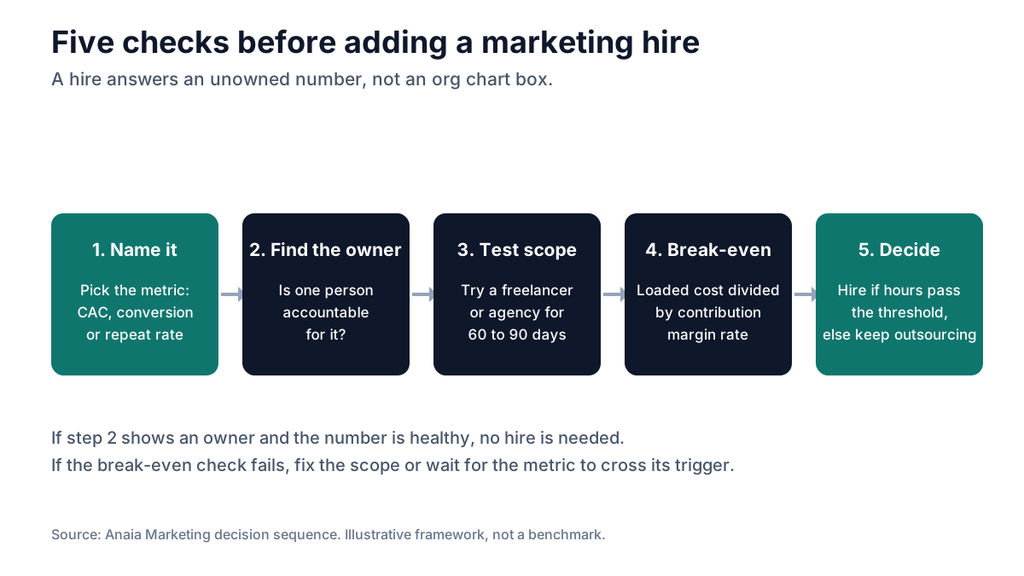
Steps one and two are the ownership map. Step three keeps a hire from being the first experiment: running the scope with a freelancer or agency for 60 to 90 days shows how many hours the work needs and whether the metric moves. Steps four and five are arithmetic, covered next. The 60 to 90 day window is Anaia’s working rule, not a published benchmark; shorten it when the role is obviously full-time.
How to calculate whether a hire pays for itself
A hire pays for itself when the contribution margin it creates exceeds its fully loaded cost. The formula needs three inputs from the store’s own books:
Required incremental revenue = loaded annual cost of the role ÷ contribution margin rate
Loaded cost is salary plus payroll taxes, benefits, software and equipment. Contribution margin rate is the share of each extra dollar of revenue left after product cost, shipping, payment fees and ad spend. Using gross margin instead of contribution margin is the most common way this calculation flatters a hire.
A worked example, with fictional numbers, for a performance marketing manager:
- Base salary: $90,000 (assumption for this example; actual pay varies by market and seniority)
- Loaded cost at 1.25 times base: $112,500 (the 1.25 multiplier is an assumption; check with payroll)
- Contribution margin rate: 30%
- Required incremental revenue: $112,500 ÷ 0.30 = $375,000 a year
If the new hire needs three months to become productive, the same $375,000 must arrive in the remaining nine months, or about $41,667 a month. That number is a test, not a forecast: the question is whether the store can credibly attribute that much extra revenue to the role, through lower acquisition cost, a better conversion rate or higher repeat sales. If not, the role is premature, or its scope is wrong.
For scale, the U.S. Bureau of Labor Statistics reports a median annual wage of $165,780 for advertising, promotions and marketing managers in May 2025 ($166,790 for marketing managers specifically). Those are management-level roles across all industries, so they sit well above the specialist salary in the example. They are a reminder that the input should come from real offers and local pay data, not from the illustration.
In-house, freelancer or agency: the hours threshold
Once a hire passes break-even, the next question is whether the work justifies a full-time person or should stay outsourced. The comparison reduces to hours:
Threshold hours per week = loaded annual cost of the hire ÷ (outsourced hourly rate × 52)
With the same fictional inputs and an outsourced rate of $85 per hour: $112,500 ÷ ($85 × 52) = 25.5 hours a week.
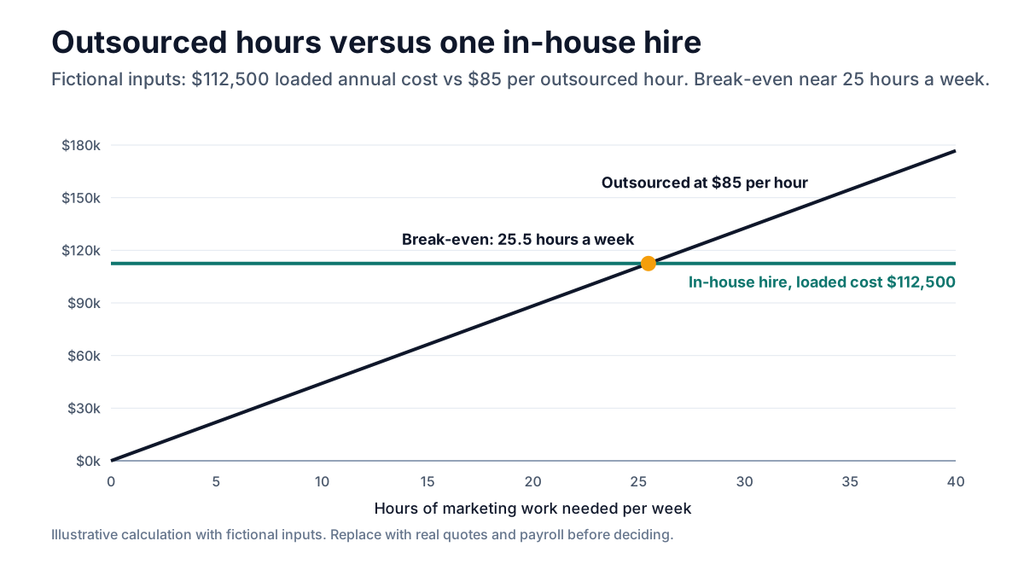
Below about 25 hours of steady weekly work in this example, outsourcing costs less. Above it, an in-house hire costs less per hour of work delivered. The chart uses invented inputs; swap in real quotes and payroll figures before deciding.
Three qualifiers keep the formula honest. Outsourcing buys specialist depth that one hire cannot match across paid, creative and analytics, so a store with only 15 hours of work in each of three functions may still be better served by three outsourced scopes. Management time is a hidden cost on both sides: Digital Position suggests bringing a function in-house when vendor management takes more than four hours a week, a heuristic worth testing rather than adopting. And a freelancer or agency can be the right permanent answer for work that is real but intermittent, such as seasonal campaign builds.
Measurement and AI: the roles that are easy to underbuild
Two areas are new enough that many structures leave them to whoever has time.
Measurement is the first. As stores add channels, platform dashboards report credit for the same sale in different ways, and the gap between reported and blended results grows. Constant Hire names a dedicated attribution analyst as a hire for the $5M to $15M stage for that reason. Before creating that role, a smaller store can assign one person to reconcile ad platform revenue to total store revenue every month; the size of the gap is the evidence for or against a hire. For context on pay, the Bureau of Labor Statistics reports a May 2025 median wage of $78,760 for market research analysts, a nearby occupation, with 7% projected employment growth from 2025 to 2035 (BLS). Titles in ecommerce analytics vary, so treat that figure as a rough anchor only.
Automation is the second. Repetitive work such as reporting, feed checks, review requests and lifecycle triggers can often be handled by systems rather than headcount. The patterns are in AI marketing workflows. Automating a task does not remove its owner; it removes hours from the threshold calculation above, which can push a role from “hire” to “keep outsourced”.
Common structure mistakes by stage
Four mistakes recur across the sources and in how stores grow. Hiring a chief marketing officer or vice president before one channel is proven gives the role nothing to manage and consumes cash that acquisition needs. Hiring a second generalist who repeats the founder’s work fills a seat without closing an ownership gap. Splitting channels too late, so one person runs paid search, marketplaces and social at once, produces mediocre results everywhere; Constant Hire makes this point for stores past about $5M. And restructuring on a calendar rather than on evidence leads to reorganizations that change titles but not outcomes.
A light review rhythm helps. Each quarter, re-read the ownership map, check whether any function lost its owner, and re-run the two formulas for the next likely hire. The wider growth plan around these decisions is in the ecommerce growth strategy guide.
Build the team around the numbers, not the chart
A good ecommerce marketing team structure is a list of functions with a named owner and a proof number beside each. The stage tables show which hires tend to come first, but the order that matters for a given store comes from its own unowned numbers: the function with the largest monthly cost of having no owner gets the first hire, after a freelancer test and a break-even check. The in-house threshold then decides whether that role is a person or a contract.
Run that sequence once, write down the result, and repeat it each quarter. Stores that want an outside read on which gap to close first can book the Revenue Growth Diagnosis and leave with a ranked list of the leaks costing the most revenue.
FAQ
Q1. What is the first hire for an ecommerce marketing team?
The first hire is the role that owns the most expensive unowned number. For many stores around $1M to $5M in revenue that is an ecommerce manager who owns conversion and the promotion calendar, followed by a performance marketer for the main paid channel, which matches the sequence described by Constant Hire. A store with healthy conversion and weak repeat purchasing may need a lifecycle specialist first. The ownership map above makes the choice explicit.
Q2. Should a small ecommerce store hire a head of marketing?
Usually not before one channel is proven. A senior leader has no team to manage in a founder-led store, and the salary competes with acquisition spend. Freelancers and agencies cover execution, while the founder keeps strategy until the break-even and hours checks show a permanent role is justified.
Q3. How many people should an ecommerce marketing team have?
No universal headcount exists. Sources give ranges tied to their own client base, such as 3 to 5 full-time staff at roughly $1M to $5M in revenue (Constant Hire), and Digital Position suggests about one full-time employee per $1M to $1.5M in revenue, with total team cost of 8% to 12% of revenue excluding ad spend. Treat those as sanity checks against the store’s own break-even math, not as targets.
Q4. When should an ecommerce brand use an agency instead of in-house staff?
Use an agency or freelancer when the work is under the in-house threshold hours, when it needs several specialist skills at part-time volume, or when it is seasonal. Move in-house when steady weekly work exceeds the threshold, when vendor coordination takes a large share of a manager’s week, or when the function needs daily decisions. The formula in this guide gives the threshold for a given set of costs.

Founder & CEO of Anaia Marketing, Dominique doesn’t manage traffic. He builds systems that grow revenue, predictably, measurably, without guesswork. With 15+ years at the intersection of search strategy and editorial precision, he focuses on what matters : turning organic growth into a compounding asset that moves revenue.