
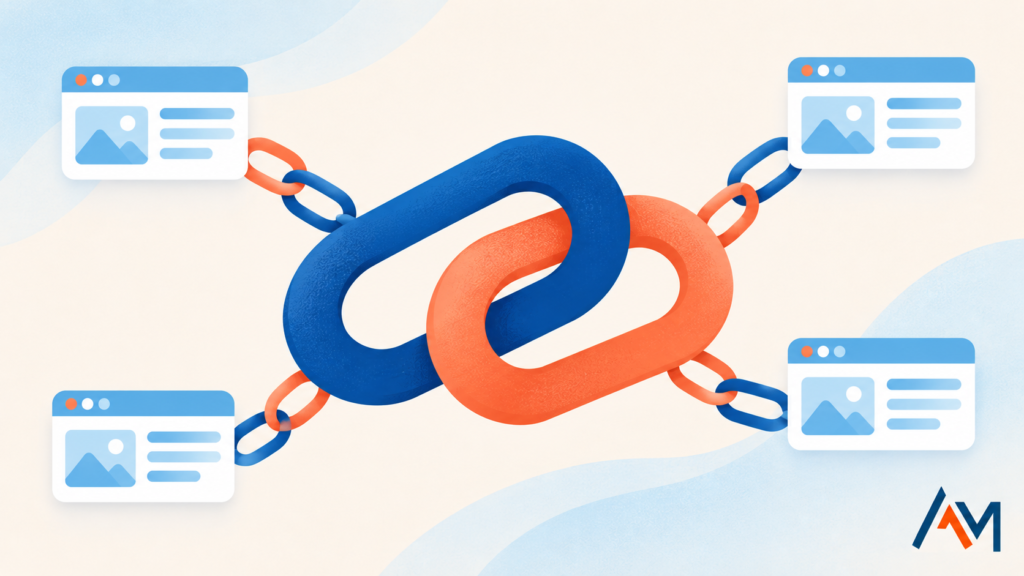
Ecommerce link building is the work of earning links and brand mentions from other websites to your store, then routing that authority to the category and product pages that sell. It is harder than link building for a blog, because few people want to link to a product page. The stores that make it work build a small number of pages worth linking to, pitch them to the right people, and pass the value on with internal links.
This guide gives you 12 strategies, a payback calculation to judge any link budget, and Google’s rules on paid links, free products and affiliate links, so your campaign grows revenue without creating risk.
Why ecommerce link building is harder than normal link building
Product and category pages are rarely linkable on their own. Neil Patel’s guide puts it plainly: sharing them rarely adds value to the page that links, and affiliate links, which site owners are happy to place, carry limited SEO value (Neil Patel, ecommerce link building). The same guide frames the answer as creating a handful of linkable assets and distributing the equity through a well-organized internal link structure.
That framing changes where you spend time. You do not ask strangers to link to a $10 water bottle. You earn links to a guide, a data page, a tool or a promotion page, and then use your own internal links to send that authority to the pages that carry margin. Our guide to ecommerce SEO optimization covers the on-site foundation that makes this routing work, and the guide to SEO for ecommerce product pages covers what those money pages need once they receive the authority.
Schema showing how ecommerce links flow: linkable assets earn links from external sites, internal links pass that value to category and product pages, and redirects and link attributes protect it.
The 12 ecommerce link building strategies
The strategies below fall into three groups: earn links with assets, recover links you are already owed, and build relationships that produce links. The effort and risk ratings in the table are our editorial judgment, not measured data. Use them to choose where to start, not as benchmarks.
| # | Strategy | Group | Effort | Link risk |
|---|---|---|---|---|
| 1 | Guides on informational queries | Earn | Medium | Low |
| 2 | Original data and research | Earn | High | Low |
| 3 | Tools and calculators | Earn | High | Low |
| 4 | Digital PR campaigns | Earn | High | Low if the story is real |
| 5 | Permanent promotion pages | Earn | Low | Low |
| 6 | Unlinked brand mentions | Recover | Low | Low |
| 7 | Broken links on other sites | Recover | Medium | Low |
| 8 | Redirect cleanup for retired URLs | Recover | Low | Low |
| 9 | Expert source pitches | Relationships | Medium | Low |
| 10 | Supplier, brand and niche directories | Relationships | Low | Medium |
| 11 | Free products to reviewers | Relationships | Medium | Medium to high without disclosure |
| 12 | Affiliate and partner programs | Relationships | High | Low, but links are usually nofollow |
Earn links with assets people want to cite
1. Guides on informational queries. Site owners link to content that helps their readers, and affiliate-style product links are mostly nofollow. That is why Neil Patel recommends targeting informational keywords that editors can find and link to. His team’s research, which he reports, found three content types outperform the rest: comprehensive guides, original research and tools (Neil Patel). StudioHawk makes a similar first recommendation, mining customer support emails and search suggestions for topics (StudioHawk). Start with the questions a buyer asks before purchasing in your category, and publish the single best answer on the web for one of them.
2. Original data and research. Research is easier in B2B, but a store can do it too. Aggregate your own anonymized sales, returns or fit data, run a survey of your customers, or test products and publish the method. Journalists and bloggers link to numbers they cannot get elsewhere. Only publish what you can document, with the period and sample size.
3. Tools and calculators. A size finder, a compatibility checker or a cost calculator gives a site owner a reason to link that has nothing to do with selling. The cost is development time, so build one only when your category has a repeated calculation that shoppers do badly today.
4. Digital PR campaigns. Digital PR means creating something newsworthy and pitching it to journalists. Neil Patel’s examples include timely products, high-value promotions, charitable initiatives and celebrity partnerships. His warning applies as much as his advice: gimmicky offers and attention-seeking campaigns that do not match your brand’s track record can backfire into negative press. For campaign ideas that can double as a story, see our ecommerce marketing ideas.
5. Permanent promotion pages. Seasonal sales attract links to the page that hosts them, and those links are lost when the page is deleted. Use one static URL for each recurring event, such as a Black Friday page, and retire it quietly after the event instead of removing it. The same applies to an ongoing student or veteran discount page, which discount and money-saving sites like to cite.
Recover links you should already have
6. Unlinked brand mentions. Set up alerts for your brand and product names, check whether each mention links to you, and ask the editor to add the link when it does not. It is a low-effort tactic and works best for brands that already get talked about.
7. Broken links on other sites. Use a backlink tool to find pages that link to dead URLs on competitor sites or on your own old URLs. If you have a page that serves as a real replacement, email the site owner with the broken URL and your suggestion. People generally prefer fixing a broken link to deleting it.
8. Redirect cleanup for retired URLs. Ecommerce stores retire products and categories constantly. Redirecting every old URL to the homepage wastes the links those pages earned, and Neil Patel notes that Google may treat such redirects as soft 404 errors. Send each retired URL that still has backlinks to the closest replacement: a newer model, a similar product or a relevant category. Check your redirect list against your backlink report once a quarter.
Build relationships that produce links
9. Expert source pitches. Journalists need quotes from people who know a category. Pitch yourself, or your founder or product lead, on topics where you have first-hand data. StudioHawk notes that the HARO platform was discontinued in 2024, so direct outreach to reporters and newsletters that cover your category is now the practical route.
10. Supplier, brand and niche directories. Many manufacturers list authorized sellers and many industry bodies keep member directories. A listing from a relevant, curated source is a legitimate link. Skip bulk submission to low-quality directories: Google lists low-quality directory and bookmark links among its examples of link spam.
11. Free products to reviewers. Reviewers with their own sites can send real links. Google’s link spam examples include sending a free product in exchange for a write-up with a link, unless the link is qualified. Ask for honest reviews and agree that the reviewer will mark the link rel="sponsored" or rel="nofollow". Neil Patel makes the same point about disclosure and nofollow for complimentary product reviews.
12. Affiliate and partner programs. Affiliate programs bring traffic and sales, and the links are usually nofollow, so judge them on revenue, not on SEO value. Partner pages work better when the partner genuinely recommends you to its own audience. For the acquisition side of the same work, see our guide to ecommerce customer acquisition.
What Google’s rules mean for your link building
Google defines link spam as creating links to or from a site primarily to manipulate search rankings (Google Search Central, spam policies). The examples most relevant to a store are buying or selling links for ranking, excessive link exchanges, automated link creation, advertorials and guest posts with paid links that pass ranking credit, low-quality directory links, and widely distributed keyword-rich footer or widget links.
Google also says buying and selling links for advertising or sponsorship is a normal part of the web when the links are qualified. Its documentation on outbound links tells site owners to use rel="sponsored" for ads and paid placements, rel="ugc" for user-generated content, and rel="nofollow" when neither applies (Google Search Central, qualify outbound links).
In practice, this gives you a simple test. If you or anyone working for you gave money, goods or services in exchange for a link, the link should carry a qualifying attribute. If a vendor promises “dofollow” links from paid placements, ask how they comply with that rule before you sign.
How much should an ecommerce link budget cost, and when does it pay back?
Cost depends on whether you earn links with your own assets, which costs time, or buy placements from a service. For a reference point on the service side, one vendor, Vazoola, publishes per-link prices on its ecommerce page, read on 7 November 2026: $50 for a site with a domain authority of 20 or more, $90 for 30 or more, $130 for 40 or more and $215 for 50 or more (Vazoola). Domain authority is a third-party score, not a Google metric, and the page does not show results or independent proof for its claims, including a 3 to 4 month timeline for ranking gains. Treat these prices as a market data point, not a recommendation.
The question that matters is not what a link costs but whether the page it supports earns the money back. Here is a payback calculation you can reproduce with your own numbers.
Payback in months = total link cost ÷ monthly gross profit gained.
Monthly gross profit gained = monthly searches × (new visit share − current visit share) × visit-to-order rate × gross profit per order.
A worked example with a fictional store
The following example is fictional. All inputs are assumptions, including the visit shares, which stand for a move from a lower to a higher position in the results.
A store plans 10 placements at the published tiers above: 4 at $50, 3 at $90, 2 at $130 and 1 at $215, for a total of $945. They target a category page for a search with 3,000 monthly searches. The page captures 3% of visits today and is expected to reach 8%. Gross profit per order is $55.
Extra visits per month are 3,000 × 5% = 150. At a 2% visit-to-order rate, that is 3 extra orders and $165 of extra monthly gross profit. Payback is $945 ÷ $165, about 5.7 months.
Bar chart of payback months for a fictional $945 link budget: 11.5 months at a 1% order rate, 5.7 months at 2%, 3.8 months at 3%
| Visit-to-order rate | Extra orders per month | Extra monthly gross profit | Payback |
|---|---|---|---|
| 1% | 1.5 | $82.50 | 11.5 months |
| 2% | 3 | $165 | 5.7 months |
| 3% | 4.5 | $247.50 | 3.8 months |
The lesson is the sensitivity. The same budget takes three times longer to pay back when the page converts at 1% instead of 3%. A link to a page that does not convert only moves the problem. Before you buy or earn links to a category page, check that page’s conversion rate and content, and fix them first when they are weak. Our ecommerce conversion rate optimization guide is the next step for that work.
How to choose your first three strategies
Match strategies to your situation rather than trying all 12.
A store with an established brand and no link program should begin with recovery: unlinked mentions, broken links and redirect cleanup. They are low-effort and use authority you already earned.
A newer store with a narrow category should begin with one guide or data page on a question buyers ask, plus a permanent promotion page and two or three directory listings from relevant sources.
A store with a larger budget and a newsworthy product should add a digital PR campaign, but only after the recovery work is done.
In all cases, pick the target page first. List the three category pages with the best margin and the weakest rankings, and ask which of the 12 strategies could realistically earn links that point to or through them.
How to measure ecommerce link building
Track links and outcomes separately. For links, record each new referring page, the target URL, the anchor, whether it is followed and the date. For outcomes, use Google Search Console to follow impressions, clicks and average position for the queries each target page serves, and your analytics tool for orders and revenue per organic session on that page. Compare against the period before the campaign and keep the same definitions. A rise after a campaign shows correlation, not proof that the links caused it, so note other changes made in the same weeks.
Review the list every quarter. Remove any link you cannot defend under the rules above and, if a paid link lacks a qualifying attribute, ask the site owner to add one.
How this compares with the top-ranking guides
The three pages at the top of Google for this query on 7 November 2026 are Neil Patel’s guide, Vazoola’s service page and StudioHawk’s 10-strategy post. Neil Patel’s guide, updated May 2026, is the strongest on what works and what to avoid. Vazoola’s page is a service page with prices but no evidence behind its quality claims. StudioHawk’s post, dated August 2025, lists ten strategies with little sourcing and no mention of how Google treats free products or paid links beyond a disavow link.
None of the three shows how to decide whether a link budget will pay back. That is the gap the calculation above fills.
A link plan that pays for itself
Ecommerce link building works when links point to a plan, not a pile. Earn links with assets editors want to cite, recover the links you already deserve, qualify every paid or free-product link, and send the authority to category pages that convert and carry margin. The fictional example shows why: the same $945 pays back in under 4 months or in nearly a year depending on one conversion rate.
Start with one category page. Check its conversion rate, choose two strategies from the list, and set a payback target before you spend. If you want help deciding which of your pages deserve links first, get your Revenue Growth Diagnosis and see which part of your funnel to fix before you build more links. For stores that want link building handled together with SEO, answer-engine and generative-engine work, Anaia’s ecommerce SEO services cover that end to end.
Frequently asked questions
Q1. What is ecommerce link building?
It is the process of earning links and brand mentions from other websites to your online store, with the goal of improving rankings for category and product pages. Because those pages are rarely linked directly, most of the work goes into linkable assets, outreach and internal links that pass authority on.
Q2. How do I build backlinks for an ecommerce site?
Publish guides, data or tools that answer buyer questions, pitch them to relevant editors and bloggers, recover unlinked mentions and broken links, and route the authority to your category pages with internal links. Qualify any paid or free-product link with rel="sponsored" or rel="nofollow".
Q3. Is it safe to pay for ecommerce backlinks?
Google says buying and selling links for advertising or sponsorship is acceptable when the links are qualified with rel="sponsored" or rel="nofollow". Buying links to pass ranking credit is link spam. Ask any vendor how its placements comply before you pay.
Q4. How long does ecommerce link building take to work?
There is no verified standard. One vendor claims 3 to 4 months for ranking gains without a source, and results depend on competition and on the page you point links to. Measure position, clicks and orders for the target pages over several months.
Q5. Do affiliate links help SEO?
Usually little. Affiliate links are typically nofollow, so judge an affiliate program on the traffic and sales it brings. Editorial links to a useful guide or data page give more SEO value.
Q6. Should I hire an ecommerce link building agency or do it in-house?
Do the recovery tasks in-house, since they use data you own. Consider an agency for digital PR or for outreach capacity you lack, and ask for sample placements, the attributes used on paid links and a payback estimate for your target pages before you commit.

Passionate about the future of search, co-founder of Anaia Marketing and an SEO strategist focused on helping brands grow through search, strategic content, and AI-driven visibility. Her work sits at the intersection of technical SEO, content systems, and emerging AI search optimization, with a focus on building sustainable organic growth.