

Mobile ecommerce growth comes from helping more smartphone visitors complete the job they already came to do: find the right product, understand it, trust the store, pay without friction, and return when the product is relevant again. A responsive theme is only the baseline. Sustainable growth requires a mobile journey that is fast, easy to operate with one hand, clear at every decision point, and measured separately from desktop.
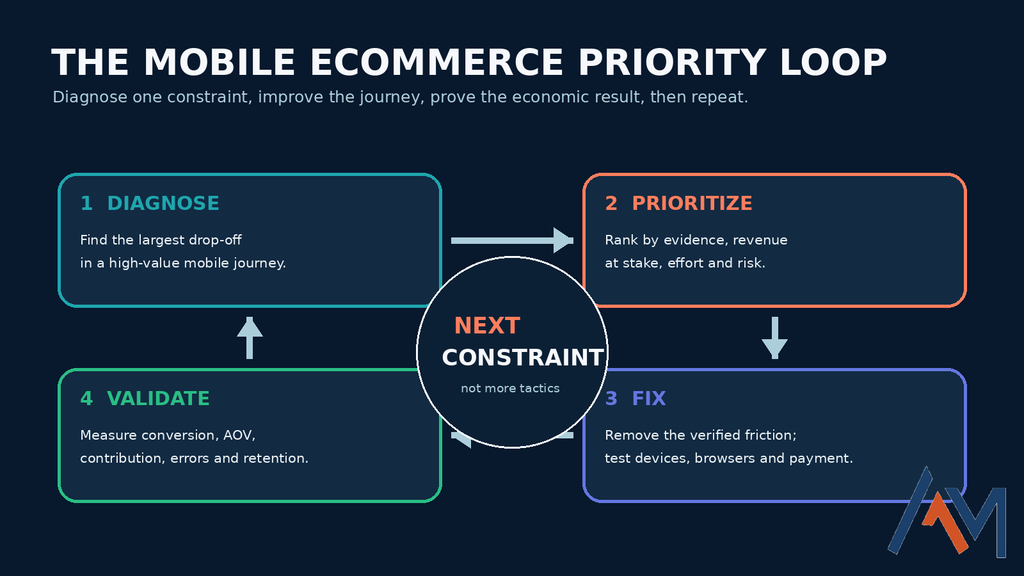
The practical sequence is simple: diagnose the largest mobile drop-off, fix the highest-value journey first, validate the change with behavioral and revenue data, then scale acquisition.
That sequence fits Anaia’s broader ecommerce growth strategy: improve the system before sending more demand into it.
What mobile ecommerce growth actually means
Mobile ecommerce growth is a sustained increase in profitable orders and repeat revenue originating from smartphones and tablets. It is not the same as more mobile traffic, a higher app-download count, or a visually modern mobile site.
The operating equation is:
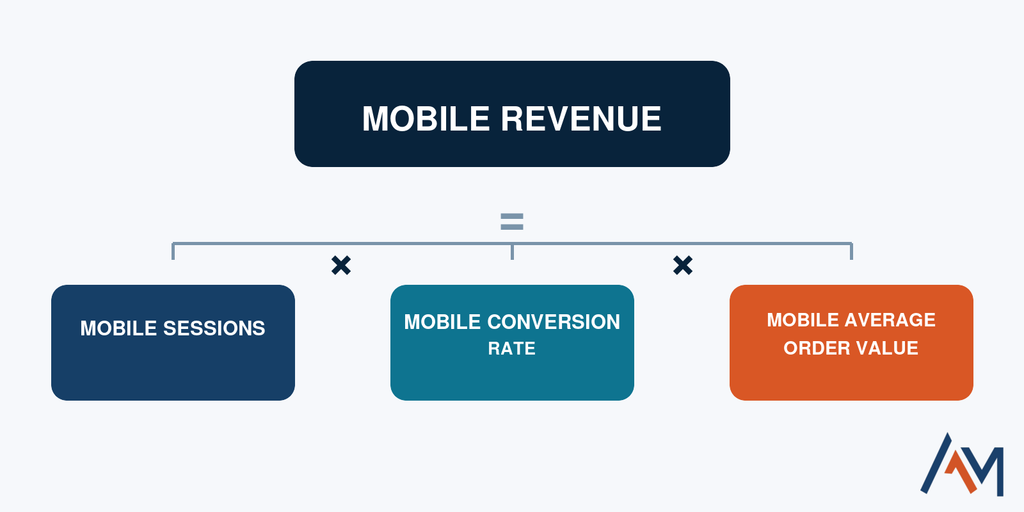
That equation is useful because it separates three different problems. A store may need qualified demand, a better shopping experience, or a stronger basket. It also prevents traffic growth from hiding conversion loss.
Market reports show that mobile commerce is a large and expanding category. Fortune Business Insights estimated the U.S. mobile commerce market at $410.37 billion in 2026, but forecasts are not a store-level business case. Your own device-level funnel, margin, and customer behavior should determine the investment (Fortune Business Insights, 2026).
Diagnose the mobile growth constraint before redesigning
Start with a journey, not a homepage critique. Select a high-value mobile path, such as a paid landing page to product page to checkout and compare it with the equivalent desktop path.
Build a baseline for:
| Stage | Mobile measure | Diagnostic question |
|---|---|---|
| Acquisition | Qualified sessions and cost per session | Are campaigns attracting shoppers whose intent matches the landing page? |
| Product discovery | Search use, filter use, product-list engagement | Can shoppers narrow the catalog quickly on a small screen? |
| Product decision | Product-view-to-add-to-cart rate | Does the page answer fit, price, delivery, return, and trust questions? |
| Cart | Cart-to-checkout rate | Are costs, delivery timing, and next steps clear? |
| Checkout | Checkout completion rate | Does the flow require unnecessary typing, steps, or account creation? |
| Order value | Mobile AOV and contribution per order | Are bundles and add-ons relevant without obstructing purchase? |
| Retention | Mobile repeat purchase rate | Can customers reorder and resume across devices without starting over? |
Segment further by operating system, browser, screen size, traffic source, new versus returning customer, and connection quality when sample size permits. A blended “mobile” average can hide a failure isolated to one browser, payment method, campaign, or template.
Anaia’s analysis of ecommerce revenue leaks provides a broader framework for locating losses before, during, and after purchase. For this article, the boundary is narrower: how those leaks appear on a mobile device and how to remove them.
Build the mobile journey around six customer jobs
1. Help shoppers land in the right place
The first mobile screen has limited room. It should confirm that the shopper reached the expected category, product, or offer without requiring a long scroll.
The destination must match the source closely. A product ad should open the correct product and variant, while a category query should lead to a useful collection rather than the homepage. Promotional traffic should arrive on a page where eligibility and conditions are immediately visible. When consent and platform capabilities allow it, returning shoppers should also be able to recover a relevant cart or recently viewed item.
Keep campaign parameters, redirects, deep links, and out-of-stock handling under regular review. A strong ad cannot compensate for a dead end after the tap.
2. Make product discovery usable with one hand
Mobile navigation should reduce decisions without concealing essential options.
Use concise category labels, visible site search, filters ordered by real buyer priorities, and a persistent way to see or clear selected filters. Product cards should expose enough information to compare options: image, product name, price, important variant or availability information, and a meaningful review signal when genuine reviews exist.
Do not reproduce desktop mega-menus inside a narrow drawer. Test whether shoppers can reach a priority category, apply a filter, compare products, and return to the same list position without losing context.
3. Turn the product page into a decision page
A mobile product page should answer the purchase question in layers. Place the essentials near the top, then make supporting detail easy to expand.
The initial view generally needs to combine a clear product name and primary image with the price, promotion conditions, available variants, and a visible primary action. Delivery timing, or an obvious way to calculate it should appear before uncertainty becomes an objection. A concise return or exchange cue and trust evidence appropriate to the product can then support the decision without overwhelming the screen.
Below that, provide specifications, size or compatibility guidance, materials, usage, shipping, returns, reviews, and questions. Preserve text in accessible HTML; do not put essential specifications only inside images.
Mobile imagery should load efficiently while still supporting zoom and inspection. Video may help a complex product, but it should not displace the core purchase information or load automatically at the expense of performance.
For a deeper page-level approach, Anaia’s guide to SEO for ecommerce product pages shows how product information can serve both discovery and conversion.
4. Reduce cart and checkout effort
Mobile checkout should ask for the minimum information needed to complete and fulfill the order safely.
Allow guest checkout unless account creation is genuinely necessary. Use the appropriate input type for email, telephone, postal code, and card fields, and support autofill or reliable address lookup where possible. Every field needs a clear label, while error messages should appear next to the problem and explain how to correct it.
Payment options should reflect the market and the store’s actual customer base. Before the final action, shoppers should see the complete order total, shipping cost, and expected delivery timing. If they leave and return, preserving the cart prevents them from repeating work they have already completed.
Avoid using discount-code prominence to send full-price shoppers hunting for a coupon. Do not interrupt checkout with unrelated cross-sells, surveys, or forced application downloads.
BigCommerce’s mobile commerce guide similarly emphasizes mobile-first layouts, guest checkout, simplified forms, wallets, and continuity across channels. Its platform-specific claims should be evaluated in the context of your own stack and data (BigCommerce).
Anaia’s ecommerce conversion rate optimization service focuses on identifying the product, cart, checkout, and mobile steps with the most revenue at stake before choosing fixes.
5. Protect speed and visual stability
Mobile performance is part of the shopping experience. A page that moves while a shopper is trying to tap, delays its main content, or freezes during interaction creates both uncertainty and errors.
Track Core Web Vitals at the template level, using field data when available. Largest Contentful Paint (LCP) reflects loading performance, Interaction to Next Paint (INP) reflects responsiveness, and Cumulative Layout Shift (CLS) reflects visual stability.
Google’s current guidance defines “good” thresholds as LCP within 2.5 seconds, INP within 200 milliseconds, and CLS at or below 0.1 at the 75th percentile. These thresholds are diagnostic targets, not guarantees of ranking or conversion (Google web.dev).
Common ecommerce causes include oversized hero and product images, third-party scripts, tag-manager sprawl, personalization tools that alter the layout late, variant logic, review widgets, and unreserved media space.
Fix performance in revenue order. Start with the mobile templates and journeys that carry the most qualified traffic or orders. Removing a low-value script from a high-revenue product template may matter more than optimizing an obscure content page.
6. Continue the journey after purchase
Mobile growth should not end at the confirmation screen. Make order status, delivery updates, support, returns, and reordering easy to access from a phone.
Every post-purchase communication should perform a clear customer job. First, confirm the purchase and expected timeline. When setup, care, or usage guidance can reduce failure or returns, provide it at the moment it becomes useful. Request feedback only after the customer has had a reasonable opportunity to use the product.
Replenishment reminders and complementary recommendations should follow real purchase logic rather than a universal delay. Customers should also be able to manage communication preferences instead of facing a binary subscribe-or-unsubscribe decision.
A retained customer should not need to rediscover the product, re-enter every detail, or search email for essential order information. These workflows turn the mobile experience into part of an ecommerce growth engine rather than a one-time checkout.
Decide whether your store needs an app
A native app is not automatically a mobile growth strategy. It introduces acquisition, installation, maintenance, release, analytics, and retention costs.
An app is easier to justify when customers buy frequently or benefit from device-specific capabilities such as barcode scanning, saved in-store identity, location-aware service, complex loyalty, or repeated account workflows. A strong mobile web experience is usually the first priority when purchases are infrequent, discovery comes mainly from search or paid media, or the store cannot yet support a reliable web journey.
Compare three options:
| Option | Strongest fit | Main limitation |
|---|---|---|
| Responsive mobile web | Broad reach, search discovery, occasional buyers | Less access to device-native capabilities |
| Progressive web experience | Web reach with selected app-like behavior | Capability and support vary by browser and platform |
| Native app | Frequent customers and distinctive repeat-use cases | Installation and ongoing product cost |
Choose from customer frequency and use case, not competitor imitation.
Prioritize mobile improvements by evidence and effort
Create a backlog that records the observed problem, the affected journey and customer segment, the supporting evidence, the metric expected to move, and the effort and risk involved. Then rank the items.
A severe checkout error affecting a common browser should precede a speculative homepage redesign. A recurring product-page objection found in session research and support logs should precede a decorative animation.
Useful evidence includes funnel drop-offs, error logs, site-search terms, customer-service contacts, usability sessions, field performance data, surveys, and experiment results. Treat heatmaps and recordings as clues, not proof of motivation.
When the constraint spans several teams, define one owner. Mobile problems often cross marketing, merchandising, design, development, analytics, payments, and operations; without ownership, each team sees only its fragment.
Run a 90-day mobile ecommerce growth plan
Days 1–30: establish the baseline
Begin by mapping the highest-value mobile journeys and verifying that analytics events reconcile with orders and revenue. Compare mobile and desktop funnels by source and template, then review performance data, browser errors, site-search behavior, and recurring support themes.
Representative customer sessions or usability tests can reveal the context behind those signals. At the end of this phase, select one primary constraint and one guardrail metric.
Days 31–60: fix the priority journey
Remove the verified source of friction and test the revised journey on real devices and common browsers. The quality check should cover accessibility, tracking, payments, tax, shipping, and order confirmation—not only the redesigned interface.
When feasible, release the change through an experiment or controlled rollout, then monitor conversion, AOV, contribution, errors, and support contacts together.
Days 61–90: learn and expand
Document the result, the method, and the limitations. A validated component can then be applied to comparable templates when the same problem exists, but it should not be copied indiscriminately.
Build the next test around the new bottleneck, increase acquisition only when the journey can absorb more demand, and add retention or reorder improvements for the customers already acquired.
The 90-day window is a planning cadence, not a promised revenue timeline. Anaia’s guide to scaling an ecommerce business explains why the operational constraint should be stabilized before demand is increased.
Measure mobile ecommerce growth without false precision
Use a compact scorecard that connects experience to economics. It should follow qualified mobile sessions through product-view-to-add-to-cart rate, cart-to-checkout rate, checkout completion, conversion, and mobile AOV.
Add contribution per session so that a conversion gain cannot hide weaker economics. Payment failures, technical errors, returns, cancellations, and repeat purchase rate show whether the experience is reliable beyond the initial order.
Contribution per mobile session is especially useful because it combines conversion, order value, and variable economics. Define the cost inputs consistently; otherwise apparent improvement may come from discounting or a change in product mix.
Compare cohorts and journeys, not only weekly totals. Seasonality, campaign mix, promotions, inventory, and returning-customer share can all move the headline conversion rate. Use an experiment where possible; when it is not, record the change date, comparison method, and competing explanations.
Common mobile ecommerce growth mistakes
Treating responsive design as completion
A layout can fit the screen while navigation, product selection, forms, payment, and performance remain difficult.
Copying desktop priorities
The mobile context has less space, more interruption, touch input, and variable connectivity. Preserve the information needed for a decision, but present it in the order required.
Optimizing page speed as a score
Lab scores help diagnose problems. Growth depends on improving real customer journeys and business outcomes, not maximizing a tool score in isolation.
Adding an app before fixing the web experience
An app can create a second weak experience and a new acquisition problem. Prove the recurring use case first.
Increasing traffic into a broken checkout
Paid reach magnifies both successful journeys and existing leaks. Fix the conversion floor before scaling spend.
Declaring success from conversion rate alone
Aggressive discounts or a lower-value product mix may lift conversion while reducing contribution. Read revenue, margin, returns, and retention alongside conversion.
Build mobile growth one constraint at a time
Mobile ecommerce growth is not a list of interface trends. It is a disciplined process for finding where smartphone shoppers lose momentum and removing the highest-value barrier.
Start with the journey that matters most, measure it by device and segment, fix one evidenced constraint, and validate the economic result. Then repeat. This produces a mobile experience that earns more from existing demand and is safer to scale.
If the primary constraint is unclear, Anaia’s Predictable Revenue Growth process connects visibility, conversion, retention, and operations into a prioritized diagnosis rather than an unsequenced redesign backlog.
Mobile ecommerce growth checklist
Before scaling mobile acquisition, confirm that mobile is measured separately from desktop and that the complete journey—from landing page to repeat purchase—is visible in the data. Segment the analysis by source, browser, operating system, customer type, and template whenever the sample is large enough to support a useful conclusion.
Then verify that landing pages match campaign and search intent, navigation and filters work comfortably by touch, and product selection and forms do not require unnecessary effort. Price, delivery, returns, and trust information should appear at the point of decision. Checkout should minimize typing while supporting payment methods that customers actually use.
Finally, prioritize real-user performance on high-value templates, validate accessibility and common-device behavior, and read contribution and retention alongside conversion. Increase acquisition only after the priority mobile journey is reliable.
Frequently asked questions
Q1 : What is mobile ecommerce growth?
Mobile ecommerce growth is the sustained increase in profitable orders and repeat revenue generated through smartphones and tablets. It combines qualified mobile traffic, conversion, order value, contribution, and retention rather than treating traffic or app downloads as success by themselves.
Q2 : How can an ecommerce store increase mobile sales?
Identify the largest drop-off in a high-value mobile journey, then remove the verified cause. Common priorities include clearer product information, faster templates, better filters, guest checkout, less typing, transparent delivery costs, relevant wallets, and persistent carts.
Q3 : What is a good mobile ecommerce conversion rate?
There is no universal target. Category, price, traffic source, geography, customer mix, measurement setup, and purchase frequency all affect the rate. Compare mobile performance with your own historical baseline, desktop gap, qualified segments, and contribution economics.
Q4 : Does a mobile ecommerce store need an app?
Not necessarily. An app is most useful when customers buy frequently or need device-native capabilities and account workflows. A reliable mobile web experience generally deserves priority because it reaches shoppers without requiring installation.
Q5 : Which mobile ecommerce metrics matter most?
Track mobile funnel progression, conversion rate, AOV, contribution per session, errors, returns, and repeat purchase rate together. The combination shows whether experience improvements create durable economic value rather than a temporary lift in one metric.

Founder & CEO of Anaia Marketing, Dominique doesn’t manage traffic. He builds systems that grow revenue, predictably, measurably, without guesswork. With 15+ years at the intersection of search strategy and editorial precision, he focuses on what matters : turning organic growth into a compounding asset that moves revenue.