
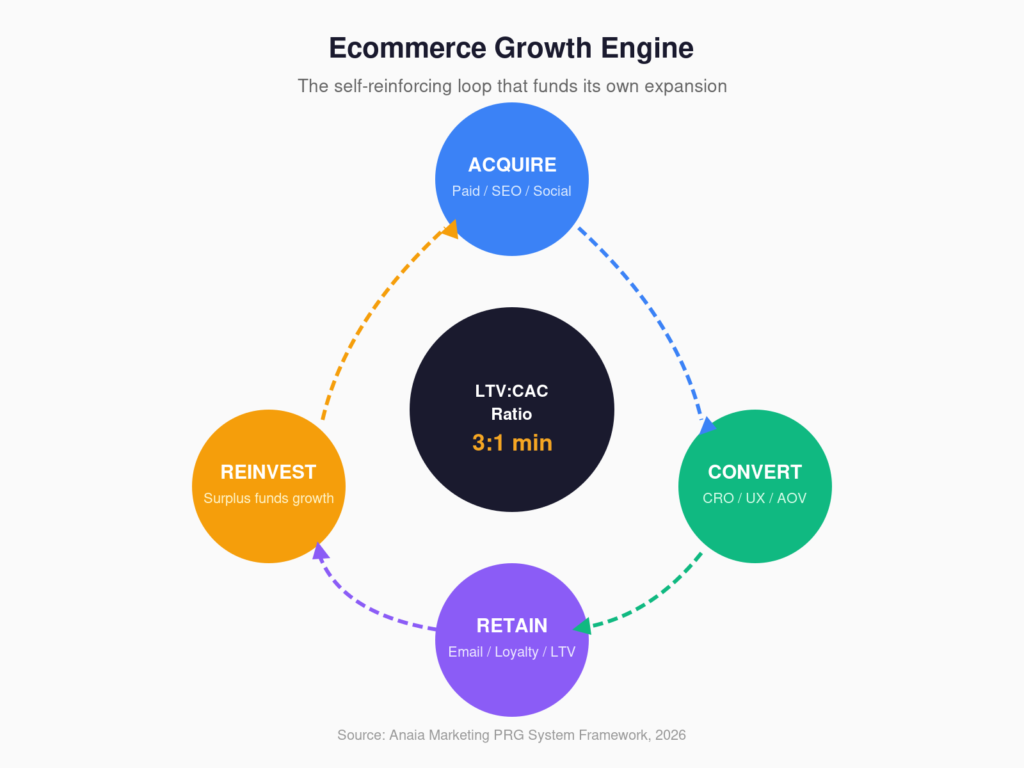
An ecommerce growth engine is a system where customer acquisition, conversion, and retention work in a self-reinforcing loop. When calibrated correctly, each paying customer reduces the effective cost of acquiring the next, creating compounding revenue that funds further growth without proportional increases in ad spend.
What is an ecommerce growth engine?
An ecommerce growth engine is not a single tactic or channel. It is a structured system that connects three business functions in sequence: traffic acquisition (paid and organic), on-site conversion, and post-purchase retention. Each function feeds the next, and each cycle through the loop generates more revenue per dollar invested than the previous one.
The concept draws from the flywheel model: lower prices attract more customers, who generate more volume, which lowers unit costs, which allows further reinvestment. For ecommerce, the equivalent loop runs through customer lifetime value. A higher LTV allows the business to bid more aggressively for acquisition, which drives volume, which improves unit economics, which unlocks more reinvestment capacity.
What distinguishes a growth engine from a standard marketing strategy is the feedback loop. Without it, every campaign starts from zero. With it, every satisfied customer compounds the next cycle. The engine does not require more inputs to produce more outputs, it becomes more efficient as it scales.
Why acquisition-only growth is losing the profitability war?
The paid acquisition model that fueled ecommerce growth from 2015 to 2022 is under structural pressure. Average customer acquisition costs are now between $68 and $84 across ecommerce categories, up more than 60% from five years ago (Mobiloud, 2026). Shopify data shows a CAC increase from $274 to $318 among mid-market brands within a single year (Shopify, 2025).
Three forces explain this shift. First, iOS privacy changes reduced the tracking accuracy of paid campaigns, increasing wasted spend across all channels. Second, large-scale entrants like Amazon, Temu, and Shein entered paid auctions at scale, inflating CPCs across search and social. Google Shopping CPCs rose 33.72% in 2025 alone. Third, a growing cohort of DTC brands now competes for the same keywords and ad placements, compressing margin at every level of the funnel.
The result is predictable. A brand spending $84 to acquire a customer who generates $90 in first-purchase gross profit is not building a business. It is operating a transaction machine that collapses the moment ad costs increase by another 10%.
Brands that shifted to an engine model, where acquisition spend is funded by retained customer revenue rather than external capital consistently outperform. Retention-led brands generate a 4.2:1 LTV:CAC ratio compared to 1.8:1 for acquisition-heavy peers at equivalent revenue levels. To understand how much of this cost pressure may be amplified by structural leaks in the existing funnel, the ecommerce revenue leaks diagnostic is a useful starting point.
The three components of a self-funding ecommerce growth engine
A self-funding growth engine has three components working in sequence. Each must reach a minimum performance threshold before the loop becomes self-sustaining. Optimizing retention before fixing conversion, or scaling acquisition before the unit economics are validated, will not produce compounding results.
| Component | Core function | Minimum viable metric |
|---|---|---|
| Traffic acquisition | Drive qualified visitors via paid, organic, and social channels | Blended CAC below first-purchase gross profit |
| On-site conversion | Convert visitors into paying customers efficiently | Conversion rate 2.5%+ for standard ecommerce |
| Post-purchase retention | Drive repeat purchases, increase AOV, and extend LTV | LTV:CAC ratio 3:1 or above |
Traffic acquisition encompasses every channel that brings visitors to the store: paid social, search ads, SEO, content marketing, email acquisition, and referral programs. The goal is not raw volume but quality: visitors who convert at or above the category average and show early signals of repeat purchase intent. Acquisition without a quality filter inflates CAC and skews cohort LTV downward.
On-site conversion is the engine’s efficiency multiplier. A 1-point improvement in conversion rate at 10,000 monthly visitors generates the same revenue lift as a 25% increase in ad spend, at zero additional acquisition cost. Product page clarity, site speed, checkout friction, and return policy transparency are the four highest-leverage conversion variables for most brands below $5 million in annual revenue.
Post-purchase retention is where compounding begins. A customer who makes a second purchase has an average lifetime value 3 to 5 times higher than a one-time buyer. When retention is strong, the LTV:CAC ratio improves automatically, giving the acquisition component more margin to operate with, without any increase in spend. This is the mechanism by which growth becomes genuinely self-funding.
For a structured overview of what drives ecommerce revenue growth at each stage, the linked analysis covers the metrics and levers in measurable detail.
How to measure if your growth engine is working
Before building or optimizing the engine, the business must be able to read its own performance. Four metrics form the minimum viable dashboard for any ecommerce growth engine. Brands that do not track all four are optimizing blind.
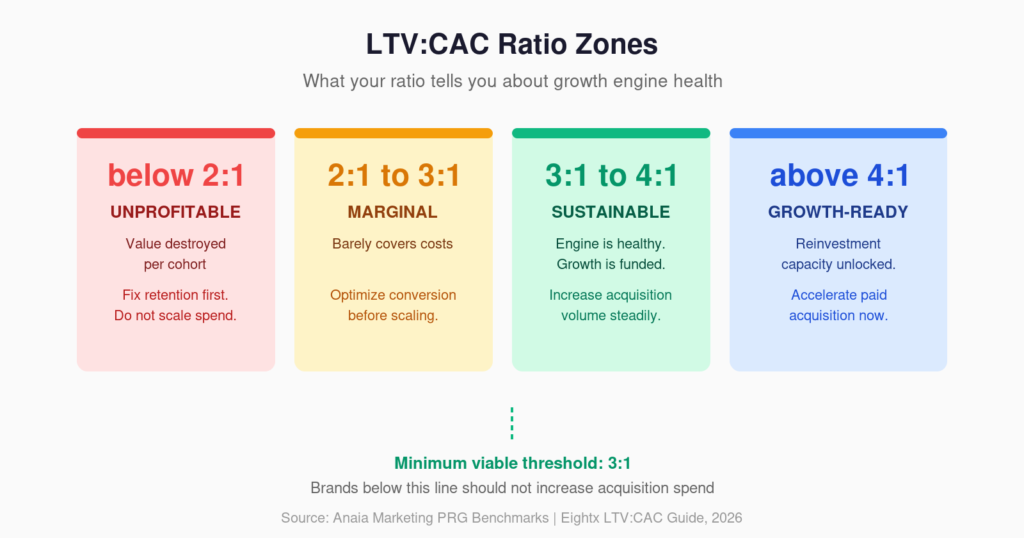
LTV:CAC ratio is the engine’s core health indicator. A ratio below 2:1 means the business destroys value with each cohort over time. At 3:1, the engine is sustainable. At 4:1 or above, the business can aggressively reinvest in acquisition. LTV should initially be calculated on a 12-month window, then extended to 24 months as cohort data matures.
Repeat purchase rate measures what percentage of customers make a second purchase within 12 months. Industry medians sit between 25% and 40%, depending on category and price point. Brands with a repeat rate above 40% typically have enough LTV headroom to outbid competitors on acquisition without sacrificing margin.
CAC payback period indicates how many months of gross profit are required to recover acquisition spend. For a self-funding growth engine, the payback period must not exceed the average customer reorder interval. A brand with a 6-month payback and a 4-month reorder cycle can fund its own expansion from existing customer revenue. A brand with a 9-month payback and a 6-month reorder cycle cannot.
Contribution margin by cohort tracks whether each acquisition cohort generates positive cash flow over time, after accounting for cost of goods sold, fulfillment, returns, and customer service. This metric surfaces hidden costs that standard CAC calculations frequently omit, and it is the most reliable predictor of long-term engine viability.
How to build your ecommerce growth engine, step by step
Building the engine is a sequenced process. Each step creates the foundation for the next. Skipping steps or executing them out of order is the most common reason growth engines fail to compound.
Step 1: Establish baseline unit economics
Before any optimization, calculate the current LTV:CAC ratio, repeat purchase rate, CAC payback period, and contribution margin per cohort. This takes two to three weeks of structured data work. The output is a clear picture of where value is being created and where it is being lost.
Step 2: Fix the conversion floor
If the site conversion rate is below 2%, no retention strategy will generate enough volume to matter. Prioritize the conversion layer first: product page quality, mobile experience, checkout friction, and trust signals. A 0.5-point conversion lift doubles the efficiency of every acquisition dollar already in market.
Step 3: Install a retention infrastructure
A minimum viable retention stack includes post-purchase email flows (confirmation, product onboarding, reorder reminder), a segmented loyalty mechanism, and a win-back sequence for lapsed customers at 60, 90, and 180 days. For most brands starting from zero, this infrastructure alone increases repeat purchase rate by 8 to 15 percentage points within the first six months.
Step 4: Calibrate acquisition bids to LTV, not first-purchase margin
Once retention data is available at 90 days or more, feed 12-month LTV estimates back into paid channel bidding strategy. A customer acquired through organic search with a 12-month LTV of $320 justifies a substantially higher bid than the first-order conversion value suggests. Brands that bid against LTV rather than first-order revenue consistently generate lower effective CAC at equal or higher spend levels.
Step 5: Reinvest the retention surplus into acquisition
When the LTV:CAC ratio reaches 3:1 or above, the engine is generating enough free cash from retained customers to fund new acquisition without external capital. This is the self-funding threshold. At this point, increasing acquisition spend accelerates the flywheel rather than depleting margin reserves.
For the operational playbook that maps this process across traffic, conversion, and retention with specific channel tactics, the complete ecommerce growth strategy guide provides the sequenced framework.
The mistakes that stall a growth engine
The most common reason an ecommerce growth engine fails to compound is not a traffic problem. It is a sequencing or measurement problem. Brands invest in retention programs before fixing conversion, or scale acquisition before the unit economics support it.
Four patterns account for the majority of stalled engines.
Treating the three levers as independent channels
Acquisition, conversion, and retention have separate owners in most ecommerce organizations. Channel managers optimize for individual KPIs: ROAS for paid, conversion rate for UX, and open rate for email. The growth engine requires all three to optimize against a single shared metric: LTV:CAC. Without a shared metric, each team creates local optima that conflict with overall engine efficiency.
Measuring LTV on too short a window
A 30-day or 60-day LTV figure is not a reliable predictor of long-term customer value. Brands that set acquisition bids against 30-day LTV systematically undervalue high-quality customers who take longer to reorder, and overpay for discount-seeking customers who convert quickly but never return. Build 90-day and 12-month cohort tables before adjusting any bidding strategy.
Under-investing in the first post-purchase experience
The decision to make a second purchase is largely formed within 72 hours of the first delivery. The post-purchase email sequence, unboxing experience, and product quality signal together set the retention trajectory from day one. Brands that optimize acquisition but neglect the week after delivery consistently see flat repeat rates regardless of how much they invest in loyalty programs.
Scaling acquisition before unit economics are validated
A brand that accelerates paid spend at a 2:1 LTV:CAC ratio does not generate a better ratio at scale. It generates larger losses at scale. Validate the engine at a controlled volume first. When it performs at 3:1 or above, the investment in acceleration is justified.
The Bottom Line on the ecommerce growth engine
An ecommerce growth engine is not an advanced strategy reserved for brands that have already crossed $10 million in revenue. It is the minimum viable operating model for any brand that intends to grow profitably in a market where customer acquisition costs will continue rising. The brands that generate durable revenue over the next three to five years will not be those with the largest ad budgets. They will be the ones whose customer retention funds their own acquisition.
The core insight is structural, not tactical. Acquisition, conversion, and retention are not three separate marketing problems. They are three components of a single revenue system, and they must be diagnosed and optimized together. When the LTV:CAC ratio is below 3:1, there is a specific place in the loop where value is leaking, and finding it is always faster than adding more spend upstream.
The PRG System that Anaia applies across its client engagements is built on this principle. Every intervention begins with a full diagnostic of the engine: where is acquisition quality degrading cohort LTV, where is the conversion layer losing customers who would have been high-value repeaters, and where is the retention infrastructure failing to convert one-time buyers into the compounding customer base the engine needs. The diagnostic reveals the highest-leverage fix, which is rarely the most obvious one.
Building the engine takes three to six months of sequenced, measured work. Sustaining it requires continuous cohort measurement and a willingness to adjust all three levers in coordination. What it does not require is an ever-increasing ad budget. A properly calibrated growth engine funds itself. The goal is always to make the next acquisition cheaper than the last.
FAQ
Q1 : What is an ecommerce growth engine?
An ecommerce growth engine is a system that connects customer acquisition, on-site conversion, and post-purchase retention in a self-reinforcing loop. Each cycle through the loop improves unit economics, allowing the business to fund further acquisition from retained customer revenue rather than proportional increases in ad spend or external capital.
Q2 : What is a healthy LTV:CAC ratio for ecommerce?
A 3:1 LTV:CAC ratio is the minimum benchmark for a sustainable ecommerce growth engine. At this level, every dollar spent on acquisition generates three dollars in lifetime customer value. Ratios below 2:1 indicate that the business destroys value with each new customer cohort, regardless of top-line revenue or ROAS figures.
Q3 : How long does it take to build a self-funding growth engine?
Most brands reach the self-funding threshold within three to six months of implementing a structured retention stack, assuming baseline conversion rates are already above 2%. The timeline depends on the current CAC payback period and reorder frequency. Brands with a payback period under six months and a strong post-purchase sequence typically reach the 3:1 LTV:CAC threshold fastest.
Q4 : What is the most important metric in a growth engine?
The LTV:CAC ratio is the most important metric because it captures the efficiency of the entire system, not just one lever. A strong ROAS with a poor LTV:CAC ratio signals that the acquisition channel is working but the retention layer is leaking value. The LTV:CAC ratio surfaces this misalignment immediately and points to where to intervene.
Q5 : Why does a 5% retention increase produce such a large profitability gain?
Retained customers contribute margin on every reorder without the CAC being charged again. According to Yotpo’s 2026 ecommerce benchmarks, a 5% increase in retention correlates with a 25% to 95% increase in profitability. The wide range reflects differences in margin structure and AOV by category, but the directional logic is consistent: each additional purchase from an existing customer has a near-zero effective acquisition cost.
Q6 : Can a small ecommerce brand under $1 million in revenue build a growth engine?
Yes. The growth engine model applies at any revenue level. The primary constraint for smaller brands is data volume: reliable cohort LTV calculations require at least 200 to 300 customers per acquisition channel. Below that threshold, directional signals are more useful than statistically significant conclusions. The retention infrastructure (post-purchase email flows, win-back sequences) can and should be implemented from the first 100 customers.

Passionate about the future of search, co-founder of Anaia Marketing and an SEO strategist focused on helping brands grow through search, strategic content, and AI-driven visibility. Her work sits at the intersection of technical SEO, content systems, and emerging AI search optimization, with a focus on building sustainable organic growth.


Pingback: How to define your ICP in B2B: a step-by-step guide