
Ecommerce growth trends worth acting on in 2026 carry a traceable revenue signal, not just headlines. Two currently qualify: AI-referred traffic to US retail sites, up 393% year over year and converting 42% better than other channels, and overall US ecommerce sales, which grew 12.4% year over year in Q2 2026, the fastest pace since 2021.
What makes an ecommerce growth trend worth acting on?
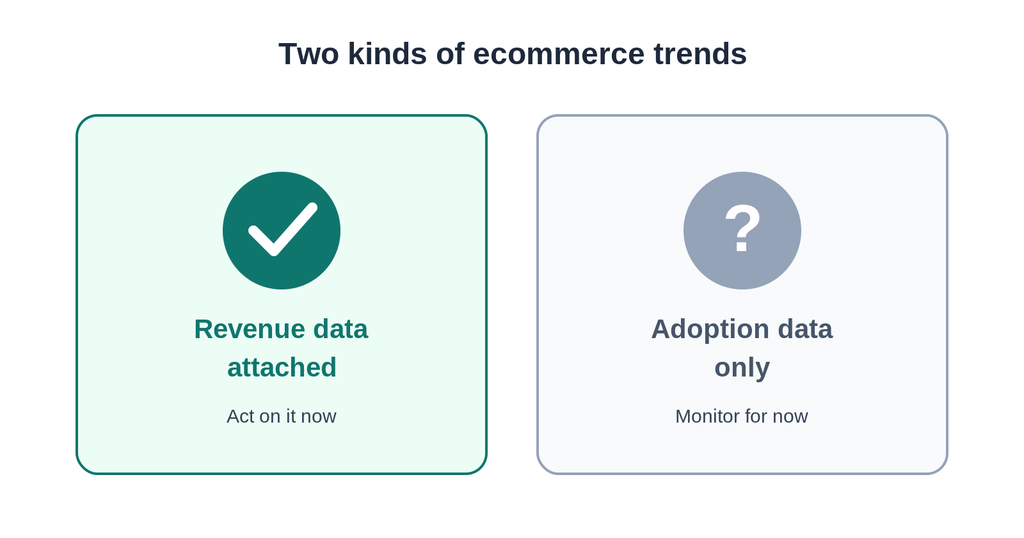
An ecommerce growth trend is worth acting on when it comes with a measurable revenue or conversion metric tied to a dated, named source, not adoption or attention data alone. A trend supported only by a statistic like “X% of brands are testing this” signals interest, not proof that it moves revenue.
That distinction matters because most 2026 trend roundups mix the two freely. A report on social commerce might cite the number of shoppers active on a platform in the same paragraph as a conversion lift figure, without flagging that one measures reach and the other measures results. Anaia Marketing’s PRG System (Predictable Revenue Growth) applies this filter before recommending a trend to a client: does the data show a lift in conversion rate, average order value or revenue per visit, and is that lift specific enough to a store’s own segment, whether under 500k€, between 500k€ and 2M€, or above 2M€ in annual revenue, to act on.
How fast is ecommerce actually growing in 2026?
US ecommerce sales grew 12.4% year over year in Q2 2026, reaching $329.53 billion, more than double the 5.3% growth rate of total US retail sales, according to Digital Commerce 360’s analysis of US Department of Commerce data. That was the fastest ecommerce growth pace recorded since 2021.
Ecommerce accounted for 23.5% of total US retail sales in Q2 2026, the second-highest quarterly penetration on record after Q4 2025’s 25.0%. Globally, Statista projects B2C ecommerce revenue will reach $3.86 trillion in 2026, a 6.0% increase over 2025, with a projected compound annual growth rate of 6.20% through 2030. Growth at this pace isn’t evenly distributed. It concentrates in specific channels and behaviors, which is exactly where the next two trends come in.
Which ecommerce growth trend shows the clearest revenue signal right now?
AI-referred traffic is the ecommerce growth trend with the clearest revenue signal available right now. It grew 393% year over year in the first quarter of 2026, converted 42% better than non-AI traffic in March 2026, a record high, and drove sessions 48% longer with 13% more pages viewed per visit, according to Adobe Digital Insights.
That conversion gap is a reversal from a year earlier, when AI-referred traffic converted 38% worse than other channels in March 2025, per the same Adobe report. The catch is visibility, not intent. Adobe’s audit of US retail sites found that homepages average a 75% machine-readability score and individual product pages only 66%, meaning roughly a third of product page content is currently invisible to the large language models sending this traffic. Closing that visibility gap is a generative engine optimization problem as much as a growth one, and it compounds with the broader discipline behind an ecommerce growth engine: traffic that already exists needs to convert before a store spends on acquiring more of it.
Which ecommerce growth trends are still unproven?
Several trends featured prominently in 2026 industry roundups are supported by adoption or survey data rather than a revenue benchmark. Agentic AI purchasing, social commerce native checkout and digital product passports fall into this category as of this year.
Salesforce, for instance, reports that close to a third of US consumers say they would let an AI assistant make a purchase for them. That’s a stated intent, not a measured conversion rate. Digital product passports are advancing because of EU regulation (the Ecodesign for Sustainable Products Regulation), not because of a documented revenue effect, and they become mandatory for certain product categories starting in 2026 and 2027 regardless of their commercial impact. None of this means these trends are wrong to watch. It means they belong in a “monitor” category rather than a “prioritize now” category until a dated, sourced metric exists.
| Trend | Type of evidence available | Source |
|---|---|---|
| AI-referred traffic to retail sites | Revenue and conversion data: +393% traffic, +42% conversion | Adobe Digital Insights, 2026 |
| Overall US ecommerce sales growth | Revenue data: +12.4% year over year, Q2 2026 | Digital Commerce 360, 2026 |
| Agentic AI purchasing | Consumer intent survey only, no conversion benchmark | Adobe Digital Insights, 2026 |
| Social commerce native checkout | Adoption and usage stats, limited revenue benchmark | Salesforce, 2026 |
| Digital product passports | Regulatory mandate, no revenue data yet | Akeneo / EU ESPR, 2025-2026 |
What ecommerce growth trends actually move revenue for small and mid-size stores?
For most stores under 2M€ in annual revenue, the trend that moves revenue fastest is fixing AI visibility on existing product pages, since it requires content changes rather than new acquisition spend. A store doesn’t need a share of the 393% national traffic number; it needs to check whether its own analytics already show AI referral traffic arriving and underconverting.
A store under 500k€ in revenue typically has capacity to run one structured test at a time, which argues for starting with the single trend showing the clearest data, AI traffic and visibility, before adding a second initiative. A store between 500k€ and 2M€ can usually run that same test alongside a secondary one, such as checking whether social commerce traffic, where it already exists, converts differently from other paid channels. Above 2M€, a team can typically test two or three trends in parallel, provided each one is still measured against its own conversion and revenue numbers rather than adopted because a competitor announced it.
How should a store decide which ecommerce growth trend to test first?
A store should test the ecommerce growth trend that passes three filters: it has a dated revenue or conversion metric behind it, that behavior already shows up somewhere in the store’s own traffic or sales data, and the first test can ship within 30 to 60 days without a platform rebuild.
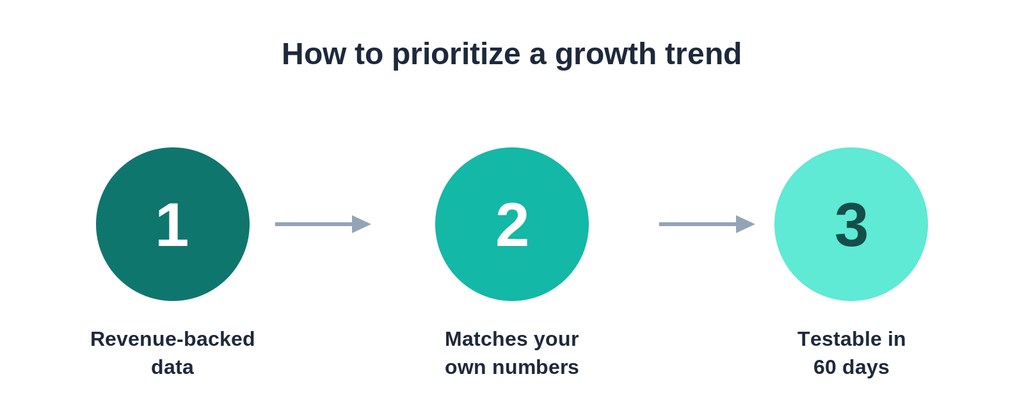
Ranking trends against these three filters, in that order, prevents two common mistakes: chasing a trend with strong headlines but no store-specific evidence, and stalling on a trend that would help but seems to require a six-month rebuild before it can even be tested. The same fast-testing discipline behind ecommerce growth hacking applies directly here: isolate one trend, ship a version that can be measured within weeks, and only commit further budget once the store’s own numbers confirm what the aggregate data suggested. The same logic applies to the broader set of ecommerce growth tactics a team already has queued: trends get slotted into that list, not treated as a separate track. Reviewing the shortlist quarterly, rather than annually, keeps pace with how quickly a trend can move from unproven to revenue-backed, roughly the speed at which AI traffic shifted over the past twelve months.
Putting ecommerce growth trends into perspective
Most ecommerce growth trend content published in 2026 optimizes for being comprehensive (ten trends, twelve trends, a full landscape view) rather than for telling a reader which of those trends actually has a number attached to it. That approach isn’t wrong, but it leaves the reader to do the filtering work that should have been done for them: separating a genuine revenue signal from a plausible-sounding prediction.
The data available right now points to two trends with a clear, dated revenue signal: the acceleration in overall ecommerce growth itself, and the shift toward AI-referred traffic converting better than every other channel it’s compared against. Everything else covered in this year’s trend lists (agentic purchasing, social commerce checkout, sustainability passports) is real and worth monitoring, but it hasn’t yet cleared the bar of a documented conversion or revenue lift. Treating those two categories differently isn’t caution for its own sake. It’s what keeps a limited testing budget pointed at the changes most likely to show up in next quarter’s revenue.
For a store trying to decide where its own next test should go, the fastest path is checking whether the store’s existing data already reflects the two proven trends, rather than starting from an industry list. AI traffic and overall ecommerce growth rarely arrive evenly across every store. A team that isolates where they already show up, and where they don’t, has a more useful starting point than any general ranking of trends could provide.
Frequently asked questions
Q1 : What is the biggest ecommerce growth trend in 2026?
AI-referred traffic is currently the ecommerce growth trend with the strongest documented revenue signal: it grew 393% year over year in Q1 2026 and converted 42% better than non-AI traffic in March 2026, according to Adobe Digital Insights. Overall ecommerce sales growth, up 12.4% year over year in Q2 2026, is the second clearest signal.
Q2 : Is social commerce actually driving ecommerce revenue growth in 2026?
Social commerce shows strong adoption data, but publicly available 2026 reporting ties it mainly to usage and reach rather than a documented conversion or revenue benchmark comparable to what exists for AI traffic. It remains a trend worth monitoring on a store’s own data rather than adopting on industry adoption figures alone.
Q3 : How much is ecommerce growing compared to overall retail in 2026?
US ecommerce sales grew 12.4% year over year in Q2 2026, more than double the 5.3% growth rate of total US retail sales, according to Digital Commerce 360. Ecommerce accounted for 23.5% of total US retail sales in that quarter.
Q4 : Should a small ecommerce store prioritize AI search traffic in 2026?
A store under 500k€ in annual revenue should first check whether AI-referred traffic already appears in its own analytics before prioritizing it. If it does, fixing product page visibility for AI crawlers is typically the fastest available lift, since it requires content changes rather than new acquisition spend.
Q5 : What ecommerce growth trends have no revenue data yet?
Agentic AI purchasing and digital product passports currently have adoption, survey or regulatory data behind them, not a documented revenue or conversion benchmark. Both are worth monitoring quarterly rather than prioritizing immediately.
Q6 : How often should a store revisit its ecommerce growth trend priorities?
Quarterly review is enough for most stores, since that’s roughly the pace at which a trend like AI-referred traffic moved from a minor signal to a documented double-digit conversion advantage over the past year.

Passionate about the future of search, co-founder of Anaia Marketing and an SEO strategist focused on helping brands grow through search, strategic content, and AI-driven visibility. Her work sits at the intersection of technical SEO, content systems, and emerging AI search optimization, with a focus on building sustainable organic growth.