
An ecommerce growth accelerator is usually sold as a program: a vendor or agency that takes over a store’s marketplace strategy for a cut of the profit. Most stores do not need to buy one. What actually accelerates ecommerce growth is a small set of internal frameworks, applied in the right order, that compound revenue faster than adding new channels or new vendors.
What does “ecommerce growth accelerator” actually mean?
An ecommerce growth accelerator, in its most common commercial sense, is a paid partner (an agency, a marketplace accelerator, or a platform bundle) that manages acquisition, retention, and operations in exchange for a fee or profit share. In this guide, the term is used differently: as the set of internal frameworks a store can run itself to get the same compounding effect without hiring a named program.
That distinction matters because it changes what a store should actually build. A paid accelerator sells speed through outsourced headcount and pooled data across its portfolio of brands. An internal framework sells speed through sequencing: doing the highest-leverage fix first, measuring it properly, and only adding the next layer once the first one is working. Both can accelerate growth. Only one requires giving up margin or control to get there.
Why does growth stall before it accelerates?
Growth stalls when a store adds spend or channels faster than it fixes the leaks already in its funnel, and 2026 makes that mistake more expensive than it used to be. Marketing budgets have flatlined at 7.7% of company revenue for the second consecutive year, according to Gartner’s 2025 CMO Spend Survey, so a store cannot simply outspend a plateau (Gartner, 2025).
At the same time, the market a store is competing in keeps expanding. US e-commerce sales reached 17.1% of total retail in the second quarter of 2026 and grew 12.2% year over year, more than three times the growth rate of total retail sales, according to the US Census Bureau (Census Bureau, 2026). More of the pie is moving online, but flat budgets mean a store has to extract more revenue from the traffic and customers it already has rather than buying its way to a bigger share.
That is the actual argument for frameworks over “adding an accelerator”: every euro spent fixing an existing leak (a confusing checkout, a customer who never comes back, a manual process eating a operator’s week) returns more than the marginal euro spent acquiring a colder new customer through a channel that is not getting any cheaper.
The four frameworks that accelerate ecommerce growth
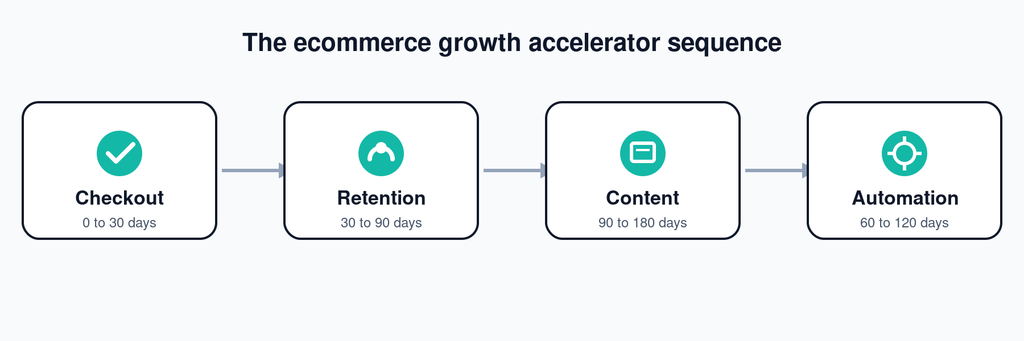
Four frameworks account for most of the compounding revenue a store can generate without hiring an outside accelerator: fixing checkout friction, building a retention and average order value layer, shifting part of acquisition to owned content, and automating the workflows that eat operator time.
| Framework | What it fixes | Primary lever | Typical signal window |
|---|---|---|---|
| Checkout and conversion tightening | Cart abandonment at the point of highest intent | Remove fee surprises, shorten forms, cut forced account creation | 30 to 60 days |
| Retention and AOV layer | Revenue lost to one-time buyers | Post-purchase flows, bundles, loyalty triggers | 60 to 90 days |
| Content-led acquisition | Overreliance on paid channels | Pillar and cluster content, internal linking, organic discovery | 90 to 180 days |
| Workflow automation | Manual reporting and ad allocation slowing execution | Automated alerts, dynamic budget rules, inventory triggers | 60 to 120 days |
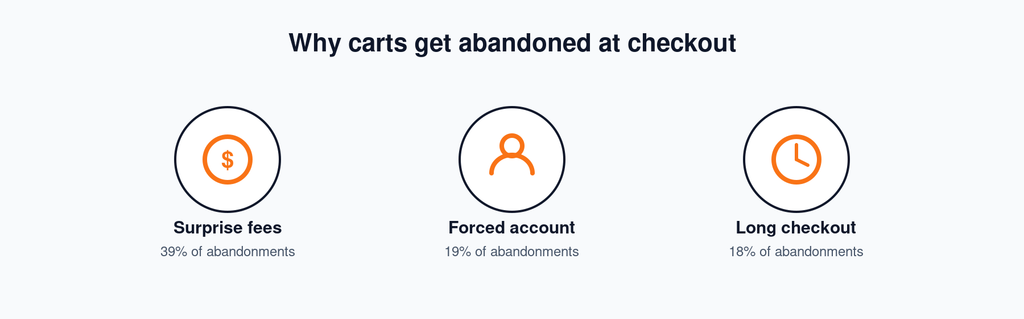
Checkout tightening comes first because the data on where money is actually lost is unusually clear. Baymard Institute’s meta-analysis of 50 published studies puts average cart abandonment at 70.22%, and the leading causes are structural, not emotional: 39% of shoppers abandon when hit with unexpected costs at checkout, 19% abandon because the site forces account creation, and 18% abandon because the checkout flow is too long or complicated (Baymard Institute, 2025). None of those three causes requires a new channel, a new vendor, or a bigger budget to fix. For the full mechanics of diagnosing and fixing each cause, see our guide to ecommerce conversion rate optimization.
The retention and AOV layer works on the same logic from a different angle: a repeat customer already trusts the store enough to buy once, so converting them again costs less than acquiring someone new, and that gap widens as acquisition channels get more competitive rather than cheaper. Post-purchase email or SMS flows, product bundles, and simple loyalty triggers are the highest-leverage starting points because they do not require new traffic to work.
Content-led acquisition addresses the channel-dependency problem directly. Adobe’s Digital Economy Index found that the 2025 holiday shopping season drove a record $257.8 billion in US online spending, with consumers increasingly discovering products through generative AI tools and social channels rather than paid search alone (Adobe, 2026). A store that has invested in pillar content and internal linking captures that shift in discovery behavior; a store that depends entirely on paid acquisition pays full price for every visit regardless of how discovery is changing.
Workflow automation comes last, not because it matters less, but because it needs the first three frameworks generating enough volume and consistent data to be worth automating. Automating a reporting process or an ad-bidding rule before the underlying checkout and retention mechanics are fixed just automates the wrong decisions faster.
How should a store sequence these frameworks over 90 days?
A store should sequence these frameworks by leverage and dependency, not by preference: checkout fixes in the first 30 days, retention and AOV work layered on top by day 60, content and automation started in parallel once the first two are stable.
- Days 1 to 30: Audit the checkout flow against the three leading abandonment causes (fee surprises, forced accounts, form length) and ship fixes for the two costing the most volume. This is the same fast-testing discipline behind our ecommerce growth hacking framework: one hypothesis, one metric, a clean kill-or-scale decision.
- Days 30 to 60: Build or repair post-purchase flows and one bundle or loyalty trigger. Measure repeat purchase rate and AOV separately; a framework that raises one while quietly lowering the other is not actually working.
- Days 60 to 90: Start one pillar content piece tied to the store’s highest-intent search terms, and identify the first manual process (weekly reporting, ad budget reallocation, low-stock alerts) worth automating once checkout and retention data are stable enough to automate against.
Sequenced this way, the four frameworks stop behaving like four separate projects competing for the same team’s attention and start functioning as a single compounding revenue engine: each layer makes the next one more valuable rather than adding unrelated work.
When does a growth partner make more sense than another framework?
Internal frameworks stop being enough when the constraint is not knowledge but capacity: a store knows exactly what to fix but does not have the hours, the specialized skill (a checkout developer, a content strategist), or the executive bandwidth to run all four frameworks at once.
That is a fair reason to bring in outside help. It is not a fair reason to buy a named “accelerator” product on the promise that a label alone will fix a leaking funnel. The honest test is whether a store can name the specific framework it lacks capacity for, or whether it is looking for a program to make the decision-making itself go away. The first is a resourcing problem with a clear fix. The second usually means the underlying diagnosis has not been done yet, which a paid program will not do any better than an internal audit would.
What actually accelerates ecommerce growth
The label “ecommerce growth accelerator” gets sold as a product because a product is easier to buy than discipline is to build. The frameworks in this guide are the opposite of a shortcut: they require picking the highest-leverage fix, shipping it, measuring it honestly, and only then adding the next layer. That sequencing is unglamorous, but it is also the part most paid accelerator programs are actually doing behind the scenes when they work.
What makes the difference between a store that stalls and one that compounds is rarely a missing channel or a missing vendor relationship. It is usually a checkout flow nobody has audited in a year, a repeat-customer flow that was set up once and never revisited, or a reporting process still done by hand every Monday. Fixing those in order costs far less than any accelerator program and produces a version of the business that does not depend on an outside partner to keep growing.
Track the impact with revenue growth metrics tied to each framework specifically, rather than aggregate traffic or session counts that cannot show which lever is actually working. A store that can point to which framework moved which number is in a much stronger position to decide, later, whether it ever needs to buy acceleration at all.
Frequently asked questions
Q1 : What is an ecommerce growth accelerator?
Commercially, it is a paid partner, an agency, marketplace accelerator, or platform bundle, that manages acquisition, retention, and operations for a fee or profit share. Used as a framework, it refers instead to the internal sequence of checkout, retention, content, and automation fixes that produce the same compounding effect without an outside program.
Q2 : How is an ecommerce growth accelerator different from a growth strategy?
A growth strategy sets the destination: which markets, channels, and customer segments to pursue over a year or more. An accelerator framework is the operating sequence that gets there faster by fixing the highest-leverage leaks first, in a defined order, rather than spreading effort evenly across every possible lever at once.
Q3 : How long does it take to see results from these frameworks?
Checkout fixes typically show a signal within 30 to 60 days because they act on existing high-intent traffic. Retention and AOV layers need 60 to 90 days to show a clean repeat-purchase signal. Content-led acquisition takes 90 to 180 days, since organic discovery compounds slower than a direct funnel fix.
Q4 : Does a store need to hire an accelerator program to grow faster?
No. A named program makes sense when the constraint is capacity (missing hours or specialized skill for a framework a store has already diagnosed), not when it is used as a substitute for diagnosing the funnel in the first place. Most of the leverage described here does not require outside ownership of the strategy.
Q5 : Which framework should a store prioritize first?
Checkout and conversion tightening, because it acts on visitors who have already decided to buy and because the leading causes of abandonment (surprise costs, forced accounts, long forms) are well documented and fixable without new traffic or new budget (Baymard Institute, 2025).
Q6 : What metrics show that a growth framework is actually working?
Track each framework against its own metric rather than a blended dashboard: cart abandonment rate and checkout completion for framework one, repeat purchase rate and AOV for framework two, organic sessions and assisted conversions for framework three, and hours saved or error rate for framework four.

Founder & CEO of Anaia Marketing, Dominique doesn’t manage traffic. He builds systems that grow revenue, predictably, measurably, without guesswork. With 15+ years at the intersection of search strategy and editorial precision, he focuses on what matters : turning organic growth into a compounding asset that moves revenue.