
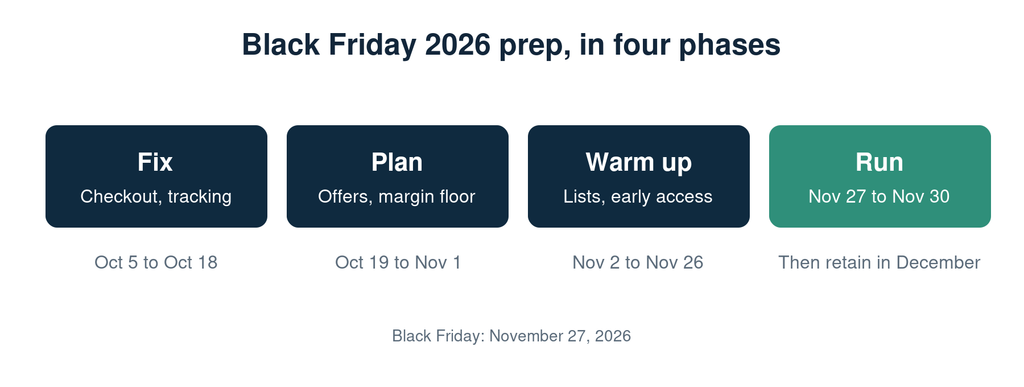
A Black Friday ecommerce strategy is a dated plan that fixes checkout and tracking first, sets a margin floor before any discount, warms up owned audiences early, and measures profit per order instead of revenue alone. Black Friday 2026 falls on November 27, which leaves about eight weeks to execute it in four phases.
What is a good Black Friday ecommerce strategy?
A good Black Friday ecommerce strategy protects contribution margin while capturing peak demand. It combines a technical readiness check, a limited and margin-safe offer, early access for the email and SMS list, a tested checkout, and a post-event retention flow. Discount depth is the last variable to decide, not the first.
Top-ranking guides for this keyword mostly list tactics (popups, bundles, influencers, live chat) without a sequence, a margin rule or a timeline. That is the gap. The same tactics produce very different profit depending on when they are prepared and what they cost per order.
The holiday ecommerce strategy that follows is built for stores between roughly 500k and 2M euros in annual revenue, where one weak week of execution can erase the margin of a whole quarter. It maps to the revenue-first logic of Anaia’s PRG System (Predictable Revenue Growth): diagnose where revenue leaks, fix those points, then add volume.
How big is the Black Friday opportunity in 2026?
The opportunity is large and still growing. In the US, Adobe measured $11.8 billion in online Black Friday spend in 2025 (up 9.1%), $14.25 billion on Cyber Monday (up 7.1%) and $44.2 billion across the five-day Cyber Week (up 7.7%). Adobe projected $253.4 billion for the full November to December season.
Shopify merchants alone generated $14.6 billion in global sales over the 2025 weekend, up 27% from 2024, with an average order value of $114.70 and 16% of orders crossing borders (Shopify, December 2025). Peak demand reached $5.1 million per minute on Black Friday.
Two details matter for planning. First, Adobe reported that mobile accounted for 57.5% of Cyber Monday sales, so every checkout test needs a mobile pass. Second, buy now pay later spend hit $1.03 billion on Cyber Monday, with 79.4% of those transactions on mobile. A mobile checkout without a visible installment option risks losing those orders.
These are 2025 results. Adobe and Shopify will publish new forecasts and figures as the 2026 season approaches, so benchmark plans against 2025 actuals and update them when 2026 data is released.
When should a store start preparing for Black Friday?
A store should start eight to ten weeks before Black Friday. For a November 27 date, that means early October. The first two weeks go to fixing the funnel and the tracking, because those fixes raise the return of every later dollar of traffic.
| Phase | Dates (2026) | Main goal | Output |
|---|---|---|---|
| Fix | Oct 5 to Oct 18 | Remove leaks and verify tracking | Faster mobile pages, clean analytics, tested checkout |
| Plan | Oct 19 to Nov 1 | Decide offers and margin floor | Offer calendar, inventory plan, creative briefs |
| Warm up | Nov 2 to Nov 26 | Grow and prime owned lists | Waitlist, early access, scheduled flows |
| Run | Nov 27 to Nov 30 | Execute and monitor hourly | Live dashboard, stock and support coverage |
The later phases only work if the first one is finished. A store that skips the fix phase pays for traffic that meets a slow or confusing checkout.
Phase 1: What should be fixed in the first two weeks?
Fix checkout friction, page speed on mobile, and conversion tracking. Baymard Institute documents that the average cart abandonment rate is 70.22%, and the top reason is extra costs at checkout (40%), followed by forced account creation (18%) and a long or complicated process (17%). Those are fixable before November.
The checks to complete are: total cost visible before the final step, guest checkout enabled, wallet and installment payment methods live, returns policy visible on product pages, and server and theme performance tested under load. Anaia’s analysis of ecommerce revenue leaks shows where these losses usually concentrate, and the broader ecommerce conversion rate optimization guide covers the testing method.
Tracking deserves the same attention. Confirm that purchase events, discount codes and traffic sources are recorded correctly, otherwise the post-event analysis will credit the wrong channels.
How deep should Black Friday discounts go?
Discounts should go only as deep as the margin floor allows, and often shallower than competitors. Klaviyo data from Black Friday Cyber Monday 2025 shows average discounts fell 10% year over year, daily averages never exceeded 30% across its brands, and brands with the smallest discounts grew fastest (+14%).
The margin floor is a number set before the offer is designed. A simple method: take the product price, subtract cost of goods, shipping, payment fees, expected returns and the blended acquisition cost, then confirm the discounted order still leaves a positive contribution. Any offer below zero contribution is a customer acquisition bet, and it needs a repeat purchase target to justify it.
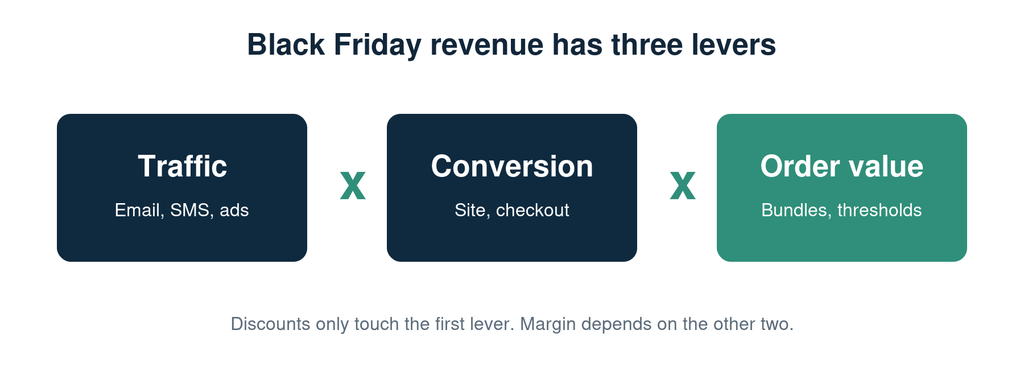
Because revenue is traffic multiplied by conversion multiplied by order value, a discount only acts on one lever. Bundles, free shipping thresholds and gift-with-purchase mechanics raise order value without cutting the price of every unit. For a longer list of tested mechanics, see Anaia’s ecommerce growth tactics.
| Offer type | Effect on margin | Best use |
|---|---|---|
| Sitewide percentage off | Highest margin loss | Clearance or acquisition-led stores with proven repeat rate |
| Tiered threshold (spend more, save more) | Lifts order value | Stores with several complementary products |
| Bundle | Protects unit margin | Consumables and accessories |
| Gift with purchase | Low cost, high perceived value | Brands with cheap, desirable add-ons |
| Early access, no discount | Zero margin loss | Best customers and loyalty members |
How should email and SMS be used for holiday ecommerce marketing?
Email and SMS should carry the largest share of planned revenue, because owned channels cost the least per order at peak time. Klaviyo reported that email and text drove 42% of total revenue across its brands during the 2025 event, rising to 43% on peak days, and that cross-channel shoppers placed 11% more orders.
The same report shows repeat customer revenue grew 13.5% year over year, faster than new buyer revenue. For holiday ecommerce marketing, this argues for a list-first plan: segment past buyers, recent browsers and high-value customers, then give each group a different message and a different offer.
A practical sequence for the warm-up phase follows. In early November, open a waitlist with a clear reason to join (early access or a bonus). In the last week of November, send a teaser with the preview of the offers. On the morning of November 27, send to best customers first, then the full list, then SMS reminders for abandoned carts later the same day. Cap frequency so the list is not exhausted before Cyber Monday.
Which paid and social channels deserve budget during Black Friday?
Paid channels deserve budget where the store already converts well, and only after the funnel fix. Retargeting past visitors and the email list usually returns more than cold prospecting, because auction costs typically rise at peak and cold audiences convert at lower rates in a crowded week.
Practical rules for paid and social:
- Set campaign budgets by contribution margin, not revenue alone, using the margin floor from the plan phase.
- Pre-load creative and landing pages, and test them in October when auction prices are lower.
- Exclude existing customers from prospecting where possible, and give them the early access offer instead.
- Keep a reserve of budget for Cyber Monday, when Adobe recorded the biggest single day of online spend.
Search and AI discovery matter too. Adobe reported AI traffic to retail sites grew 670% on Cyber Monday 2025 versus the previous year, so product pages with clear specifications, pricing, shipping details and reviews are more likely to be cited and clicked from AI assistants. This is a good reason to revisit product content in the fix phase.
How should a store run Black Friday week itself?
Run the week with a live dashboard, a stock plan and a support plan. Check revenue, conversion rate, average order value, margin and stock every hour on November 27 and 28, and decide in advance what triggers a change (for example, pausing an offer when a hero product drops below a set stock level).
Operations decide the customer experience after the sale. Confirm carrier cut-off dates, publish delivery estimates on product pages, and brief customer support on the offers and the returns policy. Slow delivery was the second most common reason for abandonment in Baymard’s data (20%), so delivery promises affect conversion directly.
What should happen after Cyber Monday?
After Cyber Monday, the plan shifts from acquisition to retention. First-time Black Friday buyers are a segment worth protecting, because a second purchase within 60 to 90 days can turn a thin-margin order into a profitable customer. A welcome flow, a post-purchase education email and a replenishment or complementary product offer should be ready before the event.
Run a review within ten days. Compare actual results to the plan on four numbers: contribution margin per order, new versus returning customers, email and SMS share of revenue, and cost per acquired customer. Anaia’s ecommerce growth framework explains how to turn these numbers into the next quarter’s priorities.
Putting Black Friday 2026 into perspective
Black Friday rewards preparation more than creativity. The demand is there: US shoppers spent $11.8 billion online on Black Friday 2025 and $14.25 billion on Cyber Monday, and Shopify merchants grew 27% year over year. Stores that capture that demand profitably are the ones that fixed their checkout in October, not the ones that discounted the deepest in November.
The most useful lesson in the 2025 data is that heavier discounting did not win. Klaviyo brands with the smallest discounts grew fastest, and repeat customer revenue outpaced new buyer revenue. That points to a clear order of operations for any brand: protect margin with a floor, win the owned channels with early access, and use paid budget where conversion is already proven.
Anaia Marketing applies the same sequence in its PRG System: find the leak, fix it, then scale what works. For a store that has eight weeks left, the highest-return action this week is to find the largest leak in the funnel before the first Black Friday dollar is spent. The first two phases decide most of the outcome, and they can start today.
Black Friday ecommerce strategy FAQ
Q1 : When should a Black Friday ecommerce strategy start?
Preparation should start eight to ten weeks before the event. For Black Friday on November 27, 2026, that means early October. The first two weeks go to checkout fixes and tracking, then offers and inventory, then list warm-up in November, and execution from November 27 to November 30.
Q2 : How much should a store discount on Black Friday?
Only as much as the margin floor allows. Klaviyo’s 2025 data shows average discounts fell 10% and never exceeded 30% daily across its brands, while the smallest-discount brands grew fastest (+14%). Calculate contribution margin per order after costs before choosing any percentage.
Q3 : What is the difference between a Black Friday strategy and a holiday ecommerce strategy?
Black Friday strategy covers the November 27 to November 30 sales window. A holiday ecommerce strategy covers the full November and December season, including gifting periods, shipping deadlines and post-event retention. Adobe projected $253.4 billion in US online holiday spend for 2025, so Black Friday is one peak inside a longer season.
Q4 : Which channels work best for Black Friday ecommerce marketing?
Email and SMS usually return the most, since Klaviyo found they drove 42% of revenue across its brands in 2025. Retargeting and branded search follow. Cold prospecting is the most expensive channel at peak, so budget it last and test creative in October.
Q5 : How can a store measure whether Black Friday was profitable?
Measure contribution margin per order, not revenue alone. Compare actual results with the plan on margin, new versus returning customers, email and SMS share of revenue, and cost per acquired customer. Review within ten days, then track second-purchase rate over the next 60 to 90 days.
Find the leak before the traffic arrives, and protect margin on November 27 Run the Anaia revenue growth diagnostic in 15 minutes and identify your largest revenue leak. Start the diagnostic →

Passionate about the future of search, co-founder of Anaia Marketing and an SEO strategist focused on helping brands grow through search, strategic content, and AI-driven visibility. Her work sits at the intersection of technical SEO, content systems, and emerging AI search optimization, with a focus on building sustainable organic growth.