AI marketing workflows are connected sequences of marketing tasks in which AI handles the repeatable steps (research, drafting, segmentation, reporting, optimization) while humans set the strategy and approve what goes live. The goal is not more output. It is faster, more consistent execution on the activities that actually drive revenue.
What are AI marketing workflows, exactly?
An AI marketing workflow is a repeatable process of the revenue growth method where a defined trigger starts a chain of tasks, AI executes the steps that follow clear rules or patterns, a human reviews the output at a set checkpoint, and the result feeds a measurable business outcome.
The distinction matters because most teams confuse AI usage with AI workflows. Asking a chatbot to write a product description is usage. A workflow is what happens when a new product lands in the catalog, an AI step drafts the description from the spec sheet and brand guidelines, a merchandiser approves or edits it within 24 hours, and the page publishes with tracking already attached.
The first saves ten minutes once. The second saves ten minutes on every product, forever, and produces consistent pages.
Every functional AI marketing workflow shares four components:
| Component | What it does | Example (content refresh) |
|---|---|---|
| Trigger | Starts the workflow automatically | An article loses 20% of its organic clicks over 90 days |
| AI execution | Handles the repeatable work | Pulls the current SERP, flags outdated sections, drafts updates |
| Human checkpoint | Protects brand, accuracy, and judgment | An editor validates facts, tone, and sources before republishing |
| Outcome metric | Proves the workflow is worth running | Clicks and assisted conversions 60 days after refresh |
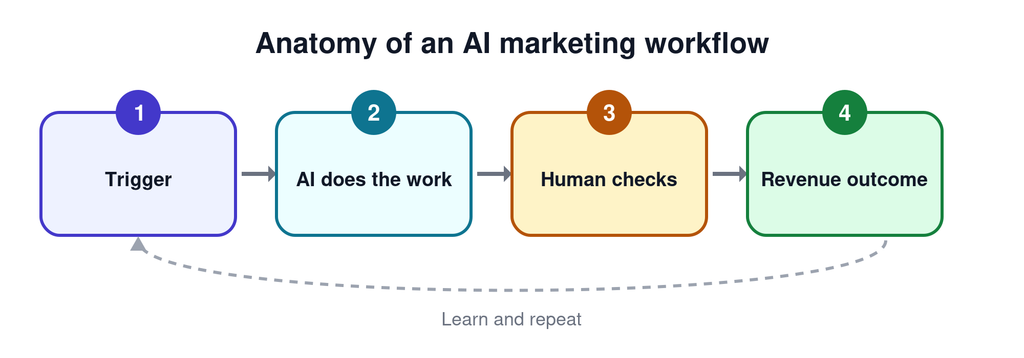
If one of the four is missing, the process breaks in a predictable way. No trigger means someone has to remember to start it. No human checkpoint means brand and accuracy risk. No outcome metric means nobody knows whether the automation is helping or just producing activity.
Why do most AI marketing efforts fail to show revenue impact?
Most AI marketing efforts fail to show revenue impact because they automate isolated tasks instead of complete workflows. Teams produce more assets, but the process around those assets (approval, publishing, distribution, measurement) stays manual and slow, so the bottleneck simply moves downstream.
McKinsey describes this pattern precisely. In its April 2026 analysis of agentic AI in marketing, the firm notes that marketers were among the earliest adopters of generative AI, but because most tools solve isolated tasks, the result has been “a patchwork of disconnected pilots” that increase activity without meaningful enterprise-wide benefits (McKinsey, April 2026). The same article reports that nearly 90% of CMOs are experimenting with AI use cases, while less than 10% have captured value across end-to-end workflows.
The broader data points in the same direction. McKinsey’s global survey on the state of AI found that 62% of organizations are at least experimenting with AI agents, but most have not yet scaled them in any single function (McKinsey, The state of AI, November 2025).
On the ground, HubSpot’s 2026 survey of more than 1,500 marketers shows the same gap between usage and results. Only 26.5% of marketers say AI has significantly increased their productivity, while 83.5% say they are now expected to produce more content (HubSpot, January 2026). Higher expectations, modest gains: that is what task-level automation delivers when the workflow around it has not changed.
The practical lesson is simple. The unit of automation is the workflow, not the task. A faster first draft is worth very little if it still waits a week in someone’s inbox.
Which AI marketing workflows should teams automate first?
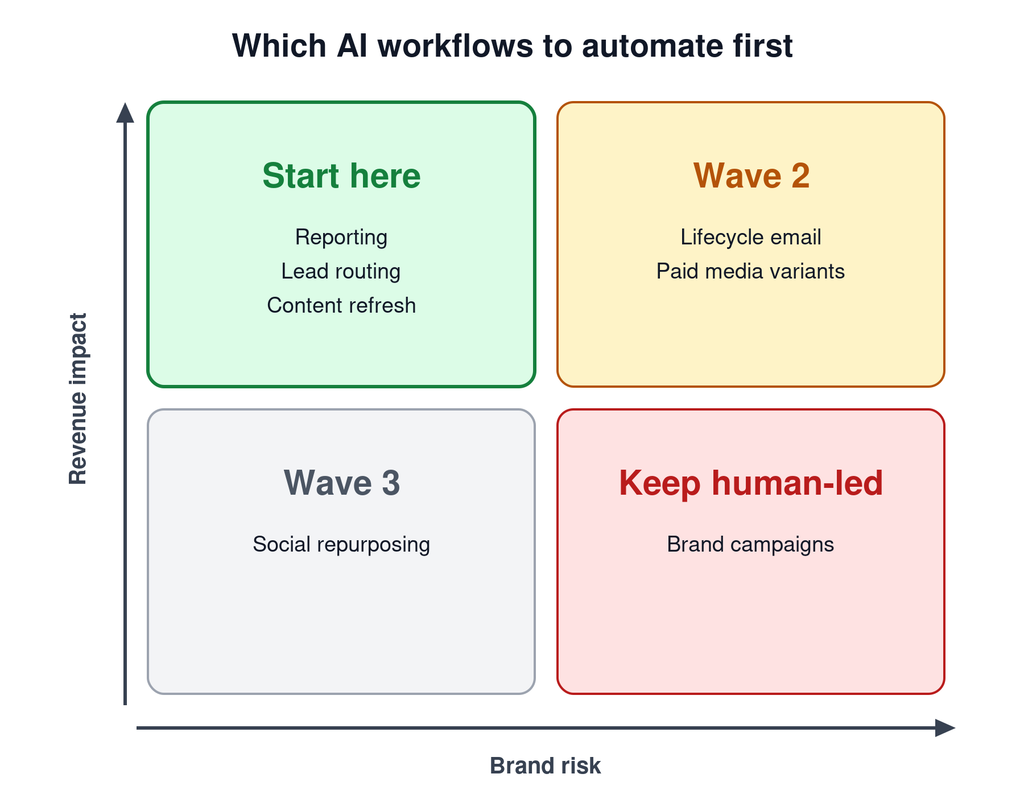
Teams should automate first the workflows that are high in revenue impact, low in brand risk, and already well documented. In practice, that usually means performance reporting, lead scoring and routing, and content refresh, then lifecycle email, before touching brand campaigns or creative concepts.
The table below ranks eight common AI marketing workflows by where they usually sit on revenue proximity and brand risk. It reflects the prioritization logic Anaia applies in its AI Workflow Factory pillar, not a universal benchmark: the right order for a given business depends on where its revenue is leaking today.
| Workflow | Revenue proximity | Brand risk | Typical starting priority |
|---|---|---|---|
| Weekly performance reporting and anomaly alerts | High (faster decisions on spend) | Very low | Start here |
| Lead scoring and routing (B2B) | Very high | Low | Start here |
| Content refresh for declining pages | High (recovers existing traffic) | Low to medium | Start here |
| Lifecycle email (abandoned cart, post-purchase, win-back) | Very high | Medium | Wave 2 |
| Product description and category copy at scale | Medium to high | Medium | Wave 2 |
| Paid media variant testing | High | Medium | Wave 2 |
| Social content repurposing | Low to medium | Medium | Wave 3 |
| Brand campaign concepts | Indirect | High | Keep human-led, AI assists |
Why reporting comes first
Reporting is the least glamorous workflow and the one with the fastest payback. An AI step that pulls data from analytics, ad platforms, and the CRM every Monday, flags anything that moved more than a set threshold, and drafts a one-paragraph explanation turns hours of manual work into a ten-minute review. More importantly, it shortens the time between a problem appearing and someone acting on it. To be useful, the report has to track the right numbers: the revenue growth metrics that actually predict revenue, not traffic and impressions alone.
Why content refresh beats content volume
With 83.5% of marketers under pressure to produce more content (HubSpot, January 2026), the instinct is to use AI to publish more. The better return usually comes from updating what already ranks. A refresh workflow protects traffic that already converts, and it carries far less risk than flooding a site with new AI-drafted pages that nobody has time to review properly.
Why lifecycle email sits in wave 2
Lifecycle flows sit very close to revenue, which is exactly why they deserve a careful rollout. A personalization error in an abandoned cart email reaches a customer directly. Once the team has proven its checkpoint process on lower-risk workflows, lifecycle email becomes one of the highest-return areas to automate, especially for stores already building an ecommerce growth engine based on repeat customers.
How do you build an AI marketing workflow step by step?
An AI marketing workflow is built in five steps: map the current process in detail, identify which steps are repeatable, redesign the process with explicit human checkpoints, pilot on one workflow with one metric, and only then scale to the next wave. Skipping the mapping step is the most common reason automation fails.
This sequence is consistent with the five-step method McKinsey outlines for agentic marketing workflows, which starts with a detailed taxonomy of current marketing activities and ends with prioritizing rollout in waves (McKinsey, April 2026). Adapted for a growth team of five to fifty people, it looks like this:
- Map the current workflow at task level. List every step, who does it, which tool it touches, and how long it takes. A content refresh that “takes a day” often breaks down into fifteen micro-tasks, and only a few of them need human judgment.
- Separate repeatable steps from judgment steps. Data pulls, formatting, first drafts, tagging, and QA checklists are repeatable. Positioning, final approval, and anything involving legal or pricing claims are judgment steps.
- Redesign with explicit checkpoints. Decide exactly where a human reviews, what they check, and how long they have. A checkpoint without a deadline becomes the new bottleneck.
- Pilot one workflow against one metric. Choose a single outcome (time to publish, refreshed-page clicks, lead response time) and measure it for 30 to 60 days before and after. This is the same test-and-learn logic behind a sound ecommerce growth hacking framework: one hypothesis, one metric, a clear decision at the end.
- Scale in waves. Once the first workflow is stable, reuse its components (prompts, brand guidelines, QA checklist) for the next one. Reuse is where the real efficiency gain compounds.
What does a well-governed AI marketing workflow look like?
A well-governed AI marketing workflow has a named owner, documented brand and accuracy rules the AI must follow, a human approval step before anything customer-facing goes live, and a log of what was changed and why. Governance is not a brake on automation; it is what allows teams to trust the output enough to scale it.
McKinsey’s survey of 35 CMOs of Fortune 250 consumer and technology companies found that their primary concerns were brand and legal governance, human capability gaps, technology underinvestment, and data bottlenecks (McKinsey, April 2026). Smaller teams face the same risks at a different scale: one wrong claim in an automated email, one off-brand product page, one report built on a broken data source.
Four rules keep those risks contained. First, every workflow has a single human owner who is accountable for its output. Second, the AI works from a written brand and compliance brief, not from memory or improvisation. Third, anything that reaches a customer passes a human checkpoint, at least until the workflow has a proven error rate. Fourth, every workflow is reviewed quarterly against its outcome metric, and retired if it no longer earns its place.
There is also a quality argument. HubSpot’s 2026 data shows that 62.7% of marketers believe more unique, human-centered content is needed to compete with AI content (HubSpot, January 2026). The human checkpoint is where that distinctiveness gets added. It is not overhead.
How does the AI Workflow Factory fit into the PRG System?
The AI Workflow Factory is one of the three pillars of Anaia’s PRG System (Predictable Revenue Growth), alongside the Content Growth Engine and the CRO Revenue System. Its role is to identify, build, and govern the AI marketing workflows that remove friction from revenue-generating activities, starting from a diagnosis rather than a tool list.
The difference with a tool-first approach lies in the order of operations. Most teams pick an AI tool, then look for tasks to give it. The AI Workflow Factory starts from the Revenue Growth Diagnosis, which locates the largest revenue leak (slow lead response, decaying content, weak lifecycle emails, reporting that arrives too late to act on), and then builds the workflow that addresses that specific leak. The step-by-step Anaia method follows the same sequence for every account: diagnose first, activate one pillar, confirm the revenue impact, then extend.
This approach applies to e-commerce businesses at every stage (under 500k€, 500k to 2M€, above 2M€), to SaaS scale-ups, and to SMBs in transformation. What changes is which workflow comes first, not the discipline behind it.
The real takeaway on AI marketing workflows
The data from 2026 is unusually consistent. Almost every marketing team now uses AI, and very few have turned that usage into measurable business results. The gap is not about models, prompts, or tools. It is about workflow design: whether AI is plugged into a complete process with a trigger, a human checkpoint, and a revenue metric, or simply used to produce more assets that still move through the same slow system.
That makes the path forward less complicated than the AI conversation often suggests. Start with the workflows that sit close to revenue and far from brand risk, such as reporting, lead routing, and content refresh. Map them in detail before automating anything. Put a named human owner and a clear checkpoint on every workflow, and measure one outcome before and after. Then reuse what works for the next wave.
Teams that follow this discipline tend to gain something more valuable than time saved: they gain speed of decision. Problems surface earlier, fixes ship faster, and the people on the team spend their hours on positioning, creative judgment, and customer insight rather than on copy-pasting data between tools.
The first question is not which AI tool to buy. It is where revenue is leaking today, and which workflow would close that leak fastest. Answering that question with data, before automating anything, is what separates AI marketing workflows that pay for themselves from those that simply add activity.
Frequently asked questions about AI marketing workflows
Q1 : What is the difference between AI marketing automation and AI marketing workflows?
Traditional marketing automation follows fixed rules: if a contact does X, send email Y. AI marketing workflows add steps that interpret, generate, or decide, such as drafting a personalized message, scoring a lead from unstructured data, or summarizing why a metric moved. The workflow still needs rules and human checkpoints; AI simply handles steps that rules alone could not.
Q2 : Which AI marketing workflow should a small team start with?
Most small teams should start with automated weekly performance reporting. It carries almost no brand risk, saves hours every week, and makes every later decision faster. Once reporting is reliable, content refresh or lead routing are strong second candidates because they sit close to revenue and have clear, measurable outcomes.
Q3 : Do AI marketing workflows replace marketers?
No. They shift where marketers spend their time. AI handles repeatable execution such as data pulls, first drafts, and variant generation, while people keep ownership of strategy, positioning, final approval, and customer insight. McKinsey’s April 2026 analysis frames the model as marketers designing and overseeing AI-driven execution, not being removed from it.
Q4 : How do you measure the ROI of an AI marketing workflow?
Pick one outcome metric per workflow before launching it, measure a 30 to 60 day baseline, then compare the same period after launch. Useful metrics include time to publish, lead response time, clicks recovered on refreshed pages, and revenue attributed to lifecycle flows. Time saved alone is not enough; it must connect to a revenue indicator.
Q5 : What are AI agents in marketing workflows?
AI agents are systems that can execute multistep tasks with some autonomy, such as monitoring campaign data, adjusting variants, or preparing a draft plan, rather than answering one prompt at a time. McKinsey’s November 2025 survey found 62% of organizations experimenting with agents, but few scaling them. In marketing, agents work best inside workflows with clear rules and human oversight.

Founder & CEO of Anaia Marketing, Dominique doesn’t manage traffic. He builds systems that grow revenue, predictably, measurably, without guesswork. With 15+ years at the intersection of search strategy and editorial precision, he focuses on what matters : turning organic growth into a compounding asset that moves revenue.