

Ecommerce customer acquisition is the work of attracting people who have never bought from a store and turning them into first-time buyers, at a cost the business can afford.
The practical test is simple: what a new customer costs (customer acquisition cost, or CAC) must stay below what that customer is worth in profit. This guide gives twelve strategies grouped in four stages, then a formula to calculate how much a new customer can cost before growth starts losing money.
Brands that want a second opinion on where acquisition spend leaks can run the Revenue Growth Diagnosis and get a prioritized list for your ecommerce store.
What ecommerce customer acquisition covers
Acquisition starts when a stranger first meets the brand and ends at the first paid order. Everything after that (second purchase, loyalty, win-back) belongs to retention, which has its own economics and is only touched here where it changes what acquisition can afford.
Two definitions matter before any tactic:
Customer acquisition cost is total marketing and sales spend divided by the number of new customers won in the same period. Rivo’s guide lists what should be inside that spend: ad spend, marketing salaries, software, creative production, and first-order discounts or free shipping offered to new buyers (Rivo). Leaving any of these out understates the true cost.
Cost per acquisition (CPA) is narrower. commercetools describes CPA as the cost tied to one campaign or channel, which feeds into the overall CAC (commercetools). A Meta campaign can show a $30 CPA while the store’s CAC is $55 once creative, tools and discounts are counted.
How much can a new customer cost? The break-even CAC formula
Most guides give averages. Rivo reports that across the Shopify brands it works with, average ecommerce CAC sits around $70, with verticals ranging from roughly $53 (food and beverage) to $91 (jewelry) (Rivo). That is a vendor-observed range from its own customer base, not a neutral industry benchmark, and it says nothing about whether $70 is affordable for a given store. Affordability depends on margin and repeat behavior.
A reproducible way to find the ceiling:
- Contribution per order = average order value (AOV) minus product cost, shipping and fulfillment, payment fees and a returns allowance.
- Break-even CAC on the first order = contribution per order.
- Break-even CAC at a payback window = contribution per order multiplied by the expected number of orders per new customer within that window.
The worked example below uses a fictional store, not a client.
| Line | Fictional store |
|---|---|
| Average order value | $80.00 |
| Product cost | $28.00 |
| Shipping and fulfillment | $9.00 |
| Payment fees (3% of AOV) | $2.40 |
| Returns allowance | $3.60 |
| Contribution per order | $37.00 |
| Expected orders per new customer in 180 days (assumption) | 1.4 |
| Break-even CAC at 180 days | $51.80 |
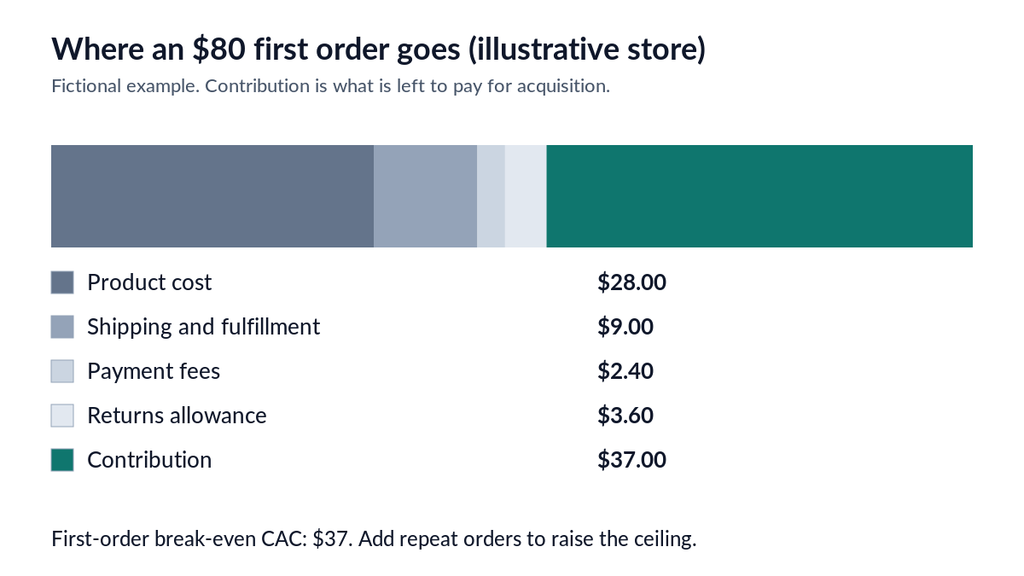
Bar showing how an $80 first order splits into product cost, shipping, payment fees, returns and $37 contribution in a fictional store.
If this store’s CAC is $50, the first order loses $13 (37 minus 50) and the customer only turns profitable if the repeat order arrives. At 180 days the store keeps about $1.80 per customer, which is thin. A CAC of $50 is therefore acceptable only if repeat behavior is real and measured, not assumed.
A second guardrail comes from the lifetime value to CAC ratio. commercetools and Rivo both cite 3:1 as a common minimum. Using the formula commercetools gives (average purchase value, times purchases per year, times years of customer life) and a one-year revenue view of $128 for this store ($80 plus 0.6 repeat orders at $80), a 3:1 ratio caps CAC near $43. That rule is stricter than the 180-day payback ceiling, and it works on revenue, not profit. Use both numbers: the lower one sets the conservative limit, the higher one shows how much room exists if repeat purchases materialize.
One more distinction avoids a common reporting error. Blended CAC divides all spend by all new customers. If the store runs promotions that bring returning buyers, or brand search that harvests demand created elsewhere, blended CAC looks better than the cost of reaching genuinely new people. Track blended CAC for the board and paid CAC by channel for budget decisions.
A related efficiency check is the marketing efficiency ratio (MER), expressed here as revenue divided by marketing spend. Klaviyo cites Jones Road Beauty’s CMO targeting a 5, which means marketing spend is 20% of sales (Klaviyo). In the fictional store above, $30,000 of monthly spend and 600 new customers at $80 produce a CAC of $50 and a new-customer MER of 1.6, a reminder that a healthy sitewide MER can hide expensive new-customer acquisition.
Twelve ecommerce customer acquisition strategies in four stages
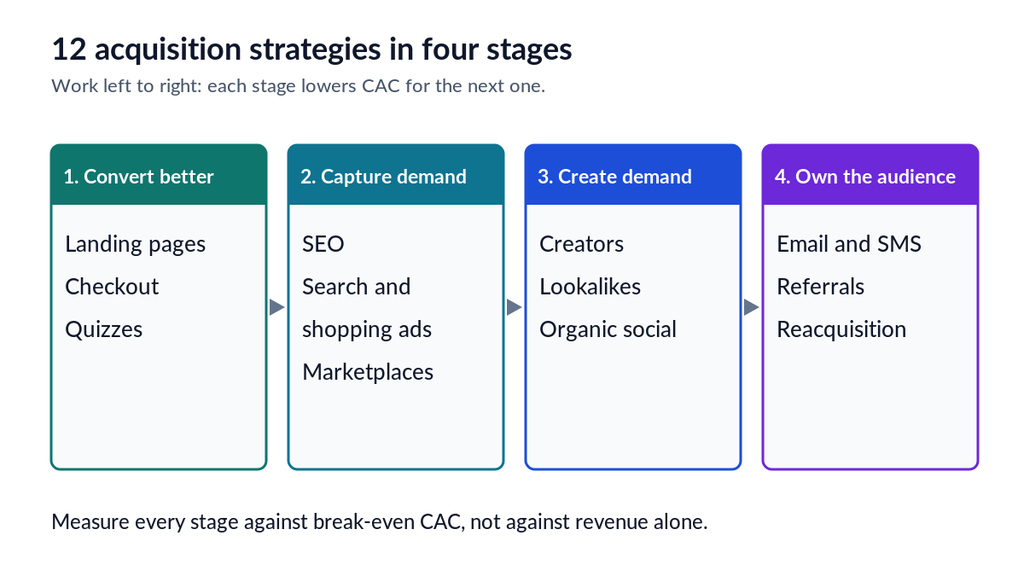
The order matters. Fixing conversion first lowers CAC for every channel that follows; owning the audience last protects the gains from platform cost swings.
Schema of four stages: convert better, capture demand, create demand, own the audience, with the twelve strategies grouped under them
Stage 1: convert better
1. Match landing pages to the ad or search that brought the visit. Traffic that lands on a generic homepage wastes the click already paid for. Send each campaign to a page that repeats its promise, shows the offer and loads fast on mobile. Rivo points out that moving conversion from 2% to 3% makes a large difference to CAC, since the same spend then buys 50% more orders (Rivo). The ecommerce conversion rate optimization guide covers how to test these pages.
2. Remove checkout friction. Guest checkout, autofill and several payment options are the baseline Rivo recommends. Each abandoned cart is acquisition spend already paid and not recovered.
3. Replace the blanket discount pop-up with a quiz or guided finder. Klaviyo quotes Jebbit’s CEO saying a quiz that recommends products and asks for an email at the end lifts lead capture by 20% on average. That figure is an expert claim, not an audited study, so treat it as a hypothesis to test. The benefit that holds regardless is first-party data about what each visitor wants, which feeds the targeting in stage 3.
Stage 2: capture demand that already exists
4. Build category, collection and product pages around high-intent searches. Shoppers searching for a product type are already close to buying. Klaviyo lists keyword research, alt text, collection pages for high-volume terms and E-E-A-T-aligned content as the main SEO tactics for stores. Product pages deserve special attention: the ecommerce product page SEO framework explains how to structure them.
5. Run search and shopping ads on proven product and brand terms. Paid search targets people who typed what the store sells. It scales only as far as margin allows, so cap bids using the break-even CAC calculated above rather than a platform’s own target return.
6. List on marketplaces where shoppers already compare products. Marketplaces give smaller brands an existing audience without building payment and delivery systems. Klaviyo notes that customer reviews matter more than any other factor in a first purchase, so marketplace listings should be optimized to earn them. Check margin after marketplace fees before counting these orders as cheap customers.
Stage 3: create demand efficiently
7. Partner with creators whose audience matches the product. Klaviyo’s example is ButcherBox working with a TikTok creator on a recipe video that reached 2.5 million views and carried an offer for new subscribers. The lesson is the structure: a trusted voice, a use case, and a trackable offer. Brief creators with a unique code or link so CAC can be measured per partner.
8. Seed lookalike audiences with first-party data. Instead of targeting broad interests, upload a segment of recent purchasers (Klaviyo’s example is buyers of a similar product in the last six months) and let the ad platform find people who resemble them. Better seed data usually means lower CAC on Meta, TikTok and Google.
9. Post organic social content that earns discovery. Klaviyo’s own research found that 29% of consumers discover new retail and ecommerce brands through organic social, with younger shoppers more likely to do so. Organic content is slow, but it feeds creator and paid efforts with proven angles.
Stage 4: own the audience
10. Capture email and SMS with a value exchange. Email and SMS are owned channels: the list and data belong to the brand and cost little per send. Klaviyo’s advice is to personalize on what the subscriber told the brand, not just to send a coupon. A welcome flow that explains the brand and recommends products converts first-time visitors without another ad click.
11. Launch a referral program. commercetools and Rivo both list referrals among the levers that lower CAC, because a recommendation from a friend arrives pre-trusted. Reward both sides, and count the reward in CAC.
12. Plan for reacquisition, not only retention. Klaviyo quotes a consultant who notes that the customer won a year ago is not the same customer today, so brands should keep re-earning purchases through relevant offers. Raising lifetime value raises the break-even CAC calculated above, which is often easier than cutting CAC. The ecommerce profitability guide shows how margin and repeat purchase interact.
How to choose and test: a simple allocation rule
Not every store needs all twelve at once. Start with the stage that fixes the biggest gap:
| If the data shows | Start with |
|---|---|
| Conversion rate stuck, high cart abandonment | Stage 1, strategies 1 to 3 |
| Little non-brand search traffic | Stage 2, strategies 4 to 6 |
| Paid CAC rising, same audiences saturated | Stage 3, strategies 7 to 9 |
| High CAC, few repeat buyers | Stage 4, strategies 10 to 12 |
For testing, Klaviyo quotes Jones Road Beauty’s CMO recommending that 80 to 85% of the digital budget go to proven tactics and about 10% to new ones. That is one operator’s rule of thumb, so adopt it as a starting point and adjust once the store has its own test results. Document each test with a hypothesis, a budget cap and a CAC target taken from the break-even calculation, so a “win” means profitable customers and not only cheaper clicks. For campaign ideas to feed these tests, see ecommerce marketing ideas, and for how acquisition fits the wider plan, the ecommerce marketing strategy guide.
Customer acquisition checklist for the next 30 days
- Calculate contribution per order and break-even CAC, first order and 180 days.
- Separate blended CAC from paid CAC by channel.
- Pick one stage from the table above and run two tests inside the 10% test budget.
- Tag every creator, referral and email source so CAC can be traced.
- Review results monthly against break-even CAC, not revenue alone.
Acquisition is a margin decision
Customer acquisition works when the cost of a new customer stays below what that customer contributes, and when the store knows both numbers. The averages published by software vendors are useful context, but the ceiling for any store comes from its own margin, return rate and repeat behavior. Fix conversion first, capture existing demand second, create new demand only with a measured budget, and build owned channels so the next customer costs less than the last.
Anaia Marketing builds this logic into its Predictable Revenue Growth (PRG) System, which starts with a diagnosis of where acquisition spend and conversion are leaking revenue. Start your Revenue Growth Diagnosis to find the first fix worth making.
Frequently asked questions
Q1. What is a good customer acquisition cost for ecommerce?
A good CAC is one that sits below break-even for the store’s own margins and repeat rate. Rivo reports an average near $70 across the Shopify brands it works with, with verticals between about $53 and $91, but that range comes from one vendor’s customer base. Calculate contribution per order and compare CAC with the 180-day ceiling before borrowing a benchmark.
Q2. What is the difference between CAC and CPA?
CAC covers all marketing and sales costs divided by new customers, while CPA measures the cost of one action or conversion from a specific campaign or channel. commercetools describes CPA as a building block of overall CAC. A campaign can look efficient on CPA while the store’s CAC stays high because creative, tools and discounts sit outside the ad platform.
Q3. What is an example of ecommerce customer acquisition?
A shopper sees a creator video, visits a collection page, joins an email list through a product quiz and buys with a first-order offer. Each step is an acquisition touchpoint. Klaviyo’s ButcherBox example shows the pattern: a creator video with a new-subscriber offer that drove brand awareness and sign-ups.
Q4. What LTV to CAC ratio should an ecommerce store target?
A ratio of at least 3:1 is the common guideline cited by commercetools and Rivo, meaning each customer should generate about three times the cost of acquiring them. The ratio uses revenue unless defined otherwise, so also check payback in contribution profit, as the worked example above does.
Q5. How can an ecommerce store lower CAC without cutting ad spend?
Raise conversion rate, improve landing pages and checkout, capture first-party data for better targeting, and add referral and email flows that recover visitors who did not buy. Raising lifetime value through repeat purchases also increases the CAC the store can afford.

Founder & CEO of Anaia Marketing, Dominique doesn’t manage traffic. He builds systems that grow revenue, predictably, measurably, without guesswork. With 15+ years at the intersection of search strategy and editorial precision, he focuses on what matters : turning organic growth into a compounding asset that moves revenue.