

Ecommerce profitability is the share of revenue a store keeps after product cost, shipping, fees, returns and customer acquisition. A store grows profitably when each extra order adds contribution margin, not only revenue. Discounts, paid traffic and free shipping raise sales fast and erase margin just as fast.
What is ecommerce profitability, and why does revenue growth not guarantee it?
Ecommerce profitability describes how much profit a store earns from each dollar of sales after all variable costs and acquisition spend. Revenue growth does not guarantee it, because every added order carries product cost, shipping, payment fees, returns and ad spend. When those costs rise faster than revenue, growth shrinks profit.
Most guides on this topic list tactics: bundles, loyalty programs, cheaper shipping. Few start from the order itself. The visual below follows a single $100 order through its costs. The numbers are an illustration, not a benchmark, but the structure applies to any store.
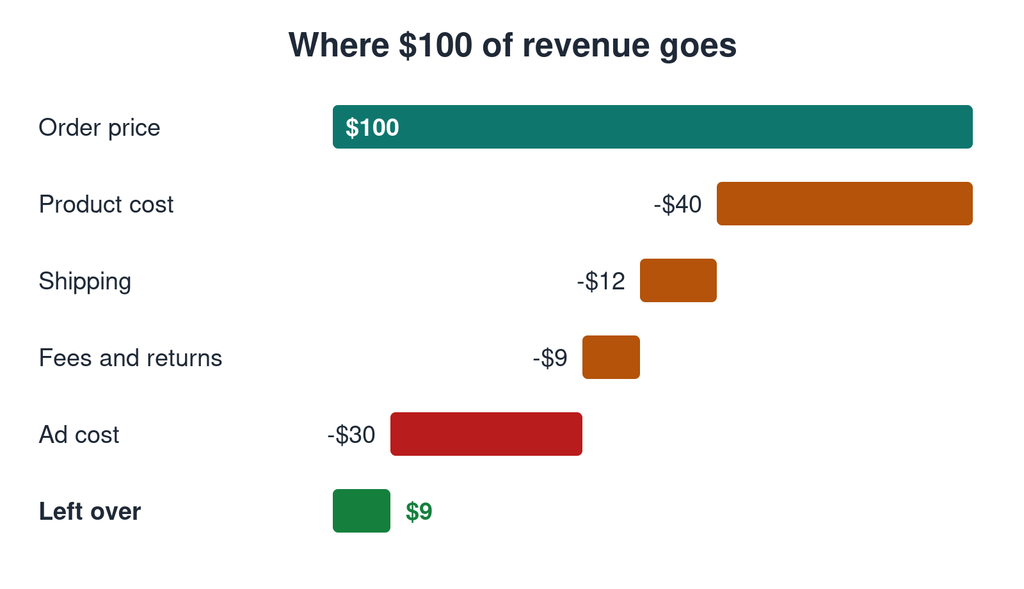
The order starts at $100 and ends at $9. Gross margin on this order looks healthy at 60%. Profit after ad cost is 9%. The gap between those two numbers is where most margin problems live, which is why the metrics below matter.
Which profitability metrics should an ecommerce store track?
An ecommerce store should track gross margin, contribution margin, customer acquisition cost (CAC) and the ratio of customer lifetime value to CAC. Gross margin shows product economics. Contribution margin shows whether an order pays for its own shipping, fees, returns and ads. Together they separate profitable growth from expensive growth.
| Metric | Formula | What it answers |
|---|---|---|
| Gross margin | (Revenue – product cost) / revenue | Is the product priced well? |
| Contribution margin | Revenue – all variable costs, including ads | Does each order add profit? |
| CAC | Acquisition spend / new customers | What does a new buyer cost? |
| LTV to CAC | Lifetime gross profit / CAC | Does a customer repay their cost? |
| Net margin | Net profit / revenue | What does the business keep? |
Contribution margin is the one to check weekly. It is available long before the accountant closes the month, and it reacts immediately to a discount, a shipping change or a rise in ad costs. Anaia’s guide to revenue growth metrics covers how these KPIs connect to revenue forecasting.
Where do ecommerce margins actually leak?
Ecommerce margins leak at five points: discounts, shipping, returns, paid acquisition and payment or platform fees. Returns are the least visible. The National Retail Federation estimated that 19.3% of online sales would be returned in 2025, and that 9% of all returns are fraudulent.
Baymard Institute adds a conversion angle: the average cart abandonment rate is 70.22%, and unexpected extra costs cause 40% of those abandonments (Baymard Institute, updated September 2025). Shipping cost therefore hurts twice: it reduces margin on completed orders and loses the orders that never complete.
| Leak | How it shows up | First check |
|---|---|---|
| Discounts | Revenue rises, contribution falls | Margin per discounted order |
| Shipping | Free shipping on small baskets | Shipping cost vs order value |
| Returns | Strong sales, weak net profit | Return rate by product |
| Paid acquisition | CAC rises with scale | CAC by channel and cohort |
| Fees | Small percentages across every order | Fee total as % of revenue |
Anaia’s analysis of ecommerce revenue leaks shows the same pattern on the revenue side: stores lose sales and margin at the same points in the funnel. A margin audit and a leak audit are two views of one problem.
How does a discount change profit per order?
A discount reduces profit by far more than its percentage suggests, because costs stay fixed while price falls. In the illustrative $100 order, a 20% discount cuts revenue by $20 but also leaves product cost and shipping unchanged. Profit after ad cost moves from $9 to a $9 loss.
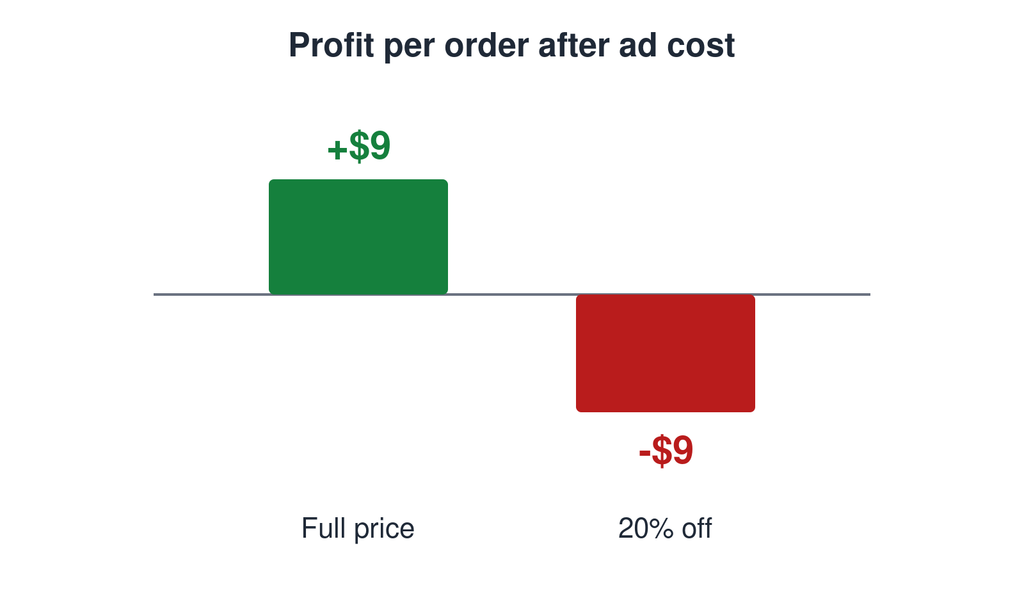
The same arithmetic explains the volume trap. Before ads, the full price order contributes $39. The discounted order contributes $20.80. To earn the same $39 in total, the store must sell about 1.9 times as many orders, and each of those extra orders needs its own traffic. That is rarely a good trade.
This does not make discounting wrong. It makes it a decision with a break-even point. The bottom line for a promotion is simple: calculate contribution margin per order at the discounted price, include ad cost, and run the offer only when the result stays positive or when the customer’s repeat value clearly repays it.
What revenue model and revenue streams support profitable growth?
A profitable ecommerce revenue model combines several revenue streams with different margin profiles: first orders, repeat orders, subscriptions or replenishment, and higher value bundles. Streams that sell to existing customers carry no acquisition cost, so they usually earn the highest contribution margin per order.
The ecommerce revenue streams worth modeling separately are:
- First orders from new customers, which carry the full CAC and often break even or lose money.
- Repeat orders, which carry marketing cost close to zero when driven by email, SMS or on-site personalization.
- Subscriptions and replenishment, which add predictable revenue for consumable products.
- Bundles and add-ons, which raise order value without raising shipping or ad cost proportionally.
- Marketplace or wholesale channels, which add volume at lower margin and different fee structures.
Klaviyo reported that revenue from repeat customers grew 13.5% year over year across Black Friday Cyber Monday 2025, outpacing revenue from new buyers. The direction is consistent: retention revenue is where margin accumulates. Anaia’s ecommerce growth strategy guide explains how acquisition and retention fit into one revenue system.
How can a store grow revenue without losing margin?
A store grows revenue without losing margin by raising order value, repeat purchase rate and conversion before adding paid traffic. These levers increase revenue from customers and visitors already acquired, so they add contribution margin instead of acquisition cost. Paid traffic then scales a funnel that already earns profit.
Five moves protect margin while revenue grows:
- Set free shipping thresholds above the current average order value. The threshold pushes baskets up instead of absorbing shipping cost on small orders.
- Replace blanket discounts with targeted offers. Reward repeat buyers or specific cohorts, and keep full price for first-time shoppers who already convert.
- Cut returns at the source. Better size guidance, clearer photos and accurate descriptions reduce the 19.3% return rate where it starts.
- Move spend toward channels with the best payback. Compare CAC and contribution margin by channel, not blended return on ad spend.
- Build the post-purchase flow. Email and SMS sequences bring buyers back at near-zero acquisition cost.
Anaia’s list of ecommerce growth tactics covers the testing side of these moves.
How should a store prioritize profitability work?
A store should prioritize profitability work in order of impact and speed: measure contribution margin first, fix the largest leak second, test one margin lever at a time third, and scale traffic last. This order prevents a store from funding growth with money it has not yet earned.
| Step | Action | Typical timing |
|---|---|---|
| 1 | Calculate contribution margin per order, by channel | 1 week |
| 2 | Identify the largest leak (discounts, shipping, returns) | 1 to 2 weeks |
| 3 | Test one fix, such as a shipping threshold | 2 to 4 weeks |
| 4 | Build repeat purchase flows | 1 to 3 months |
| 5 | Scale paid traffic on channels with positive contribution | Ongoing |
Anaia Marketing uses this sequence in its PRG System (Predictable Revenue Growth): diagnose where revenue and margin are lost, fix those points, then scale. Timings above are planning ranges, and actual results depend on traffic volume, catalog and starting conditions.
The real takeaway on ecommerce profitability
Profitable growth is a question of order economics, not of ambition. A store that knows its contribution margin per order, by channel and by offer, can say yes to growth with confidence. A store that only watches revenue is guessing, and the guess is usually paid for by margin.
The pattern in the data is consistent. Returns, shipping and acquisition cost absorb a large share of every sale, and discounts widen the gap. Retention revenue grows faster than new buyer revenue, and it carries the lowest acquisition cost. Those facts point in one direction: protect the margin on each order first, then earn the right to scale.
For most stores, the next step is not a new channel or a bigger promotion. It is a clear view of where margin disappears today. Once the largest leak is visible, the fix is usually specific, testable and cheaper than the traffic needed to outgrow it.
Ecommerce profitability FAQ
What is a good ecommerce profit margin?
There is no single benchmark, because margins vary by category, shipping model and return rate. A more useful target is positive contribution margin after ad cost on every channel. Net margin then depends on overhead, so each store should set its target from its own cost structure.
How is ecommerce profitability calculated?
Subtract product cost, shipping, payment fees, returns and ad spend from revenue, then divide by revenue. This gives contribution margin after ads. Calculate it per order and per channel. Gross margin alone overstates profitability because it ignores the costs that scale with every sale.
Does free shipping hurt ecommerce profitability?
Free shipping hurts margin when it applies to small baskets, because the cost comes straight out of contribution. A free shipping threshold set above average order value protects margin and raises basket size. Baymard data shows extra costs cause 40% of cart abandonments, so shipping must be tested, not removed.
Is revenue or profit more important for an ecommerce store?
Profit determines whether growth can continue, because profit funds inventory, traffic and hiring. Revenue matters as an input. A store with rising revenue and falling contribution margin is spending its future capacity, so both numbers belong on the same weekly dashboard.
How do returns affect ecommerce profitability?
Returns reduce profit through lost sales, return shipping, handling and unsellable stock. The National Retail Federation estimated that 19.3% of online sales would be returned in 2025. Tracking return rate by product shows which items look profitable in revenue reports but lose money in practice.

Founder & CEO of Anaia Marketing, Dominique doesn’t manage traffic. He builds systems that grow revenue, predictably, measurably, without guesswork. With 15+ years at the intersection of search strategy and editorial precision, he focuses on what matters : turning organic growth into a compounding asset that moves revenue.