
The ecommerce growth tactics that move revenue are rarely new channels or experimental tools. They are disciplined executions of specific levers: removing friction from the buying path, increasing the value of each transaction, and turning one-time buyers into repeat customers. This guide breaks down the 10 tactics used consistently by stores scaling past the €1M annual revenue threshold.
Why do most ecommerce growth tactics fail to deliver results?
Most ecommerce growth tactics fail because they are applied out of sequence. Stores pour budget into acquisition while losing revenue at checkout, then blame the channel when conversion does not materialize.
The average global ecommerce conversion rate sits at 1.58% as of late 2025 (Triple Whale Benchmarks, 2025). Stores operating below that number have a conversion problem, not a traffic problem. Addressing checkout friction first delivers faster revenue impact per euro spent than any paid acquisition campaign. Understanding where your store loses money before scaling is the prerequisite step most growth plans skip.
What separates high-growth ecommerce stores from average performers?
High-growth ecommerce stores treat customer lifetime value (LTV) as the primary growth variable, not cost per acquisition (CPA). They run tighter post-purchase sequences, higher upsell attach rates, and more precise segmentation across the customer lifecycle.
The ten tactics below reflect that operational posture. They are ordered by implementation sequence, not by alphabetical preference or trend cycle. Apply them in order.
The 10 ecommerce growth tactics used by stores scaling online revenue
Tactic 1: remove checkout friction before optimizing traffic
The single highest-leverage conversion tactic in ecommerce is simplifying the checkout path. According to the Baymard Institute, 48% of cart abandonments happen because of unexpected costs (shipping, taxes, fees) surfaced at checkout. A further 22% abandon because the process is too long or too complicated.
Immediate actions: display total landed cost on the product page, reduce checkout to a maximum of three steps, and enable guest checkout without forced account creation. These changes alone can recover 5 to 10 percentage points of abandoned revenue. No additional traffic spend required.
Tactic 2: build a post-purchase email and SMS sequence
Revenue growth begins after the first purchase. A post-purchase sequence covering the first 30 days after a transaction is the highest-ROI retention investment available to most stores.
SMS is the fastest channel for post-purchase engagement. Open rates for SMS consistently reach 90 to 98%, with 80% of messages read within five minutes of delivery. ROI estimates place returns at €21 to €41 per €1 spent, with SMS upsell campaigns converting at approximately 10% when paired with relevant product recommendations.
A minimum viable sequence runs: order confirmation (immediate), product usage tip (day 3), cross-sell recommendation (day 7), review request (day 14), replenishment nudge (day 25-30).
Tactic 3: deploy personalized product recommendations
Personalized product recommendations drive up to 31% of ecommerce site revenues, with stores implementing recommendation engines tuned to browsing behavior and purchase history seeing conversion rates nearly triple those of generic product displays (Barilliance, 2024).
The minimum implementation covers three pages: the homepage for returning visitors, the product detail page for cross-sell and “frequently bought together” logic, and the cart for last-chance upsell before checkout. According to McKinsey’s 2024 analysis, companies leading in personalization generate 40% more revenue than average performers in their category.
Tactic 4: increase AOV with contextual upsell and cross-sell
Average order value (AOV) is the growth lever most stores under-invest in relative to its impact. A 10% increase in AOV across the same transaction volume produces a 10% revenue increase with zero additional acquisition spend.
Contextual cross-sell works best when the offer is directly relevant to the primary cart item: complementary products, consumables, accessories. Bundling at a slight discount (5 to 10% off vs. individual items) increases attach rate while protecting margin. Post-checkout upsell pages, presented after payment confirmation but before the thank-you page, convert at 3 to 7% for relevant offers without disrupting checkout completion.
Tactic 5: prioritize mobile-first UX
Mobile devices accounted for 57% of global ecommerce sales in 2024, rising to an estimated 59% in 2025. Stores designed for desktop and adapted for mobile consistently underperform on conversion against stores built mobile-first.
Specific improvements that move the metric: tap-target sizing for add-to-cart and checkout buttons (minimum 44x44px), autofill-enabled address forms, Apple Pay and Google Pay for single-tap checkout, and page load times under 2.5 seconds on 4G connections. Mobile checkout completion rates run 20 to 30% lower than desktop on poorly optimized stores; closing that gap is pure conversion recovery.
Tactic 6: use lifecycle segmentation to personalize at scale
Treating all customers identically is the primary cause of flat email and SMS performance. Lifecycle segmentation divides the customer base into distinct cohorts: new, active, lapsing, and churned. Each cohort receives different messaging, offers, and cadences.
A lapsing customer (no purchase in 90 days) responds to a reactivation offer with urgency framing. A new customer (first purchase within 30 days) responds to onboarding content and social proof. A high-LTV active customer responds to early access and loyalty signals. Segmented campaigns consistently generate 3 to 8 times more revenue per send than non-segmented broadcasts, according to Omnisend’s 2025 email marketing benchmarks.
If you are unsure which of these levers produces the most impact at your store’s current revenue stage, the Anaia revenue growth diagnostic maps your primary constraint in 15 minutes.
Tactic 7: activate social proof at high-intent pages
Social proof reduces purchase hesitation at the pages where buying decisions are made. High-intent pages are the product detail page, the cart, and the checkout screen.
Star ratings displayed near the add-to-cart button increase conversion by 4 to 6% on average across categories. Review volume matters more than review score: a product with 200 reviews at 4.3 stars consistently outperforms a product with 12 reviews at 4.9 stars because volume signals genuine demand. Customer photos and video reviews in the product gallery reduce return rates by establishing realistic purchase expectations before the transaction.
Tactic 8: run search-led content to own informational demand
Organic search remains the most cost-efficient acquisition channel for ecommerce stores at scale. Stores that build content around the informational queries their target buyers run before purchase (how-to articles, comparison guides, category explainers) capture demand that paid search misses entirely.
Content targeting informational intent at 500+ monthly searches and low to medium competition feeds buyers into the top of the funnel at near-zero marginal acquisition cost. The compounding effect of a 20 to 30 article cluster takes 6 to 9 months to materialize, but the long-term CPA advantage over paid channels is structural. The full sequencing for this approach is covered in the ecommerce growth strategy guide.
Tactic 9: make pricing transparent early
Price transparency is a conversion tactic, not a pricing strategy. Shoppers who encounter unexpected costs at checkout do not simply abandon that session: 37% report they are unlikely to return to the store at all (Baymard Institute, 2024). Displaying total landed cost, including estimated shipping and applicable taxes, at the product page level eliminates the most common checkout abandonment trigger.
Free shipping thresholds displayed on the product page (“Add €15 more for free shipping”) simultaneously increase transparency and drive AOV. The dual effect makes this one of the highest-leverage single changes most stores can implement without additional development resources.
Tactic 10: shift from ROAS to MER for budget decisions
Return on ad spend (ROAS) is a channel-level metric that cannot measure true marketing performance because it ignores organic, email, SMS, and retention-driven revenue. Marketing efficiency ratio (MER), calculated as total revenue divided by total marketing spend, gives a store-level view that reflects all channels together.
A healthy MER for most ecommerce brands sits in the 3.0 to 5.0 range (Triple Whale Benchmarks, 2025). Stores optimizing for channel-level ROAS consistently over-invest in paid acquisition and under-invest in high-return retention channels. Switching the primary optimization metric from ROAS to MER reallocates budget toward the tactics with the highest true return across the full revenue picture.
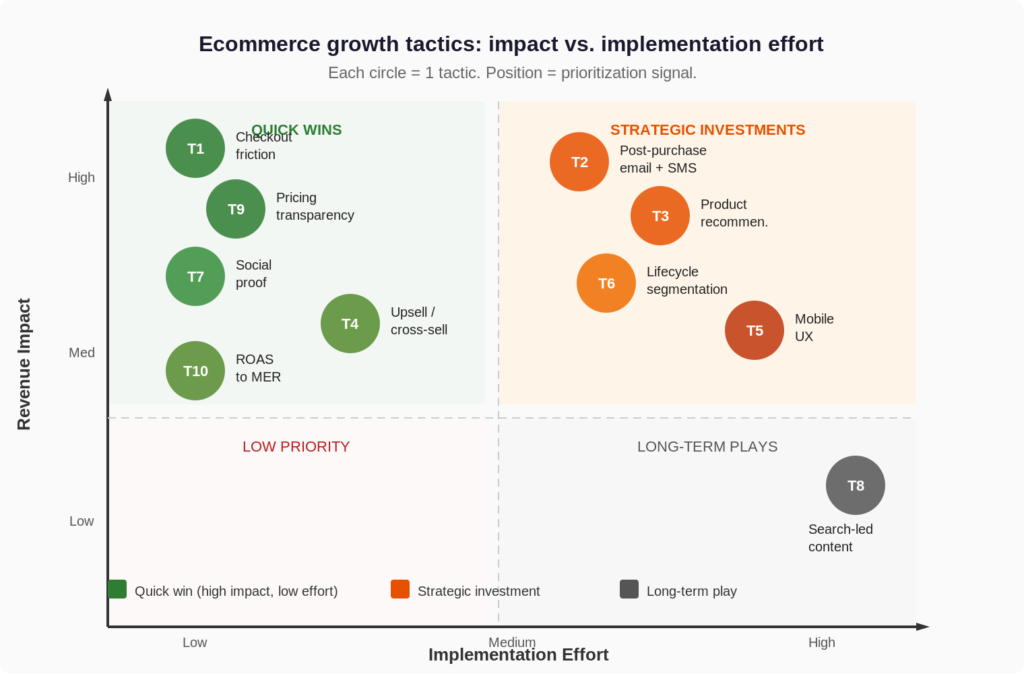
| Tactic | Funnel stage | Implementation effort | Primary metric impacted |
|---|---|---|---|
| 1. Checkout friction removal | Conversion | Low | Conversion rate |
| 2. Post-purchase email + SMS | Retention | Medium | Repeat purchase rate |
| 3. Personalized recommendations | Conversion + Retention | Medium | Conversion rate, AOV |
| 4. Upsell + cross-sell | Conversion | Low-Medium | AOV |
| 5. Mobile-first UX | Conversion | Medium-High | Mobile conversion rate |
| 6. Lifecycle segmentation | Retention | Medium | Email revenue, LTV |
| 7. Social proof activation | Conversion | Low | Conversion rate |
| 8. Search-led content | Acquisition | High (long-term) | Organic traffic, CPA |
| 9. Pricing transparency | Conversion | Low | Cart abandonment rate |
| 10. ROAS to MER shift | Efficiency | Low | Marketing ROI |
The bottom line on ecommerce growth tactics
The ten tactics above share one underlying logic: they increase revenue from existing demand before spending more to generate new demand. Checkout friction removal, post-purchase sequencing, and AOV optimization all operate on buyers who are already in the funnel. That sequencing is not arbitrary. It reflects the reality that the fastest path to ecommerce revenue growth runs through conversion and retention, not acquisition.
What separates stores that execute these tactics successfully from those that cycle through them without measurable results is prioritization. Attempting all ten simultaneously produces diluted outcomes across the board. The approach that consistently works is identifying the single biggest revenue leak in the current store, fixing it fully, measuring the impact, then advancing to the next tactic in order of leverage.
Anaia’s PRG System is built on exactly this sequencing logic. The stores that see the fastest revenue impact are not the ones with the most sophisticated technology stack. They are the ones with the clearest picture of where their revenue is leaking and the operational discipline to address one constraint at a time.
If the ten tactics above describe actions you know you should take but cannot prioritize with confidence, the starting point is a structured diagnostic. Identifying your primary revenue leak before allocating budget to any specific tactic saves months of misallocated effort and gives your team a clear, defensible sequence to execute against.
Identify your biggest ecommerce revenue leak before allocating budget to any tactic. Run the Anaia revenue growth diagnostic in 15 minutes and get a prioritized view of which lever to pull first
Frequently asked questions about ecommerce growth tactics
Q1 : What are the most effective ecommerce growth tactics for a store under €1M in annual revenue?
For stores under €1M annually, the three highest-leverage tactics are checkout friction removal, post-purchase email and SMS sequences, and pricing transparency. These require minimal technology investment and address the most common revenue leaks at the conversion and retention stage before any increase in acquisition spend is warranted.
Q2 : How long does it take to see results from ecommerce growth tactics?
Checkout optimization and post-purchase sequences produce measurable results within 30 to 60 days of implementation. Search-led content takes 6 to 9 months to compound into meaningful organic traffic volume. Lifecycle segmentation improvements show in email revenue within 60 to 90 days of rollout.
Q3 : What is the difference between ecommerce growth tactics and ecommerce growth strategies?
A growth strategy defines the direction and priority of a store’s expansion: which markets, which channels, which customer segments to pursue. Growth tactics are the specific, executable actions that implement the strategy. Tactics without a clear strategy produce fragmented results. Strategy without tactics remains theoretical.
Q4 : Should ecommerce stores prioritize retention or acquisition tactics first?
Stores with conversion rates below 2% should address conversion and retention before scaling acquisition. Spending more on traffic generation while checkout friction exists amplifies loss, not gain. The sequence that produces sustainable ecommerce growth runs: fix conversion, maximize retention, then scale acquisition.
Q5 : What is MER and why does it matter for ecommerce growth?
Marketing efficiency ratio (MER) is total revenue divided by total marketing spend across all channels. Unlike ROAS, it captures the full picture of marketing performance, including organic, email, and SMS contributions. A healthy MER for ecommerce brands sits between 3.0 and 5.0. Optimizing for MER typically reallocates budget toward higher-return retention channels.
Q6 : How many ecommerce growth tactics should a store run simultaneously?
One to two tactics, fully executed, consistently outperform running five or more in parallel. Parallel execution splits focus, complicates attribution, and reduces the speed at which you learn what is working. Identify your primary constraint, execute the tactic that addresses it, measure the result, then advance.

Passionate about the future of search, co-founder of Anaia Marketing and an SEO strategist focused on helping brands grow through search, strategic content, and AI-driven visibility. Her work sits at the intersection of technical SEO, content systems, and emerging AI search optimization, with a focus on building sustainable organic growth.


Pingback: Ecommerce growth engine: how to build self-funding revenue
Pingback: Ecommerce conversion rate optimization guide 2026