To increase ecommerce sales, a store works on four levers in a fixed order: fix the checkout and site friction that loses ready buyers, raise conversion on existing traffic, lift average order value, then bring customers back. Paid traffic comes last, because it multiplies whatever the funnel already does well or badly.
What actually determines ecommerce sales?
Ecommerce sales are determined by traffic, conversion rate, average order value and repeat purchase rate. Revenue is the product of those four numbers, so a store can raise sales by lifting any one of them. The right lever is the one with the weakest current performance.
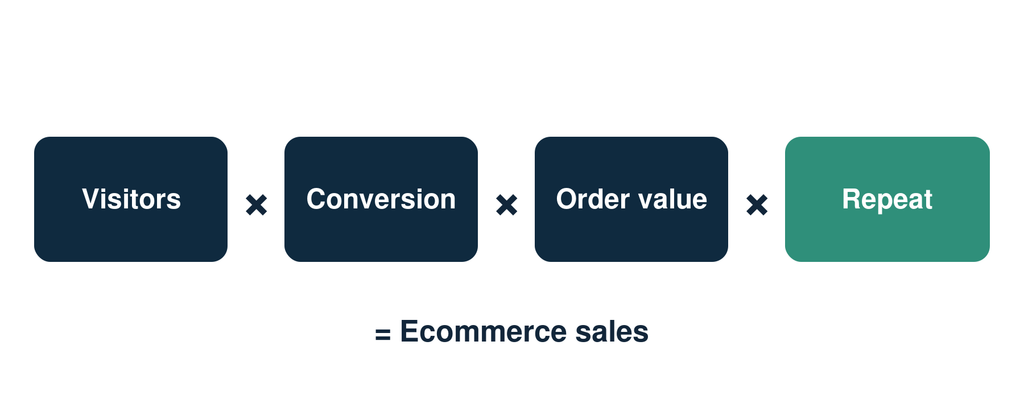
Most guides on how to boost ecommerce sales begin with tactics: popups, influencers, loyalty programs. Those lists rarely say which tactic to run first, or how to tell whether it worked. A reliable ecommerce sales strategy starts from the equation instead, because it exposes where growth is cheapest.
| Lever | Metric to track | Typical first move |
|---|---|---|
| Traffic | Sessions by channel, cost per visit | Add owned channels before paid |
| Conversion | Conversion rate, checkout completion | Remove checkout friction |
| Order value | Average order value, items per order | Bundles and shipping thresholds |
| Repeat purchases | Second-order rate, days to reorder | Post-purchase email and SMS flows |
Shopify reported an average cart price of $114.70 across its merchants over the 2025 Black Friday weekend (Shopify, December 2025). That figure is a useful reference point, but a store’s own average order value, by channel and by device, is the number that matters for decisions.
Where should a store start to increase ecommerce sales?
A store should start by measuring where visitors drop out, then fix the biggest drop first. Fixing a leak raises revenue from traffic already paid for. Adding traffic to a leaking funnel raises cost without raising the return, so the order of work matters as much as the tactics.
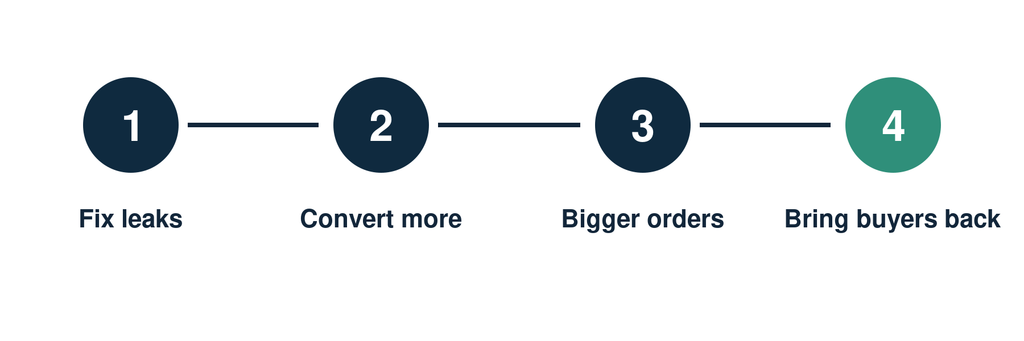
Anaia’s analysis of ecommerce revenue leaks shows where stores usually lose sales: slow mobile pages, unclear shipping costs, broken tracking and weak product pages. Anaia Marketing builds on this order in its PRG System (Predictable Revenue Growth): diagnose, fix, then scale. The broader ecommerce growth strategy guide explains how the pieces connect.
How can a store convert more of the traffic it already has?
A store converts more visitors by removing the specific reasons they leave. Baymard Institute found that checkout design improvements alone could raise conversion rates by 35.26% across large ecommerce sites. Fixing friction is usually cheaper than buying the next thousand visitors, which makes it the first lever to pull.
1. Show the total cost early
Extra costs such as shipping, tax and fees are the top reason for abandonment, at 40% according to Baymard. Display shipping thresholds on product pages and an estimated total in the cart. Surprises at the last step cost more sales than any price difference.
2. Offer guest checkout
Forced account creation causes 18% of abandonments (Baymard, 2025). Make guest checkout the default and offer account creation after the order, using the email already collected.
3. Simplify the checkout flow
Lengthy or complicated checkout causes 17% of abandonments. Remove optional fields, enable address autofill and keep progress visible. A mobile checkout needs a separate review, since mobile behavior differs from desktop.
4. Add payment methods that match the market
Insufficient payment options account for 9% of abandonments and card declines for 10%. Add wallets and installment options relevant to the markets served, and display trust signals near the payment fields.
5. Improve product pages
Product pages carry the decision. Clear photography, specific sizing or specification data, delivery dates and visible reviews reduce the questions that stop a purchase. Anaia’s guide to ecommerce conversion rate optimization covers the testing method for each element.
How can a store raise average order value?
A store raises average order value by making a larger basket the easy choice, not by discounting. Bundles, shipping thresholds and relevant cross-sells increase revenue per order while protecting margin. This lever improves ecommerce sales conversion into revenue because the traffic cost stays the same.
6. Set a free shipping threshold
Set the threshold slightly above current average order value, then show progress toward it in the cart. Check the effect on contribution margin after shipping costs, since a threshold set too low erodes profit.
7. Build bundles from products that sell together
Use order data to find pairs and sets that customers already buy. Present them as a single offer at a lower combined price than the separate items. Test one bundle per category before expanding.
8. Recommend relevant add-ons
Relevant cross-sells in the cart outperform generic recommendations. Limit the offer to two or three items priced below the main product, so the add-on feels like a small decision.
9. Use discounts sparingly
Klaviyo found that discounts fell 10% year over year during Black Friday Cyber Monday 2025, and the brands with the smallest discounts grew fastest at +14%. Deep discounting trains customers to wait. Reserve it for clearance and test non-price incentives first.
How can a store get more repeat sales?
A store gets more repeat sales by contacting buyers at the right moment after purchase. Klaviyo reported that repeat customer revenue grew 13.5% year over year during Black Friday Cyber Monday 2025, ahead of new buyer growth. Increasing ecommerce revenue from existing customers costs less than acquiring new ones.
10. Build post-purchase flows
Send a sequence after the first order: confirmation, delivery update, usage tips, review request and a replenishment or complementary product reminder. Time the last message to the product’s typical reorder window.
11. Combine email and SMS
Klaviyo’s data shows email and SMS together drove 42% of total revenue across its brands in the 2025 period, and shoppers who received both placed 11% more orders. Collect consent at checkout and on-site, and keep the two channels consistent.
12. Start a simple loyalty or referral program
A loyalty or referral program needs a clear reward tied to a second purchase. Start with a points or credit mechanic on a platform app, measure the second-order rate, then adjust. Avoid complex tiers until the basics work.
How can a store add traffic without burning ad spend?
A store adds efficient traffic by building channels that compound before increasing paid budgets. Search, email capture and partnerships keep delivering after the spend stops. Paid media then amplifies a funnel that already converts, which keeps cost per acquisition under control.
13. Build search content for buying questions
Category pages, buying guides and comparison pages capture demand at the moment of intent. Write for the questions customers ask before purchase, and structure answers so search engines and AI assistants can quote them.
14. Capture visitors before they leave
Use a single, well-timed email capture offer with a clear benefit. Owned contacts turn one-time visits into repeat traffic that costs nothing per send.
15. Spend on paid media last, and measure profit
Raise ad budgets only after conversion and order value improve. Judge campaigns on contribution margin and customer payback, not on platform ROAS alone. Anaia’s overview of ecommerce growth tactics lists further channels worth testing.
How should a store prioritize these 15 strategies?
A store should prioritize by revenue impact, effort and speed to result. Checkout fixes and shipping thresholds usually deliver the fastest return, while search content and loyalty programs take longer but compound. Run one change at a time on the weakest lever and measure it.
| Priority | Strategies | Why first | Expected timing |
|---|---|---|---|
| 1 | 1 to 5 (conversion) | Uses traffic already paid for | Weeks |
| 2 | 6 to 9 (order value) | Raises revenue per order | Weeks |
| 3 | 10 to 12 (repeat sales) | Lowers cost per sale over time | 1 to 3 months |
| 4 | 13 to 15 (traffic) | Compounds once the funnel converts | 3 to 6 months |
Measure each change with a clear before and after: conversion rate, average order value or second-order rate, over a full buying cycle. Without that baseline, a store cannot tell which action produced the gain.
Where this leaves stores that want more ecommerce sales
The pattern across all fifteen strategies is the same. Sales growth rarely depends on a missing tactic. It depends on an unfixed leak, an untested offer or a customer who was never given a reason to return. Stores that treat ecommerce sales growth as a sequence, not a checklist, make steadier progress.
The data supports that order. Baymard’s research puts the recoverable gain from checkout design at 35.26%, and Klaviyo’s 2025 figures show repeat customers growing faster than new ones. Both point to revenue that already exists inside the business, waiting to be captured before more money is spent finding strangers.
For most stores, the practical next step is a single measured change on the weakest lever. Pick the metric, set the baseline, run the fix for a full buying cycle and review the result. Then move to the next lever. This discipline is what separates a store that grows predictably from one that restarts its strategy every quarter.
That is the logic behind Anaia’s PRG System: locate the largest revenue leak, fix it, and scale only what the numbers support. A diagnostic is the fastest way to find which lever deserves attention first.
Frequently asked questions about increasing ecommerce sales
Q1 : What is the fastest way to increase ecommerce sales?
Fix checkout friction first. Baymard Institute reports a 70.22% average cart abandonment rate, and extra costs cause 40% of abandonments. Showing total cost early, enabling guest checkout and adding payment options can lift sales from existing traffic within weeks, without extra ad spend.
Q2 : How can a store increase ecommerce sales without ads?
Improve conversion, order value and repeat purchases, then add owned traffic. Search content, email capture and post-purchase flows keep producing sales without per-click cost. Klaviyo found email and SMS drove 42% of revenue across its brands during Black Friday Cyber Monday 2025.
Q3 : How can a small store boost ecommerce sales on a limited budget?
Focus on one lever at a time, starting with the checkout and product pages. Both are low-cost to improve and use traffic the store already has. Add a free shipping threshold and one post-purchase email flow next, and measure each change before the next.
Q4 : What is a good ecommerce sales strategy?
A good ecommerce sales strategy fixes leaks, lifts conversion, raises average order value and builds repeat purchases before scaling paid traffic. It tracks one metric per lever and sets a baseline before each change, so every action can be judged on its effect on contribution margin.
Q5 : How long does it take to increase ecommerce revenue?
Checkout and order value changes can show results within weeks, once enough traffic has passed through the test. Repeat purchase programs typically need one to three months, and search content three to six months. Measure over a full buying cycle before judging any change.

Passionate about the future of search, co-founder of Anaia Marketing and an SEO strategist focused on helping brands grow through search, strategic content, and AI-driven visibility. Her work sits at the intersection of technical SEO, content systems, and emerging AI search optimization, with a focus on building sustainable organic growth.