

An omnichannel ecommerce strategy connects every place a store sells (its website, marketplaces, social shops, physical stores or pickup points) through shared customer, inventory, pricing and order data, so a shopper can move between channels without starting over. Building one does not mean being everywhere. It means choosing the channels that earn a profit, then making them behave like one business. This guide gives six steps, a table to compare channels by profit, and two simple rules: when a new channel pays for itself, and how much stock to hold back so it does not oversell.
What an omnichannel ecommerce strategy is, and how it differs from multichannel
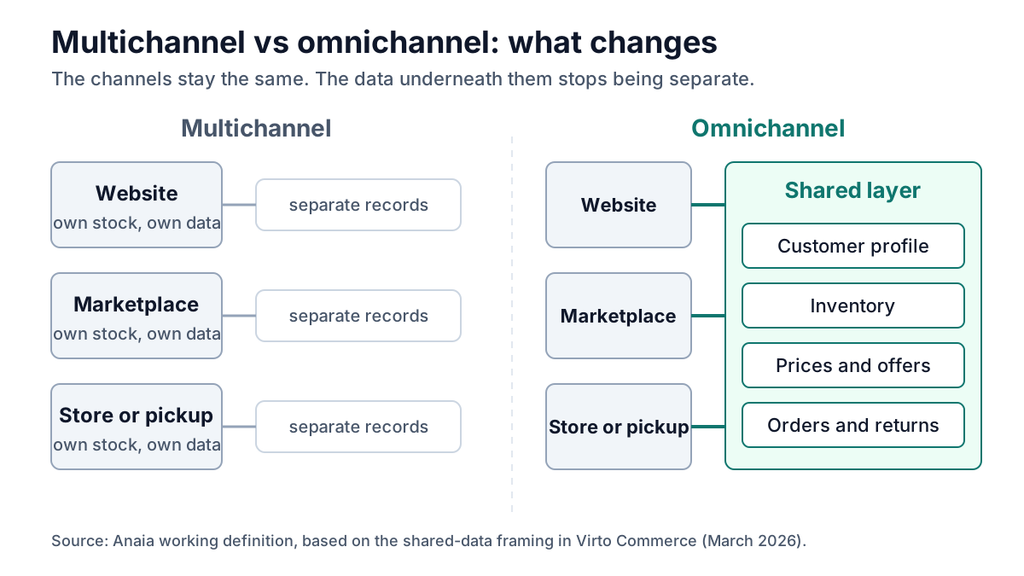
Multichannel means selling on several channels. Omnichannel means those channels share the information that matters for a sale. Virto Commerce frames the difference as data: in a multichannel setup each channel keeps its own records, while in an omnichannel setup customer, cart, order and inventory data are shared (Virto Commerce). That framing is the working definition used in this article.
Schema comparing a multichannel setup, where website, marketplace and store each keep separate records, with an omnichannel setup where all three connect to one shared layer for customers, inventory, prices and orders
| Multichannel | Omnichannel | |
|---|---|---|
| Customer record | One per channel | One profile across channels |
| Inventory | Allocated or counted per channel | Shared, with a safety buffer |
| Prices and offers | Set per channel, often drift apart | One pricing rule with channel exceptions |
| Returns | Handled where the order was placed | Accepted according to one policy |
| Reporting | Revenue per channel | Contribution and repeat rate per customer across channels |
An ecommerce sales channel is any route through which an order reaches the business: an owned website, a marketplace, a social checkout, a wholesale account, a physical shop. The strategy question is not “how many channels?” but “which channels, in what order, and sharing which data?”
Why it matters: shoppers already move between channels
Two data points frame the decision, and both come with limits.
First, online is large but not total. The U.S. Census Bureau estimated that ecommerce reached $340.2 billion in the second quarter of 2026, or 17.1% of total retail sales (seasonally adjusted), up 12.2% from the second quarter of 2025 (U.S. Census Bureau). Roughly four of every five retail dollars were still spent elsewhere, which is why brands that sell only through one website leave reach on the table. The figure covers all U.S. retail, so it is context, not a benchmark for a single brand.
Second, shoppers who use several channels tend to spend more. A Harvard Business Review study of more than 46,000 shoppers at one large U.S. retailer found that 73% used multiple channels, and that these shoppers spent about 4% more per store visit and 10% more online than single-channel shoppers, with 23% more repeat store trips within six months (HBR, figures as summarized by BARE International). The data covers June 2015 to August 2016 and one retailer with hundreds of stores, and the authors describe it as correlation, not proof that adding channels causes higher spend. Treat it as a reason to test, not a promise.
The four building blocks of an omnichannel setup
There is no official list of omnichannel “pillars”; vendors name between three and seven. For a store with a limited team, four blocks cover what actually has to be shared:
- Customer data. One profile that links purchases from every channel, with consent recorded once. Without it, a customer who buys on a marketplace and then on the website looks like two strangers.
- Inventory. One count of what is available, with rules for how much each channel can see.
- Pricing and offers. One base price and a short list of allowed exceptions, so a promotion on one channel does not undercut another.
- Orders and returns. One policy for how an order placed in one channel can be returned or exchanged in another.
Measurement sits on top of these blocks. It is covered in the measurement section below.
How to build an omnichannel ecommerce strategy in six steps
- List current channels and what each one earns. Include every route to an order, even a small one. For each, record revenue, order count and the costs that are specific to it.
- Compute contribution per unit by channel. This is the profit left after product cost, shipping, fees, returns and channel marketing. The next section shows the table. Without it, channel decisions follow revenue, which hides losses.
- Pick the next channel with a break-even rule. Add a channel only if its contribution can cover its fixed monthly cost at a sales volume the store can realistically reach.
- Connect data before adding volume. Link inventory first, then customer profile, then pricing. Stock errors cost more than any other gap, because they create cancelled orders and refunds.
- Design the cross-channel journeys that already happen. Look for the paths customers use: social post to website, website to pickup, marketplace buyer to email list. Shopify’s pickup feature is a concrete example, covered below.
- Measure per customer, not only per channel. Track repeat rate and contribution across channels, and review monthly.
For where this sits in the wider plan, see the ecommerce marketing strategy guide.
Which channel to add next: a contribution table and a break-even rule
Most guides stop at “choose the right channels”. The calculation below makes the choice reproducible. It uses a fictional store, not a client, and every number is an assumption to replace with real ones.
Assumptions: the store sells one product at a retail price of $80 with a product cost of $28. On wholesale it sells the same item at 60% of retail, $48.
| Line (per unit sold) | Own website | Marketplace | Wholesale |
|---|---|---|---|
| Revenue | $80.00 | $80.00 | $48.00 |
| Product cost | $28.00 | $28.00 | $28.00 |
| Shipping and fulfillment | $9.00 | $9.00 | $2.00 |
| Payment or marketplace fee | $2.40 | $12.00 (15% referral fee, assumed) | $0.00 |
| Returns allowance | $3.60 | $5.60 | $1.50 |
| Channel marketing | $14.00 | $8.00 | $0.00 |
| Contribution per unit | $23.00 | $17.40 | $16.50 |
| Contribution as share of revenue | 28.8% | 21.8% | 34.4% |
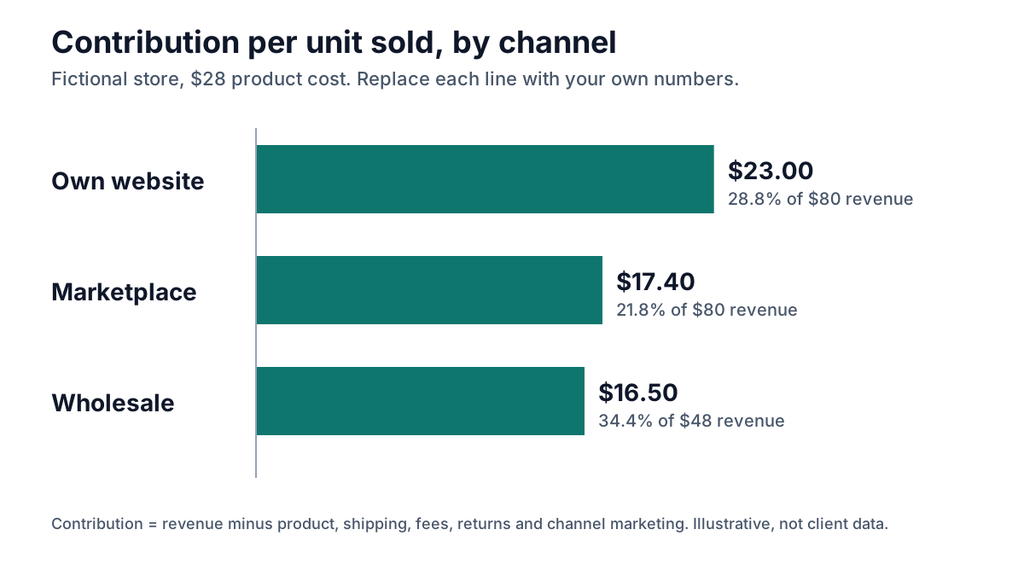
Read the table in two ways. The website earns the most dollars per unit, so growth there is worth defending first. Wholesale earns the best margin on revenue but fewer dollars per unit, and it adds orders the store does not have to acquire one by one.
Now the break-even rule for a new channel:
Break-even units per month = monthly fixed cost of the channel ÷ contribution per unit.
If the marketplace needs $900 a month in tools, listing work and account management (an assumption), the store must sell about 52 units a month on it before the channel adds profit ($900 ÷ $17.40 = 51.7). If wholesale needs $600 a month in account handling and samples (also an assumption), break-even is about 37 units ($600 ÷ $16.50 = 36.4). If the store cannot reach these volumes within a few months, the channel is a distraction, not an extension.
This is a ceiling check, not a full model. It leaves out cannibalization (a marketplace sale that would otherwise have gone to the website) and working capital for wholesale terms. Both should be estimated before committing, and the ecommerce profitability guide covers the margin side in more depth.
Examples of omnichannel journeys (fictional and documented)
The three scenarios below show how shared data changes a journey. The first is a documented platform feature, the other two are fictional.
Online order, pickup in store (documented). Shopify’s pickup in store works per location. A customer sees pickup at checkout only if the whole order is in stock at that location by default, though store transfers can move stock from other locations to it. When staff mark the order “Ready for pickup”, the customer receives a notification email (Shopify Help Center). The strategic point: pickup works only if inventory by location is accurate. That is the “connect data first” step in action.
Marketplace buyer joins the owned audience (fictional). A store sells a starter product on a marketplace at break-even to win first orders. The package includes a card that points to the brand’s website for a refill offer. The goal is to turn a rented customer into an owned contact, which makes the marketplace’s lower contribution acceptable. The test is whether the share of marketplace buyers who later order on the website rises over a quarter.
Social discovery to repeat purchase (fictional). A shopper finds a product through a short video, reads reviews on the website on a phone, buys, and receives a replenishment email twenty days later. Nothing here needs a physical store. It still behaves as omnichannel because one profile follows the shopper from video to inbox. For mobile-specific work on this journey, see the mobile ecommerce growth guide, and for campaign ideas that feed it, ecommerce marketing ideas.
The inventory buffer: a simple rule to avoid overselling
Overselling is the most visible failure of a connected setup. Stock updates are never instant, and during the delay two channels can sell the last unit.
A working rule (an Anaia rule of thumb, not an industry standard):
Safety buffer = units sold per day on the fastest channel ÷ 24 × hours between inventory syncs, rounded up.
If the fastest channel sells 48 units a day and inventory syncs every 4 hours, the buffer is 48 ÷ 24 × 4 = 8 units. Hide that many units from the slower channels, or from all channels, so the last units are not sold twice. Shorten the sync interval and the buffer shrinks. Check the result against actual cancelled orders after a month and adjust.
How to measure an omnichannel strategy
Revenue per channel stays useful, but four measures show whether the channels work as one business:
- Contribution per unit by channel, as in the table above, refreshed each quarter.
- Cross-channel repeat rate: the share of customers with two or more orders who bought on more than one channel.
- Oversell rate: cancelled orders caused by stock errors divided by total orders.
- Share of orders from known customers: how many orders are linked to a customer profile with consent.
Define each metric once and keep the definition fixed. Changing a definition mid-year makes any trend meaningless. Conversion on the owned site remains the base of the system, so keep improving it using the ecommerce conversion rate optimization guide.
Common mistakes to avoid
Adding channels before the first one is profitable is the most frequent error: a second channel multiplies problems that the first one already has. Running different promotions per channel without a rule trains shoppers to wait for the cheapest one. Leaving data connections for later creates stock errors that damage reviews. Counting channel revenue instead of contribution makes a marketplace look better than it is. And buying a platform before deciding the rules above reverses the order of work: the tool should enforce decisions, not make them.
From scattered channels to one business
An omnichannel strategy is a series of profit decisions backed by shared data. Start by computing contribution per unit for every current channel, add a new one only when its break-even volume is reachable, connect inventory before volume, and measure repeat behavior across channels. The studies on multichannel shoppers are encouraging, but they are correlations from one retailer, so each store should test the effect on its own customers.
Frequently asked questions about omnichannel ecommerce strategy
Q1. What is an omnichannel ecommerce strategy?
It is an approach where a store’s sales channels share customer, inventory, pricing and order data, so shoppers can move between them without friction. The channels can include a website, marketplaces, social shops, wholesale and physical locations. The aim is a consistent experience and a clear view of profit across channels.
Q2. What is the difference between multichannel and omnichannel?
Multichannel means selling on several channels, each with its own data and rules. Omnichannel means those channels are connected through shared data, so inventory, customer profile and offers stay consistent. A store can be multichannel without being omnichannel, and most small brands start that way.
Q3. What are the four pillars of an omnichannel strategy?
There is no standard list. A practical set for ecommerce teams is customer data, inventory, pricing and offers, and orders and returns, with measurement on top. Other publishers use different numbers of pillars, so check what each one includes before comparing.
Q4. What is the difference between ecommerce and omnichannel?
Ecommerce means selling online, usually through a website or marketplace. Omnichannel describes how all channels, online and offline, are connected. An ecommerce store that only sells through one website is not omnichannel, while a store that links its website, marketplace and pickup points through shared data is.
Q5. How many channels should a small ecommerce brand use?
Only as many as it can keep profitable. Compute contribution per unit and the break-even volume for each candidate channel, and add one at a time. Many small brands do better with an owned website plus one extra channel that fits their product than with five channels managed thinly.

Founder & CEO of Anaia Marketing, Dominique doesn’t manage traffic. He builds systems that grow revenue, predictably, measurably, without guesswork. With 15+ years at the intersection of search strategy and editorial precision, he focuses on what matters : turning organic growth into a compounding asset that moves revenue.